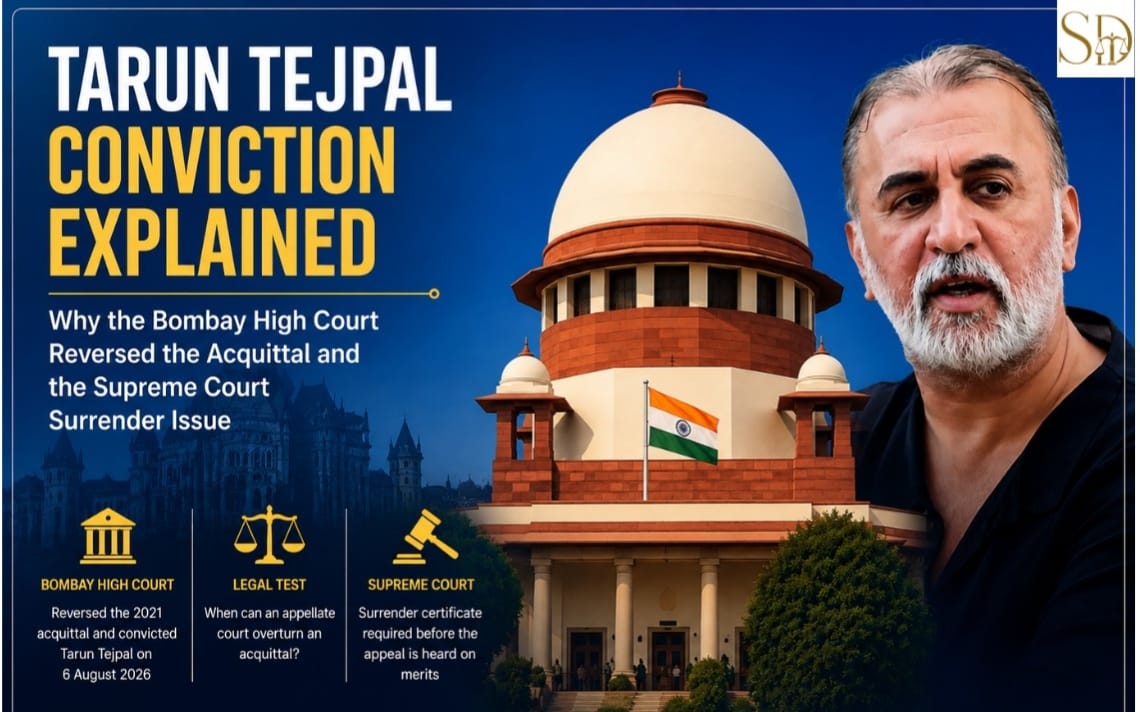
Tarun Tejpal Conviction Explained: Why the Bombay High Court Reversed the Acquittal
Tarun Tejpal Conviction Explained: Why the Bombay High Court Reversed the Acquittal
By Adv. Sarosh Damania | Bombay High Court Advocate | Updated: 28 August 2026
Key Takeaways
- The Supreme Court surrender direction is procedural; the challenge to conviction remains pending on merits, while Goa has separately sought enhancement of sentence.
- The judgment rejects stereotypical assumptions about how a survivor of sexual assault should behave before or after an incident.
- An acquittal is strongly protected on appeal, but an appellate court may interfere where material evidence is ignored, misread, or the reasoning is legally unsustainable or perverse.
- The Bombay High Court’s Goa Bench reversed the 2021 acquittal on 6 August 2026 and imposed 10 years’ rigorous imprisonment.
The Tarun Tejpal conviction explained through the Bombay High Court’s August 2026 judgment raises an important question in Indian criminal law: when can a High Court overturn an acquittal and itself convict an accused?
On 6 August 2026, the Goa Bench of the Bombay High Court set aside Tarun Tejpal’s 2021 acquittal in the 2013 sexual assault case involving a former junior colleague. The Division Bench convicted him of aggravated rape and other offences and sentenced him to 10 years’ rigorous imprisonment. The High Court concluded that the trial court’s appreciation of evidence was unreasonable and “perverse”, while also strongly criticising its reliance on stereotypical expectations about how a survivor of sexual assault should behave.
Tejpal has challenged the conviction before the Supreme Court. At the present procedural stage, the Supreme Court has declined to exempt him from the surrender requirement and has required a surrender certificate before his challenge is heard on merits. The Court has not yet decided whether the Bombay High Court conviction should be affirmed or set aside.
The case therefore goes beyond its individual facts. It provides an important framework for understanding appeals against acquittal in India, the meaning of a “perverse” acquittal, reassessment of evidence by an appellate court, survivor-behaviour stereotypes and the procedural requirement of surrender when approaching the Supreme Court.
Tarun Tejpal Case: From the 2013 Allegations to the 2026 Conviction
The case dates back to November 2013, when a junior colleague of Tejpal alleged that he sexually assaulted her on two occasions inside a hotel lift during Tehelka’s THiNK festival in Goa. She disclosed the alleged incidents to colleagues and subsequently sent an email complaint to Tehelka’s managing editor seeking, among other things, a written apology and an internal inquiry. Tejpal later sent two apology emails.
The criminal proceedings eventually led to a trial before the Additional Sessions Court at Mapusa, Goa.
Key Timeline
2013 – Allegations and criminal proceedings begin
Tejpal was accused of sexually assaulting his junior colleague during the Goa event and was subsequently prosecuted for rape and other offences.
May 2021 – Trial Court acquits Tejpal
The Sessions Court acquitted him of all charges. The State of Goa subsequently challenged the acquittal before the Bombay High Court.
6 August 2026 – Bombay High Court reverses the acquittal
A Division Bench comprising Justices Neela Gokhale and Amit Jamsandekar set aside the trial court judgment. The High Court convicted Tejpal under Sections 376(2)(f), 376(2)(k), 354, 354-A, 354-B, 341 and 342 of the IPC.
He was sentenced to 10 years’ rigorous imprisonment, with the sentences running concurrently. The High Court initially granted him four weeks to surrender.
August 2026 – Supreme Court challenge
Tejpal approached the Supreme Court challenging the Bombay High Court judgment and sought exemption from surrender. The Goa Government opposed the request, raising the surrender requirement under the Supreme Court Rules.
The Supreme Court subsequently declined the exemption request and required surrender and filing of a surrender certificate before the appeal is heard on merits. The direction concerns procedural compliance and does not amount to a decision on the merits of Tejpal’s challenge to the conviction.
Why Did the Trial Court Acquit Tarun Tejpal in 2021?
Understanding the 2021 acquittal is essential because the 2026 judgment was not simply a case of the High Court preferring a different conclusion. The High Court identified what it considered fundamental problems in the trial court’s approach to the evidence.
The Sessions Court had questioned the reliability of the complainant’s account by examining alleged inconsistencies and her conduct before and after the alleged incidents. Among other things, her continuing to perform professional duties, appearing composed in photographs, holding a wine glass at the event and initially confiding in male colleagues were treated as circumstances inconsistent with the behaviour expected from a person who had experienced sexual assault.
The trial court also considered aspects of her personal life and communications during an extensive cross-examination. It treated inconsistencies in her testimony as significant and accepted the defence explanation that Tejpal’s apology emails had been sent under pressure rather than treating them as admissions supporting the prosecution case.
Why the High Court Disagreed
The Bombay High Court found serious errors in this reasoning.
It held that the trial court had placed undue emphasis on the complainant’s character and behaviour instead of properly evaluating the relevant evidence. The High Court was particularly critical of assumptions about how an “ideal” or “perfect” victim should physically resist an assault or emotionally behave afterwards.
The High Court also reassessed evidence that included:
- The complainant’s testimony;
- Disclosures made to colleagues and family members;
- CCTV footage establishing relevant movements and timing;
- Tejpal’s two apology emails; and
- Evidence concerning his position of authority, trust and dominance over the complainant.
The High Court considered the complainant’s testimony reliable and found it corroborated by other evidence. It also rejected the trial court’s treatment of the apology emails as coerced, finding no adequate evidentiary basis for that conclusion.
This distinction is central to understanding why the Bombay High Court reversed the acquittal. The appellate court did not hold that every disagreement with a trial court permits an acquittal to be overturned. Rather, it concluded that the trial court’s assessment contained errors serious enough to make its findings unreasonable, perverse and contrary to the evidence on record.
That finding leads to the larger legal question: what is the threshold for interfering with an acquittal in India, and when does an acquittal become “perverse”?
Appeal Against Acquittal in India: What Is the Legal Test?
An appeal against acquittal in India is governed by a different level of appellate caution from an ordinary challenge to a conviction. Once a trial court acquits an accused, the appellate court does have the power to examine the evidence again, but it must do so while recognising that the accused already carries the benefit of the presumption of innocence.
The Bombay High Court, while deciding the Tarun Tejpal case, reiterated that an appellate court has the power to review, reconsider and reappreciate the evidence on which an acquittal is based. At the same time, it must keep in mind what criminal jurisprudence commonly describes as a double presumption of innocence: the original presumption in favour of the accused, reinforced by the trial court’s acquittal.
This means that a High Court should not overturn an acquittal merely because it might have interpreted the evidence differently.
When Two Views of the Evidence Are Possible
A fundamental principle in appeals against acquittal is that where two reasonable views of the evidence are genuinely possible, the appellate court would ordinarily be slow to disturb the view that favours the accused.
For example, if the trial court has:
- Considered the relevant evidence;
- Applied the correct legal principles;
- Given rational reasons for accepting or rejecting testimony; and
- Reached a conclusion that can reasonably arise from the evidence,
the fact that an appellate judge may personally have preferred another interpretation will ordinarily not be enough to reverse the acquittal.
However, the protection attached to an acquittal is not absolute.
Interference may become justified where the trial court has ignored material evidence, relied on irrelevant considerations, misunderstood important evidence, applied incorrect legal principles or reached conclusions that are simply not reasonably supported by the record.
That distinction became central to the Tarun Tejpal case. The Bombay High Court did not merely say that it preferred another possible interpretation. It held that the trial court’s findings were directly contrary to the evidence and that its appreciation of the record was unreasonable and perverse.
What Makes an Acquittal “Perverse”?
The word “perverse” has a specific significance in criminal appellate law. It does not simply mean that the appellate court disagrees with the trial judge.
Broadly, a finding may be regarded as perverse where the reasoning falls outside the range of conclusions that a reasonable court could reach after properly considering the evidence and applying the law.
An acquittal may therefore attract appellate interference where the trial court has:
- Ignored important or material evidence;
- Misread evidence that has a direct bearing on the case;
- Relied heavily on irrelevant or legally inadmissible considerations;
- Applied an incorrect legal standard;
- Drawn conclusions unsupported by the record;
- Failed to consider relevant corroborative evidence; or
- Based credibility findings on stereotypes, conjecture or assumptions rather than evidence.
In the Tejpal judgment, the Bombay High Court found that several aspects of the trial court’s reasoning crossed this threshold. It described the findings as directly contrary to the evidence on record and concluded that the appreciation of evidence was not merely another possible view, but was perverse and untenable.
The High Court highlighted, among other issues, the trial court’s treatment of the survivor’s testimony, its reliance on assumptions concerning her conduct after the alleged assault, its interpretation of disclosures to colleagues and family members, and its treatment of electronic communications and other corroborative material.
A Different View Is Not Automatically a Perverse View
This distinction is important.
If a trial court reaches one of two genuinely reasonable conclusions after a proper analysis of the evidence, the acquittal cannot ordinarily be branded “perverse” merely because the appellate court favours the other conclusion.
A perverse acquittal involves something more fundamental: a serious defect in the reasoning, treatment of evidence or application of law that makes the conclusion unreasonable in the circumstances.
That threshold protects both interests at the same time—it preserves the importance of an acquittal while ensuring that serious judicial errors are not immune from appellate correction.
How Can a High Court Reverse an Acquittal and Convict an Accused?
Related practice: Criminal appeals and post-conviction proceedings
The fact that an accused has been acquitted by a trial court does not prevent a High Court from ultimately recording a conviction if the legal requirements for appellate interference are satisfied.
In a State appeal against acquittal, the High Court can independently examine the evidentiary record. If it concludes that the acquittal is unsustainable and that the prosecution has established the offences beyond reasonable doubt, it can set aside the acquittal and convict the accused.
The process can broadly be understood as:
Trial Court Acquittal → Appeal Against Acquittal → Reappreciation of Evidence → Finding That Acquittal Is Unsustainable → Acquittal Set Aside → Conviction
A fresh trial is therefore not automatically required every time an acquittal is reversed. Where the existing record is sufficient for the appellate court to determine guilt and the accused has already had the opportunity to contest the prosecution evidence during trial, the High Court may itself record the conviction.
That is essentially what occurred when the Bombay High Court reversed the acquittal in the Tarun Tejpal case.
After reassessing the complainant’s testimony, CCTV material, disclosures made to others, apology emails and the surrounding circumstances, the High Court concluded that the complainant’s evidence was credible and that the prosecution had established the case beyond reasonable doubt.
The Court consequently set aside the Sessions Court judgment and convicted Tejpal under several provisions of the Indian Penal Code, including aggravated rape provisions under Sections 376(2)(f) and 376(2)(k).
Reversal of Acquittal Is Not a Retrial of the Case
It is useful to distinguish reappreciation of evidence from conducting a completely new trial.
The High Court does not normally hear every witness again. Instead, it examines the evidentiary record created before the trial court, together with the trial court’s reasoning, and determines whether the acquittal can legally and reasonably be sustained.
The power is substantial, but the higher threshold attached to appeals against acquittal is intended to ensure that it is exercised carefully.
Why Survivor Behaviour Stereotypes Cannot Determine Credibility
One of the most significant aspects of the Bombay High Court judgment concerns the use of stereotypes while evaluating the credibility of a sexual-assault complainant.
There is no single or legally prescribed way in which a survivor must behave during or after an alleged assault.
A person may:
- Freeze rather than physically resist;
- Continue performing professional responsibilities;
- Appear composed in public;
- Speak first to friends or colleagues rather than immediately approaching the police;
- Continue interacting with people connected to the accused; or
- Process and disclose trauma differently from what an outside observer might expect.
None of these responses, by themselves, establish consent or demonstrate that an allegation is false.
In the Tarun Tejpal case, the Bombay High Court strongly criticised the trial court for proceeding on stereotypical expectations of how an “ideal” or “perfect” victim should behave. The High Court observed that such a construct assumes that a credible survivor must display vulnerability, passivity or visible distress and that survivors who do not conform to that mould risk having their experiences improperly discounted.
The Court also rejected reasoning that treated the complainant’s subsequent smiling demeanour, professional conduct, social behaviour or lack of particular forms of physical resistance as grounds for doubting her account. It stressed that a woman’s failure to physically resist cannot, by itself, be treated as consent.
Credibility Must Be Assessed From Evidence, Not Expectations
The broader principle emerging from this survivor behaviour stereotypes judgment is that courts must assess credibility on the basis of the entire evidentiary record.
That includes the consistency and quality of testimony, corroborative circumstances, contemporaneous communications, medical or forensic material where relevant, witness evidence and the surrounding facts.
It should not depend on assumptions such as:
“A genuine survivor would have reacted differently.”
The Bombay High Court’s reasoning is therefore important beyond the facts of the Tejpal case. It reinforces the principle that criminal adjudication must distinguish evidence-based credibility assessment from culturally embedded assumptions about how a survivor of sexual assault is expected to behave.
Why Emails and Electronic Communications Became Important Evidence
Electronic communications played an important role in the Bombay High Court’s reassessment of the evidence in the Tarun Tejpal case. In a criminal trial, emails, messages, CCTV footage and other electronic material can be significant because they may help establish chronology, corroborate testimony or show how the parties communicated close to the time of the alleged incident.
In this case, particular attention was given to emails exchanged in November 2013. The record included the complainant’s communications concerning the alleged incidents and two emails sent by Tejpal. The High Court examined these communications together with the oral testimony, disclosures made to others and CCTV timestamps rather than treating each piece of evidence in isolation.
Why Contemporaneous Communications Matter
Evidence created close in time to an alleged incident may be particularly relevant because it can:
- Help establish the sequence and timing of events;
- Corroborate or contradict later testimony;
- Record disclosures or reactions before litigation develops;
- Provide context to the conduct of the parties; and
- Assist the court in testing later explanations against the contemporaneous record.
The apology emails were especially significant. The defence maintained that they had been sent under pressure. The High Court, however, disagreed with the trial court’s acceptance of that explanation and examined the language and circumstances of the emails as part of the overall evidentiary record.
This does not mean that an email automatically proves a criminal charge. Electronic evidence must still be proved and evaluated according to the applicable law, and its meaning depends on context. But the Tejpal judgment demonstrates why contemporaneous electronic communications can become important corroborative evidence when assessed alongside testimony and other material.
Why Did the Supreme Court Require Tarun Tejpal to Surrender?
After the Bombay High Court reversed his acquittal and sentenced him to 10 years’ rigorous imprisonment, Tejpal approached the Supreme Court challenging both his conviction and sentence.
At this stage, however, a procedural issue arose before the merits of his challenge could be considered: was Tejpal required to surrender before his criminal appeal could be heard?
The Goa Government argued before the Supreme Court that the applicable Supreme Court Rules required Tejpal either to furnish proof that he had surrendered or obtain an exemption from the surrender requirement. The State specifically relied on Order XXII Rule 5 of the Supreme Court Rules, 2013.
Tejpal sought exemption. His lawyers pointed, among other things, to the fact that the Bombay High Court had itself given him time to surrender and that he had remained on bail for most of the proceedings.
The Supreme Court did not accept the request for exemption at this stage. Justice Alok Aradhe directed Tejpal to surrender and furnish a surrender certificate before his appeal is heard on merits. The matter is expected to be listed on 22 September 2026, subject to compliance with the surrender-certificate direction.
Why the Surrender Direction Matters
The surrender requirement reflects an important procedural distinction. Once a person has been convicted and sentenced to imprisonment, filing an appeal does not by itself place the conviction or sentence on hold.
The convicted person may need to comply with the applicable surrender requirement or obtain an exemption from the Court.
Importantly, the Supreme Court’s refusal to exempt Tejpal from surrender does not mean that it has upheld the Bombay High Court’s conviction on merits. His substantive challenge to the conviction remains pending. The surrender question concerns the procedure that must be followed before that appeal is taken up.
Publishing note: To avoid inconsistency in contemporaneous reports regarding the precise surrender period, state the operative procedural point: the Supreme Court required surrender and a surrender certificate before the appeal is heard on merits, with the matter reported for listing on 22 September 2026 subject to compliance.
What Is an Exemption From Surrender Before the Supreme Court?
The requirement to surrender does not mean that every convicted appellant must necessarily enter custody before the Supreme Court can consider the appeal. The procedural framework allows an appellant to seek an exemption from surrender before the Supreme Court.
In practical terms, the convicted person asks the Court to excuse compliance with the ordinary surrender requirement and permit the appeal to proceed without first surrendering.
Such exemption is not automatic merely because:
- An appeal has been filed;
- The accused remained on bail during the trial;
- The High Court allowed time to surrender; or
- The appellant intends to challenge the conviction immediately.
The appellant must seek the appropriate exemption, and the Court determines whether the circumstances justify granting it.
That procedural issue was directly raised in the Tarun Tejpal Supreme Court appeal. The Goa Government objected that his appeal could not proceed without a surrender certificate or an exemption from surrender. Tejpal accordingly sought exemption, but the Supreme Court declined the request and required him to surrender before the appeal is heard on merits.
Refusal of Exemption Is Not Dismissal of the Appeal
This distinction is particularly important.
The Supreme Court has not yet determined whether the Bombay High Court was right or wrong in reversing Tejpal’s acquittal. Nor does the surrender direction amount to a final endorsement of the High Court’s findings.
The immediate ruling concerns procedural compliance. Once the surrender requirement is satisfied, the substantive grounds challenging conviction and sentence can be considered in accordance with the Court’s further orders.
Why Is the Goa Government Seeking Life Imprisonment?
The proceedings before the Supreme Court are not limited to Tejpal’s attempt to overturn his conviction.
The State of Goa has separately sought enhancement of the sentence imposed by the Bombay High Court.
After reversing the acquittal, the High Court sentenced Tejpal to 10 years’ rigorous imprisonment. In deciding sentence, it took into account factors including the passage of nearly 13 years since the incident and the absence of reported subsequent criminal misconduct. It ultimately imposed the minimum sentence applicable to the aggravated rape offence rather than the maximum punishment sought by the State.
Goa has now approached the Supreme Court seeking enhancement of the punishment to life imprisonment. Significantly, the State is not challenging the High Court’s finding that Tejpal is guilty; its challenge concerns the adequacy of the sentence.
The pending proceedings therefore raise two distinct issues:
Tejpal’s appeal:
Should the Bombay High Court’s decision reversing his acquittal and convicting him be sustained?
Goa Government’s challenge:
If the conviction stands, is the sentence of 10 years’ rigorous imprisonment adequate, or should it be enhanced?
These questions should not be conflated. The Supreme Court will ultimately have to consider the challenges before it on their respective legal grounds.
For now, the Tarun Tejpal Supreme Court appeal remains pending, and the surrender direction represents a procedural development rather than the final determination of either the conviction or the appropriate sentence.
What Happens Next in the Tarun Tejpal Supreme Court Appeal?
The Tarun Tejpal Supreme Court appeal now moves into an important procedural and substantive stage. Tejpal is challenging the Bombay High Court judgment that reversed his acquittal, convicted him and sentenced him to 10 years’ rigorous imprisonment. At the same time, the State of Goa is seeking enhancement of that sentence to life imprisonment.
The immediate requirement is compliance with the Supreme Court’s surrender direction. The Court has required Tejpal to surrender and furnish the necessary surrender certificate before his challenge is considered on merits. The matter is reported to be listed on 22 September 2026, subject to compliance with that direction.
Once the appeal proceeds, the Supreme Court may have to examine questions including:
- Whether the Bombay High Court correctly applied the principles governing an appeal against acquittal;
- Whether it was justified in characterising the trial court’s appreciation of evidence as perverse;
- Whether its reassessment of testimony, emails, CCTV material and surrounding evidence was legally sustainable;
- Whether the conviction should be maintained or interfered with; and
- If the conviction stands, whether the sentence of 10 years should remain or be enhanced as sought by Goa.
Depending on the proceedings, questions concerning suspension of sentence or bail during the pendency of the appeal may also arise.
Most importantly, the Supreme Court’s present surrender direction should not be described as a final affirmation of Tejpal’s conviction. The merits of his challenge remain to be adjudicated.
What Does the Tarun Tejpal Judgment Mean for Criminal Appeals in India?
The significance of the case extends beyond the individuals involved. It illustrates several important principles concerning appellate review in criminal cases.
An Acquittal Has Strong Protection, but It Is Not Absolute
An acquitted accused benefits from the presumption of innocence, strengthened by the trial court’s decision in his favour. An appellate court should therefore exercise caution before interfering with an acquittal.
However, that principle does not make an acquittal immune from review. Where material evidence has been ignored or seriously misread, incorrect legal principles have been applied, or conclusions are so unreasonable that the judgment becomes perverse, an appellate court can intervene.
A High Court Can Reappreciate the Evidence
The fact that witnesses were originally examined before the trial court does not prevent the High Court from reassessing the evidentiary record in an appeal against acquittal.
Where the required threshold is satisfied, the appellate court can set aside the acquittal and itself record a conviction rather than necessarily ordering a retrial.
Survivor Credibility Cannot Be Judged Through Stereotypes
Another significant aspect of the judgment concerns judicial assessment of sexual-assault allegations.
The Bombay High Court rejected the use of stereotypical expectations about how a survivor should resist, react, communicate or behave following an alleged assault. Credibility must instead be determined from the evidence and circumstances of the particular case.
This is an important distinction because a court can scrutinise inconsistencies and test the reliability of testimony without relying on assumptions about how an “ideal” survivor should behave.
Procedural Requirements Continue After Conviction
The subsequent Supreme Court proceedings demonstrate another aspect of criminal appellate practice. A convicted person seeking to challenge a judgment before the Supreme Court may have to comply with surrender requirements or successfully obtain an exemption.
A pending appeal does not, by itself, erase the legal consequences of the conviction or automatically suspend the sentence.
Case-status note: This article reflects publicly reported developments up to 28 August 2026. The Supreme Court proceedings remain pending and the procedural position may change after further orders.
Conclusion
The Tarun Tejpal conviction explained through the Bombay High Court’s 2026 judgment demonstrates an important principle of Indian criminal law: although an acquittal receives considerable protection on appeal, that protection is not absolute.
A High Court can reassess the evidence and reverse an acquittal where the trial court’s conclusions are perverse, legally unsustainable or based on serious errors in the appreciation of evidence. The judgment is also significant for its rejection of stereotypical assumptions about how a survivor of sexual assault is expected to behave.
At the same time, the litigation is not over. Tejpal has challenged his conviction before the Supreme Court, while the Goa Government is seeking enhancement of his 10-year sentence.
The Supreme Court’s present surrender direction is a procedural development, not a final decision on the validity of the conviction. The substantive issues will have to be determined when the pending proceedings are considered on merits.
Frequently Asked Questions
1. Can a High Court reverse an acquittal in India?
Yes. A High Court hearing an appeal against acquittal in India can review and reappreciate the evidence. However, because an acquittal strengthens the presumption of innocence, appellate interference requires careful scrutiny. A merely different possible view is ordinarily insufficient.
2. What is a “perverse” acquittal?
An acquittal may be considered perverse where findings are unsupported by the evidence, material evidence has been ignored or seriously misread, irrelevant considerations have influenced the decision, or the reasoning falls outside the range of conclusions that a reasonable court could reach.
3. Can a High Court convict an accused after reversing an acquittal?
Yes. If the appellate court finds the acquittal unsustainable and concludes from the evidence that guilt has been proved beyond reasonable doubt, it can set aside the acquittal and record a conviction. A fresh trial is not required in every case.
4. What is an exemption from surrender before the Supreme Court?
A person sentenced to imprisonment who approaches the Supreme Court may be required to surrender and provide proof of surrender. The appellant can seek an exemption from surrender before the Supreme Court, but such exemption is discretionary rather than automatic.
5. Has the Supreme Court upheld Tarun Tejpal’s conviction?
No. The Supreme Court’s August 2026 direction requiring Tejpal to surrender should not be confused with a decision on his criminal appeal. His challenge to the Bombay High Court conviction remains pending, and the merits are yet to be determined.
About the Author
Adv. Sarosh Damania is a Mumbai-based advocate whose practice includes civil and criminal litigation and appellate proceedings before courts and tribunals in India. This article is a general legal explainer based on the publicly reported procedural history of the case as of 28 August 2026.
Related legal resources: Civil & Criminal Litigation Practice | Criminal Law Practice
This article is intended for general informational and educational purposes only. It does not constitute legal advice. The legal principles applicable to an appeal against acquittal, criminal conviction, surrender, suspension of sentence or appeal before the Supreme Court depend upon the facts and procedural history of each case.

Advocate Sarosh Damania is the founder of Sarosh Damania & Co., a premier law firm based in Mumbai, recognized for its exceptional legal services to corporations, individuals, and international clients worldwide. With a rich blend of experience and expertise, Adv. Damania and his team specialize in a wide array of legal disciplines, including Civil Law, Criminal Law, Aviation Law, Arbitration, Consumer Law, RERA, Company Law, Succession Law, Wills, Intellectual Property Law, Property Law, Housing Society Law, Debt Recovery, and Banking Law.