
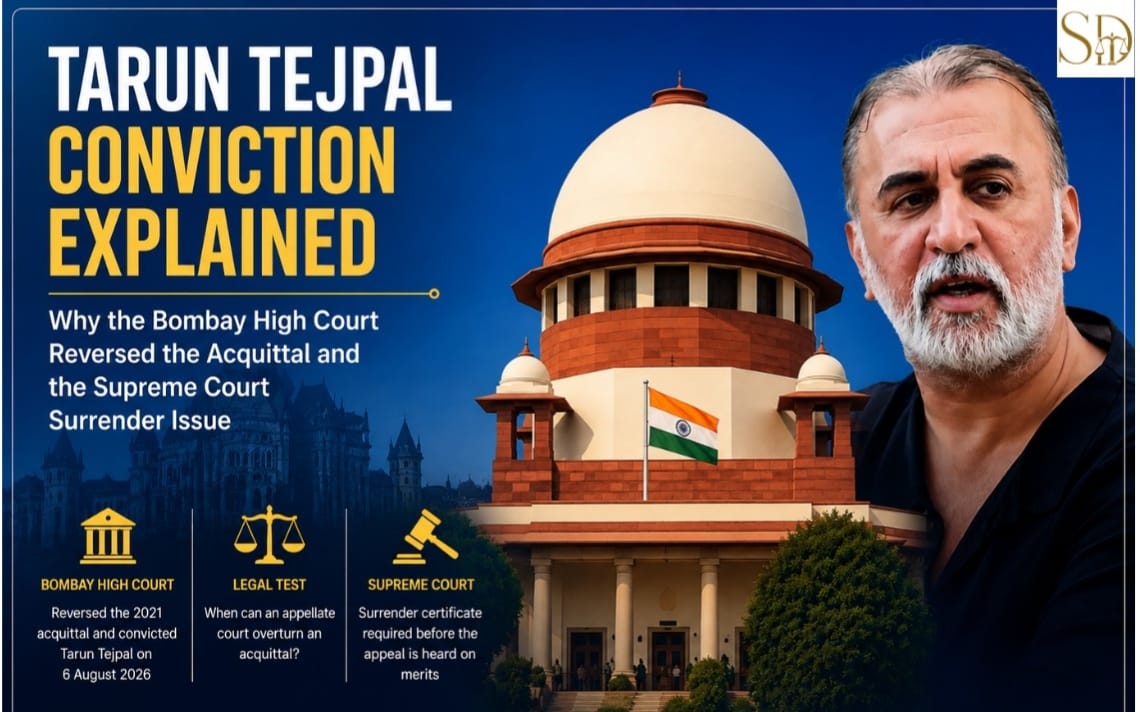
Tarun Tejpal Conviction Explained: Why the Bombay High Court Reversed the Acquittal
Tarun Tejpal Conviction Explained: Why the Bombay High Court Reversed the Acquittal
By Adv. Sarosh Damania | Bombay High Court Advocate | Updated: 28 August 2026
Key Takeaways
- The Supreme Court surrender direction is procedural; the challenge to conviction remains pending on merits, while Goa has separately sought enhancement of sentence.
- The judgment rejects stereotypical assumptions about how a survivor of sexual assault should behave before or after an incident.
- An acquittal is strongly protected on appeal, but an appellate court may interfere where material evidence is ignored, misread, or the reasoning is legally unsustainable or perverse.
- The Bombay High Court’s Goa Bench reversed the 2021 acquittal on 6 August 2026 and imposed 10 years’ rigorous imprisonment.
The Tarun Tejpal conviction explained through the Bombay High Court’s August 2026 judgment raises an important question in Indian criminal law: when can a High Court overturn an acquittal and itself convict an accused?
On 6 August 2026, the Goa Bench of the Bombay High Court set aside Tarun Tejpal’s 2021 acquittal in the 2013 sexual assault case involving a former junior colleague. The Division Bench convicted him of aggravated rape and other offences and sentenced him to 10 years’ rigorous imprisonment. The High Court concluded that the trial court’s appreciation of evidence was unreasonable and “perverse”, while also strongly criticising its reliance on stereotypical expectations about how a survivor of sexual assault should behave.
Tejpal has challenged the conviction before the Supreme Court. At the present procedural stage, the Supreme Court has declined to exempt him from the surrender requirement and has required a surrender certificate before his challenge is heard on merits. The Court has not yet decided whether the Bombay High Court conviction should be affirmed or set aside.
The case therefore goes beyond its individual facts. It provides an important framework for understanding appeals against acquittal in India, the meaning of a “perverse” acquittal, reassessment of evidence by an appellate court, survivor-behaviour stereotypes and the procedural requirement of surrender when approaching the Supreme Court.
Tarun Tejpal Case: From the 2013 Allegations to the 2026 Conviction
The case dates back to November 2013, when a junior colleague of Tejpal alleged that he sexually assaulted her on two occasions inside a hotel lift during Tehelka’s THiNK festival in Goa. She disclosed the alleged incidents to colleagues and subsequently sent an email complaint to Tehelka’s managing editor seeking, among other things, a written apology and an internal inquiry. Tejpal later sent two apology emails.
The criminal proceedings eventually led to a trial before the Additional Sessions Court at Mapusa, Goa.
Key Timeline
2013 – Allegations and criminal proceedings begin
Tejpal was accused of sexually assaulting his junior colleague during the Goa event and was subsequently prosecuted for rape and other offences.
May 2021 – Trial Court acquits Tejpal
The Sessions Court acquitted him of all charges. The State of Goa subsequently challenged the acquittal before the Bombay High Court.
6 August 2026 – Bombay High Court reverses the acquittal
A Division Bench comprising Justices Neela Gokhale and Amit Jamsandekar set aside the trial court judgment. The High Court convicted Tejpal under Sections 376(2)(f), 376(2)(k), 354, 354-A, 354-B, 341 and 342 of the IPC.
He was sentenced to 10 years’ rigorous imprisonment, with the sentences running concurrently. The High Court initially granted him four weeks to surrender.
August 2026 – Supreme Court challenge
Tejpal approached the Supreme Court challenging the Bombay High Court judgment and sought exemption from surrender. The Goa Government opposed the request, raising the surrender requirement under the Supreme Court Rules.
The Supreme Court subsequently declined the exemption request and required surrender and filing of a surrender certificate before the appeal is heard on merits. The direction concerns procedural compliance and does not amount to a decision on the merits of Tejpal’s challenge to the conviction.
Why Did the Trial Court Acquit Tarun Tejpal in 2021?
Understanding the 2021 acquittal is essential because the 2026 judgment was not simply a case of the High Court preferring a different conclusion. The High Court identified what it considered fundamental problems in the trial court’s approach to the evidence.
The Sessions Court had questioned the reliability of the complainant’s account by examining alleged inconsistencies and her conduct before and after the alleged incidents. Among other things, her continuing to perform professional duties, appearing composed in photographs, holding a wine glass at the event and initially confiding in male colleagues were treated as circumstances inconsistent with the behaviour expected from a person who had experienced sexual assault.
The trial court also considered aspects of her personal life and communications during an extensive cross-examination. It treated inconsistencies in her testimony as significant and accepted the defence explanation that Tejpal’s apology emails had been sent under pressure rather than treating them as admissions supporting the prosecution case.
Why the High Court Disagreed
The Bombay High Court found serious errors in this reasoning.
It held that the trial court had placed undue emphasis on the complainant’s character and behaviour instead of properly evaluating the relevant evidence. The High Court was particularly critical of assumptions about how an “ideal” or “perfect” victim should physically resist an assault or emotionally behave afterwards.
The High Court also reassessed evidence that included:
- The complainant’s testimony;
- Disclosures made to colleagues and family members;
- CCTV footage establishing relevant movements and timing;
- Tejpal’s two apology emails; and
- Evidence concerning his position of authority, trust and dominance over the complainant.
The High Court considered the complainant’s testimony reliable and found it corroborated by other evidence. It also rejected the trial court’s treatment of the apology emails as coerced, finding no adequate evidentiary basis for that conclusion.
This distinction is central to understanding why the Bombay High Court reversed the acquittal. The appellate court did not hold that every disagreement with a trial court permits an acquittal to be overturned. Rather, it concluded that the trial court’s assessment contained errors serious enough to make its findings unreasonable, perverse and contrary to the evidence on record.
That finding leads to the larger legal question: what is the threshold for interfering with an acquittal in India, and when does an acquittal become “perverse”?
Appeal Against Acquittal in India: What Is the Legal Test?
An appeal against acquittal in India is governed by a different level of appellate caution from an ordinary challenge to a conviction. Once a trial court acquits an accused, the appellate court does have the power to examine the evidence again, but it must do so while recognising that the accused already carries the benefit of the presumption of innocence.
The Bombay High Court, while deciding the Tarun Tejpal case, reiterated that an appellate court has the power to review, reconsider and reappreciate the evidence on which an acquittal is based. At the same time, it must keep in mind what criminal jurisprudence commonly describes as a double presumption of innocence: the original presumption in favour of the accused, reinforced by the trial court’s acquittal.
This means that a High Court should not overturn an acquittal merely because it might have interpreted the evidence differently.
When Two Views of the Evidence Are Possible
A fundamental principle in appeals against acquittal is that where two reasonable views of the evidence are genuinely possible, the appellate court would ordinarily be slow to disturb the view that favours the accused.
For example, if the trial court has:
- Considered the relevant evidence;
- Applied the correct legal principles;
- Given rational reasons for accepting or rejecting testimony; and
- Reached a conclusion that can reasonably arise from the evidence,
the fact that an appellate judge may personally have preferred another interpretation will ordinarily not be enough to reverse the acquittal.
However, the protection attached to an acquittal is not absolute.
Interference may become justified where the trial court has ignored material evidence, relied on irrelevant considerations, misunderstood important evidence, applied incorrect legal principles or reached conclusions that are simply not reasonably supported by the record.
That distinction became central to the Tarun Tejpal case. The Bombay High Court did not merely say that it preferred another possible interpretation. It held that the trial court’s findings were directly contrary to the evidence and that its appreciation of the record was unreasonable and perverse.
What Makes an Acquittal “Perverse”?
The word “perverse” has a specific significance in criminal appellate law. It does not simply mean that the appellate court disagrees with the trial judge.
Broadly, a finding may be regarded as perverse where the reasoning falls outside the range of conclusions that a reasonable court could reach after properly considering the evidence and applying the law.
An acquittal may therefore attract appellate interference where the trial court has:
- Ignored important or material evidence;
- Misread evidence that has a direct bearing on the case;
- Relied heavily on irrelevant or legally inadmissible considerations;
- Applied an incorrect legal standard;
- Drawn conclusions unsupported by the record;
- Failed to consider relevant corroborative evidence; or
- Based credibility findings on stereotypes, conjecture or assumptions rather than evidence.
In the Tejpal judgment, the Bombay High Court found that several aspects of the trial court’s reasoning crossed this threshold. It described the findings as directly contrary to the evidence on record and concluded that the appreciation of evidence was not merely another possible view, but was perverse and untenable.
The High Court highlighted, among other issues, the trial court’s treatment of the survivor’s testimony, its reliance on assumptions concerning her conduct after the alleged assault, its interpretation of disclosures to colleagues and family members, and its treatment of electronic communications and other corroborative material.
A Different View Is Not Automatically a Perverse View
This distinction is important.
If a trial court reaches one of two genuinely reasonable conclusions after a proper analysis of the evidence, the acquittal cannot ordinarily be branded “perverse” merely because the appellate court favours the other conclusion.
A perverse acquittal involves something more fundamental: a serious defect in the reasoning, treatment of evidence or application of law that makes the conclusion unreasonable in the circumstances.
That threshold protects both interests at the same time—it preserves the importance of an acquittal while ensuring that serious judicial errors are not immune from appellate correction.
How Can a High Court Reverse an Acquittal and Convict an Accused?
Related practice: Criminal appeals and post-conviction proceedings
The fact that an accused has been acquitted by a trial court does not prevent a High Court from ultimately recording a conviction if the legal requirements for appellate interference are satisfied.
In a State appeal against acquittal, the High Court can independently examine the evidentiary record. If it concludes that the acquittal is unsustainable and that the prosecution has established the offences beyond reasonable doubt, it can set aside the acquittal and convict the accused.
The process can broadly be understood as:
Trial Court Acquittal → Appeal Against Acquittal → Reappreciation of Evidence → Finding That Acquittal Is Unsustainable → Acquittal Set Aside → Conviction
A fresh trial is therefore not automatically required every time an acquittal is reversed. Where the existing record is sufficient for the appellate court to determine guilt and the accused has already had the opportunity to contest the prosecution evidence during trial, the High Court may itself record the conviction.
That is essentially what occurred when the Bombay High Court reversed the acquittal in the Tarun Tejpal case.
After reassessing the complainant’s testimony, CCTV material, disclosures made to others, apology emails and the surrounding circumstances, the High Court concluded that the complainant’s evidence was credible and that the prosecution had established the case beyond reasonable doubt.
The Court consequently set aside the Sessions Court judgment and convicted Tejpal under several provisions of the Indian Penal Code, including aggravated rape provisions under Sections 376(2)(f) and 376(2)(k).
Reversal of Acquittal Is Not a Retrial of the Case
It is useful to distinguish reappreciation of evidence from conducting a completely new trial.
The High Court does not normally hear every witness again. Instead, it examines the evidentiary record created before the trial court, together with the trial court’s reasoning, and determines whether the acquittal can legally and reasonably be sustained.
The power is substantial, but the higher threshold attached to appeals against acquittal is intended to ensure that it is exercised carefully.
Why Survivor Behaviour Stereotypes Cannot Determine Credibility
One of the most significant aspects of the Bombay High Court judgment concerns the use of stereotypes while evaluating the credibility of a sexual-assault complainant.
There is no single or legally prescribed way in which a survivor must behave during or after an alleged assault.
A person may:
- Freeze rather than physically resist;
- Continue performing professional responsibilities;
- Appear composed in public;
- Speak first to friends or colleagues rather than immediately approaching the police;
- Continue interacting with people connected to the accused; or
- Process and disclose trauma differently from what an outside observer might expect.
None of these responses, by themselves, establish consent or demonstrate that an allegation is false.
In the Tarun Tejpal case, the Bombay High Court strongly criticised the trial court for proceeding on stereotypical expectations of how an “ideal” or “perfect” victim should behave. The High Court observed that such a construct assumes that a credible survivor must display vulnerability, passivity or visible distress and that survivors who do not conform to that mould risk having their experiences improperly discounted.
The Court also rejected reasoning that treated the complainant’s subsequent smiling demeanour, professional conduct, social behaviour or lack of particular forms of physical resistance as grounds for doubting her account. It stressed that a woman’s failure to physically resist cannot, by itself, be treated as consent.
Credibility Must Be Assessed From Evidence, Not Expectations
The broader principle emerging from this survivor behaviour stereotypes judgment is that courts must assess credibility on the basis of the entire evidentiary record.
That includes the consistency and quality of testimony, corroborative circumstances, contemporaneous communications, medical or forensic material where relevant, witness evidence and the surrounding facts.
It should not depend on assumptions such as:
“A genuine survivor would have reacted differently.”
The Bombay High Court’s reasoning is therefore important beyond the facts of the Tejpal case. It reinforces the principle that criminal adjudication must distinguish evidence-based credibility assessment from culturally embedded assumptions about how a survivor of sexual assault is expected to behave.
Why Emails and Electronic Communications Became Important Evidence
Electronic communications played an important role in the Bombay High Court’s reassessment of the evidence in the Tarun Tejpal case. In a criminal trial, emails, messages, CCTV footage and other electronic material can be significant because they may help establish chronology, corroborate testimony or show how the parties communicated close to the time of the alleged incident.
In this case, particular attention was given to emails exchanged in November 2013. The record included the complainant’s communications concerning the alleged incidents and two emails sent by Tejpal. The High Court examined these communications together with the oral testimony, disclosures made to others and CCTV timestamps rather than treating each piece of evidence in isolation.
Why Contemporaneous Communications Matter
Evidence created close in time to an alleged incident may be particularly relevant because it can:
- Help establish the sequence and timing of events;
- Corroborate or contradict later testimony;
- Record disclosures or reactions before litigation develops;
- Provide context to the conduct of the parties; and
- Assist the court in testing later explanations against the contemporaneous record.
The apology emails were especially significant. The defence maintained that they had been sent under pressure. The High Court, however, disagreed with the trial court’s acceptance of that explanation and examined the language and circumstances of the emails as part of the overall evidentiary record.
This does not mean that an email automatically proves a criminal charge. Electronic evidence must still be proved and evaluated according to the applicable law, and its meaning depends on context. But the Tejpal judgment demonstrates why contemporaneous electronic communications can become important corroborative evidence when assessed alongside testimony and other material.
Why Did the Supreme Court Require Tarun Tejpal to Surrender?
After the Bombay High Court reversed his acquittal and sentenced him to 10 years’ rigorous imprisonment, Tejpal approached the Supreme Court challenging both his conviction and sentence.
At this stage, however, a procedural issue arose before the merits of his challenge could be considered: was Tejpal required to surrender before his criminal appeal could be heard?
The Goa Government argued before the Supreme Court that the applicable Supreme Court Rules required Tejpal either to furnish proof that he had surrendered or obtain an exemption from the surrender requirement. The State specifically relied on Order XXII Rule 5 of the Supreme Court Rules, 2013.
Tejpal sought exemption. His lawyers pointed, among other things, to the fact that the Bombay High Court had itself given him time to surrender and that he had remained on bail for most of the proceedings.
The Supreme Court did not accept the request for exemption at this stage. Justice Alok Aradhe directed Tejpal to surrender and furnish a surrender certificate before his appeal is heard on merits. The matter is expected to be listed on 22 September 2026, subject to compliance with the surrender-certificate direction.
Why the Surrender Direction Matters
The surrender requirement reflects an important procedural distinction. Once a person has been convicted and sentenced to imprisonment, filing an appeal does not by itself place the conviction or sentence on hold.
The convicted person may need to comply with the applicable surrender requirement or obtain an exemption from the Court.
Importantly, the Supreme Court’s refusal to exempt Tejpal from surrender does not mean that it has upheld the Bombay High Court’s conviction on merits. His substantive challenge to the conviction remains pending. The surrender question concerns the procedure that must be followed before that appeal is taken up.
Publishing note: To avoid inconsistency in contemporaneous reports regarding the precise surrender period, state the operative procedural point: the Supreme Court required surrender and a surrender certificate before the appeal is heard on merits, with the matter reported for listing on 22 September 2026 subject to compliance.
What Is an Exemption From Surrender Before the Supreme Court?
The requirement to surrender does not mean that every convicted appellant must necessarily enter custody before the Supreme Court can consider the appeal. The procedural framework allows an appellant to seek an exemption from surrender before the Supreme Court.
In practical terms, the convicted person asks the Court to excuse compliance with the ordinary surrender requirement and permit the appeal to proceed without first surrendering.
Such exemption is not automatic merely because:
- An appeal has been filed;
- The accused remained on bail during the trial;
- The High Court allowed time to surrender; or
- The appellant intends to challenge the conviction immediately.
The appellant must seek the appropriate exemption, and the Court determines whether the circumstances justify granting it.
That procedural issue was directly raised in the Tarun Tejpal Supreme Court appeal. The Goa Government objected that his appeal could not proceed without a surrender certificate or an exemption from surrender. Tejpal accordingly sought exemption, but the Supreme Court declined the request and required him to surrender before the appeal is heard on merits.
Refusal of Exemption Is Not Dismissal of the Appeal
This distinction is particularly important.
The Supreme Court has not yet determined whether the Bombay High Court was right or wrong in reversing Tejpal’s acquittal. Nor does the surrender direction amount to a final endorsement of the High Court’s findings.
The immediate ruling concerns procedural compliance. Once the surrender requirement is satisfied, the substantive grounds challenging conviction and sentence can be considered in accordance with the Court’s further orders.
Why Is the Goa Government Seeking Life Imprisonment?
The proceedings before the Supreme Court are not limited to Tejpal’s attempt to overturn his conviction.
The State of Goa has separately sought enhancement of the sentence imposed by the Bombay High Court.
After reversing the acquittal, the High Court sentenced Tejpal to 10 years’ rigorous imprisonment. In deciding sentence, it took into account factors including the passage of nearly 13 years since the incident and the absence of reported subsequent criminal misconduct. It ultimately imposed the minimum sentence applicable to the aggravated rape offence rather than the maximum punishment sought by the State.
Goa has now approached the Supreme Court seeking enhancement of the punishment to life imprisonment. Significantly, the State is not challenging the High Court’s finding that Tejpal is guilty; its challenge concerns the adequacy of the sentence.
The pending proceedings therefore raise two distinct issues:
Tejpal’s appeal:
Should the Bombay High Court’s decision reversing his acquittal and convicting him be sustained?
Goa Government’s challenge:
If the conviction stands, is the sentence of 10 years’ rigorous imprisonment adequate, or should it be enhanced?
These questions should not be conflated. The Supreme Court will ultimately have to consider the challenges before it on their respective legal grounds.
For now, the Tarun Tejpal Supreme Court appeal remains pending, and the surrender direction represents a procedural development rather than the final determination of either the conviction or the appropriate sentence.
What Happens Next in the Tarun Tejpal Supreme Court Appeal?
The Tarun Tejpal Supreme Court appeal now moves into an important procedural and substantive stage. Tejpal is challenging the Bombay High Court judgment that reversed his acquittal, convicted him and sentenced him to 10 years’ rigorous imprisonment. At the same time, the State of Goa is seeking enhancement of that sentence to life imprisonment.
The immediate requirement is compliance with the Supreme Court’s surrender direction. The Court has required Tejpal to surrender and furnish the necessary surrender certificate before his challenge is considered on merits. The matter is reported to be listed on 22 September 2026, subject to compliance with that direction.
Once the appeal proceeds, the Supreme Court may have to examine questions including:
- Whether the Bombay High Court correctly applied the principles governing an appeal against acquittal;
- Whether it was justified in characterising the trial court’s appreciation of evidence as perverse;
- Whether its reassessment of testimony, emails, CCTV material and surrounding evidence was legally sustainable;
- Whether the conviction should be maintained or interfered with; and
- If the conviction stands, whether the sentence of 10 years should remain or be enhanced as sought by Goa.
Depending on the proceedings, questions concerning suspension of sentence or bail during the pendency of the appeal may also arise.
Most importantly, the Supreme Court’s present surrender direction should not be described as a final affirmation of Tejpal’s conviction. The merits of his challenge remain to be adjudicated.
What Does the Tarun Tejpal Judgment Mean for Criminal Appeals in India?
The significance of the case extends beyond the individuals involved. It illustrates several important principles concerning appellate review in criminal cases.
An Acquittal Has Strong Protection, but It Is Not Absolute
An acquitted accused benefits from the presumption of innocence, strengthened by the trial court’s decision in his favour. An appellate court should therefore exercise caution before interfering with an acquittal.
However, that principle does not make an acquittal immune from review. Where material evidence has been ignored or seriously misread, incorrect legal principles have been applied, or conclusions are so unreasonable that the judgment becomes perverse, an appellate court can intervene.
A High Court Can Reappreciate the Evidence
The fact that witnesses were originally examined before the trial court does not prevent the High Court from reassessing the evidentiary record in an appeal against acquittal.
Where the required threshold is satisfied, the appellate court can set aside the acquittal and itself record a conviction rather than necessarily ordering a retrial.
Survivor Credibility Cannot Be Judged Through Stereotypes
Another significant aspect of the judgment concerns judicial assessment of sexual-assault allegations.
The Bombay High Court rejected the use of stereotypical expectations about how a survivor should resist, react, communicate or behave following an alleged assault. Credibility must instead be determined from the evidence and circumstances of the particular case.
This is an important distinction because a court can scrutinise inconsistencies and test the reliability of testimony without relying on assumptions about how an “ideal” survivor should behave.
Procedural Requirements Continue After Conviction
The subsequent Supreme Court proceedings demonstrate another aspect of criminal appellate practice. A convicted person seeking to challenge a judgment before the Supreme Court may have to comply with surrender requirements or successfully obtain an exemption.
A pending appeal does not, by itself, erase the legal consequences of the conviction or automatically suspend the sentence.
Case-status note: This article reflects publicly reported developments up to 28 August 2026. The Supreme Court proceedings remain pending and the procedural position may change after further orders.
Conclusion
The Tarun Tejpal conviction explained through the Bombay High Court’s 2026 judgment demonstrates an important principle of Indian criminal law: although an acquittal receives considerable protection on appeal, that protection is not absolute.
A High Court can reassess the evidence and reverse an acquittal where the trial court’s conclusions are perverse, legally unsustainable or based on serious errors in the appreciation of evidence. The judgment is also significant for its rejection of stereotypical assumptions about how a survivor of sexual assault is expected to behave.
At the same time, the litigation is not over. Tejpal has challenged his conviction before the Supreme Court, while the Goa Government is seeking enhancement of his 10-year sentence.
The Supreme Court’s present surrender direction is a procedural development, not a final decision on the validity of the conviction. The substantive issues will have to be determined when the pending proceedings are considered on merits.
Frequently Asked Questions
1. Can a High Court reverse an acquittal in India?
Yes. A High Court hearing an appeal against acquittal in India can review and reappreciate the evidence. However, because an acquittal strengthens the presumption of innocence, appellate interference requires careful scrutiny. A merely different possible view is ordinarily insufficient.
2. What is a “perverse” acquittal?
An acquittal may be considered perverse where findings are unsupported by the evidence, material evidence has been ignored or seriously misread, irrelevant considerations have influenced the decision, or the reasoning falls outside the range of conclusions that a reasonable court could reach.
3. Can a High Court convict an accused after reversing an acquittal?
Yes. If the appellate court finds the acquittal unsustainable and concludes from the evidence that guilt has been proved beyond reasonable doubt, it can set aside the acquittal and record a conviction. A fresh trial is not required in every case.
4. What is an exemption from surrender before the Supreme Court?
A person sentenced to imprisonment who approaches the Supreme Court may be required to surrender and provide proof of surrender. The appellant can seek an exemption from surrender before the Supreme Court, but such exemption is discretionary rather than automatic.
5. Has the Supreme Court upheld Tarun Tejpal’s conviction?
No. The Supreme Court’s August 2026 direction requiring Tejpal to surrender should not be confused with a decision on his criminal appeal. His challenge to the Bombay High Court conviction remains pending, and the merits are yet to be determined.
About the Author
Adv. Sarosh Damania is a Mumbai-based advocate whose practice includes civil and criminal litigation and appellate proceedings before courts and tribunals in India. This article is a general legal explainer based on the publicly reported procedural history of the case as of 28 August 2026.
Related legal resources: Civil & Criminal Litigation Practice | Criminal Law Practice
This article is intended for general informational and educational purposes only. It does not constitute legal advice. The legal principles applicable to an appeal against acquittal, criminal conviction, surrender, suspension of sentence or appeal before the Supreme Court depend upon the facts and procedural history of each case.

Advocate Sarosh Damania is the founder of Sarosh Damania & Co., a premier law firm based in Mumbai, recognized for its exceptional legal services to corporations, individuals, and international clients worldwide. With a rich blend of experience and expertise, Adv. Damania and his team specialize in a wide array of legal disciplines, including Civil Law, Criminal Law, Aviation Law, Arbitration, Consumer Law, RERA, Company Law, Succession Law, Wills, Intellectual Property Law, Property Law, Housing Society Law, Debt Recovery, and Banking Law.
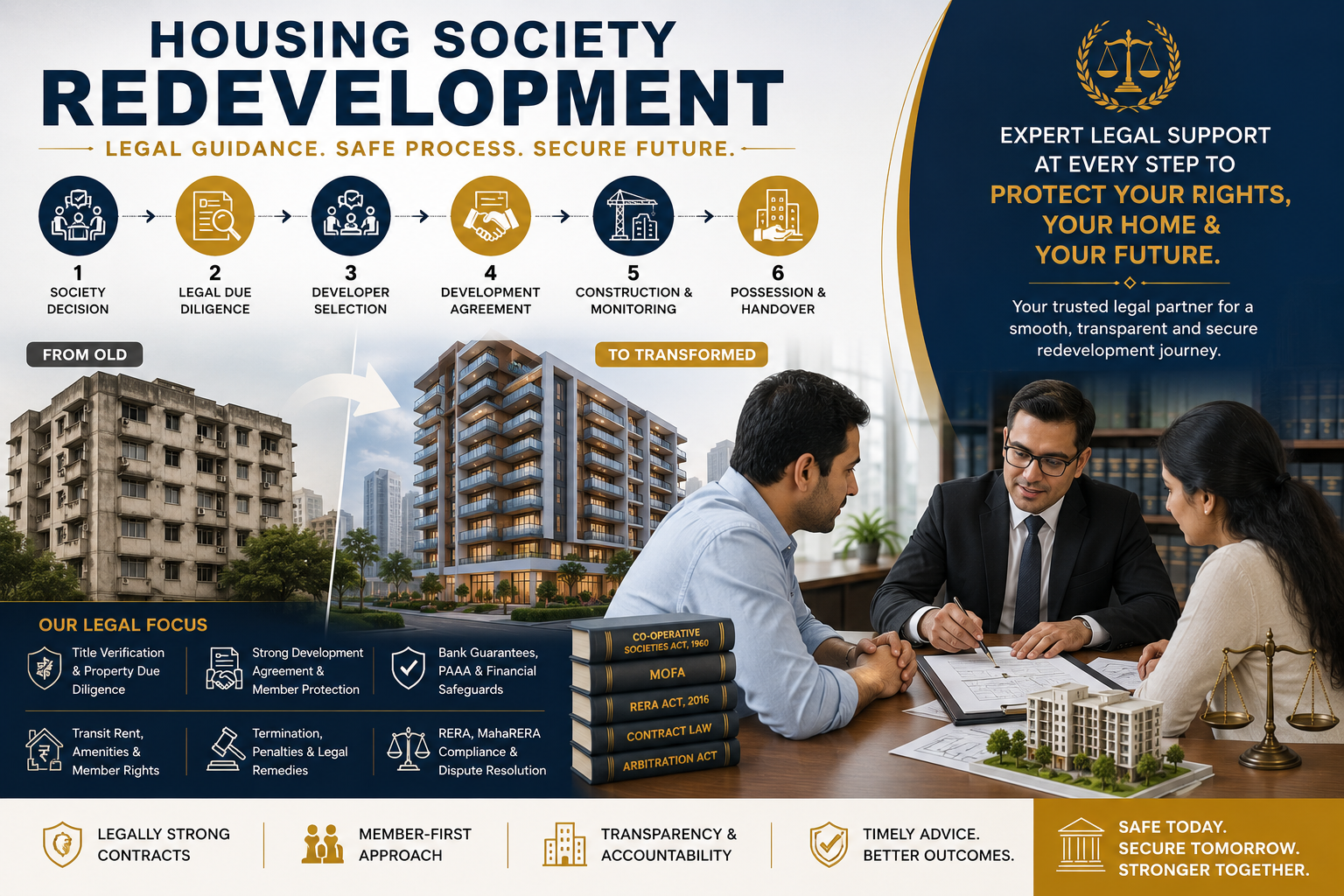
Housing Society Redevelopment Lawyer in Mumbai: Why Your Society Needs an Advocate – Legal Checklist 2026
By Adv. Sarosh Damania
Advocate, Bombay High Court
Updated: August 2026
Redevelopment of a co-operative housing society in Mumbai can transform an old building into a safer, larger and more valuable property. But it is also one of the most significant legal and financial decisions that a housing society and its members will ever take.
A society may be handing over development rights worth several crores of rupees. Members may be required to vacate homes occupied by their families for decades. The existing building may then be demolished, leaving members dependent upon the developer’s contractual promise to pay rent and reconstruct their new homes within the agreed period.
For this reason, housing society redevelopment is not merely a construction project. It is a major legal, contractual, financial and property transaction.
Most societies understand the importance of appointing an architect or Project Management Consultant (“PMC”). Far fewer appreciate the importance of appointing an independent advocate for society redevelopment at the beginning of the process.
So, does a housing society legally need a lawyer for redevelopment in Mumbai?
The better question is:
Should a housing society entrust property worth crores to a developer without having its own independent legal adviser?
In most redevelopment projects, that would be an unnecessary and significant risk.
Does a Housing Society Need an Advocate for Redevelopment in Mumbai?
There is no single provision stating that every housing society must appoint an advocate before redevelopment.
However, society redevelopment in Maharashtra involves several areas of law and regulation, which may include:
- Maharashtra Co-operative Societies Act, 1960;
- directions issued by the State Government;
- society bye-laws;
- property and title law;
- Maharashtra Ownership Flats Act (“MOFA”), where applicable;
- Real Estate (Regulation and Development) Act, 2016 (“RERA”);
- MahaRERA requirements;
- Development Control and Promotion Regulations;
- municipal permissions;
- registration and stamp laws;
- contract law;
- arbitration law; and
- various Government Resolutions, circulars and redevelopment directions.
Redevelopment procedures have also changed over time. Societies should therefore be careful about relying on old internet checklists or documents used in redevelopment projects several years earlier.
The advocate’s role is not simply to prepare a Development Agreement.
A good society redevelopment lawyer in Mumbai should advise the society from the stage of title verification and developer selection through negotiation, documentation, vacation, construction, possession and final handover.
PMC vs Advocate in Society Redevelopment: What Is the Difference?
One of the most common questions asked by managing committees is:
“We have already appointed a PMC. Why do we also need an advocate?”
The answer is that the PMC and advocate perform different functions.
Role of the PMC
The PMC ordinarily deals with technical and project-related matters such as:
- feasibility of redevelopment;
- development potential;
- FSI and TDR calculations;
- preparation of tender documents;
- architectural planning;
- construction specifications;
- amenities;
- evaluation of technical bids;
- construction milestones; and
- supervision of construction quality.
Role of the Housing Society Redevelopment Lawyer
The advocate looks at the legal and contractual risks.
For example:
- Does the society have proper title to the property?
- Has conveyance or deemed conveyance been completed?
- Does the developer have the financial capability to undertake the project?
- What rights is the society granting the developer?
- Can the developer mortgage the property?
- Can development rights be assigned to someone else?
- What happens if rent payments stop?
- What security does the society have?
- When can members safely vacate?
- What happens if construction stops?
- How can the developer be terminated?
- Can another developer be appointed?
- Who owns additional development potential?
- How are disputes resolved?
- What happens if the developer becomes insolvent?
- What happens if an Occupation Certificate is delayed?
These are principally legal issues rather than architectural issues.
A properly structured redevelopment should therefore have the PMC and advocate working together while independently protecting their respective areas.
When Should a Society Appoint a Housing Society Redevelopment Lawyer in Mumbai?
Ideally, before the developer is selected.
Societies sometimes approach an advocate only after:
- the tender has been issued;
- negotiations have concluded;
- the developer has been selected;
- an LOI has been issued; and
- the developer has circulated its Development Agreement.
By then, several important commercial decisions may already have become difficult to renegotiate.
The society’s advocate should ideally be involved from the beginning so that legal safeguards are built into the tender itself.
- Legal Title Check Before Society Redevelopment
Before asking developers what they will offer, the society should first understand what property and development rights it actually owns.
The advocate should examine the society’s title and relevant records.
Documents may include:
- Conveyance Deed;
- deemed conveyance documents;
- Property Card;
- City Survey records;
- land revenue records;
- original title deeds;
- lease documents, where applicable;
- original development agreements;
- sanctioned plans;
- Occupation Certificate;
- Completion Certificate;
- property tax documents;
- layout approvals;
- easements;
- rights of way;
- reservations;
- mortgages or charges; and
- pending litigation affecting the property.
Why Is Title Verification Important?
Imagine selecting a developer on the assumption that the society can utilise a particular parcel of land or development potential, only to discover later that:
- the society does not own part of the land;
- conveyance was never completed;
- a third party has development rights;
- an old mortgage remains recorded;
- there is a reservation affecting the property; or
- the sanctioned layout differs from the physical property.
Such issues can delay redevelopment for years.
A redevelopment advocate should therefore examine title before major contractual commitments are made.
- Drafting the Redevelopment Tender Correctly
A redevelopment tender should not be treated as only a technical document.
Many of the most important contractual terms originate in the tender.
The tender should clearly address issues such as:
- additional carpet area;
- corpus;
- monthly transit rent;
- annual rent escalation;
- brokerage;
- shifting charges;
- hardship compensation;
- bank guarantee;
- construction period;
- grace period;
- parking;
- amenities;
- specifications;
- taxes;
- maintenance;
- developer eligibility;
- developer funding;
- project timelines;
- default consequences;
- termination rights; and
- dispute resolution.
For example, a tender stating merely:
“Developer shall provide suitable bank security.”
is significantly weaker than defining:
- the amount;
- nature;
- issuing bank;
- validity;
- renewal obligation; and
- invocation conditions.
The redevelopment advocate should therefore work with the PMC while the tender is being prepared.
- Legal Due Diligence of the Redeveloper
Selecting the developer is arguably the single most important commercial decision in redevelopment.
A developer should not be selected only because it offers:
- the highest additional area;
- the largest corpus;
- the highest rent; or
- the most attractive presentation.
A fantastic commercial offer has little value if the developer cannot complete the project.
What Should a Society Check About a Developer?
Legal and commercial due diligence may include:
- constitution of the developer entity;
- directors or partners;
- group companies;
- completed redevelopment projects;
- ongoing redevelopment projects;
- delayed projects;
- abandoned projects;
- pending litigation;
- MahaRERA proceedings;
- insolvency proceedings;
- secured borrowing;
- financial capability;
- lender relationships; and
- previous disputes with housing societies.
The purpose is not necessarily to find a developer who has never faced litigation.
Large developers may naturally have cases involving them.
The real question is whether the due diligence reveals a pattern of delay, default, financial distress or redevelopment disputes.
- Should a Society Sign a Letter of Intent to the Developer?
After the developer is selected, societies commonly issue a Letter of Intent (“LOI”).
An LOI should not casually be treated as a harmless preliminary letter.
Depending upon its wording, it may create contractual rights.
A properly drafted LOI should state:
- that appointment is subject to definitive agreements;
- the conditions precedent;
- timelines;
- security requirements;
- whether exclusivity exists;
- circumstances permitting withdrawal;
- consequences of failure to execute documents; and
- whether the developer acquires any development right merely because the LOI has been issued.
The society should avoid creating an unintended irrevocable appointment before the Development Agreement has even been negotiated.
- Development Agreement for Society Redevelopment
The Development Agreement (“DA”) is the most important contract in a housing society redevelopment project.
The tender may contain promises.
The developer’s presentation may contain promises.
Negotiation meetings may contain promises.
WhatsApp messages and emails may contain assurances.
But the society should ensure that every important commercial promise is translated into a legally enforceable contractual obligation.
Important Clauses in a Redevelopment Development Agreement
A Development Agreement should ordinarily deal with:
- development rights;
- additional carpet area;
- free-sale component;
- FSI;
- TDR;
- fungible FSI;
- future development potential;
- corpus;
- rent;
- rent escalation;
- brokerage;
- shifting charges;
- bank guarantee;
- approvals;
- construction period;
- milestones;
- grace period;
- possession;
- parking;
- specifications;
- amenities;
- developer financing;
- mortgage rights;
- assignment;
- RERA compliance;
- delay compensation;
- events of default;
- termination;
- consequences of termination;
- arbitration; and
- jurisdiction.
A society should avoid simply signing the developer’s “standard Development Agreement”.
In redevelopment, there is no standard risk profile.
Every property and every redevelopment project has different legal issues.
- Additional Carpet Area: It Must Be Precisely Defined
One of the biggest attractions of redevelopment is additional area.
But the agreement should clearly identify what the developer is actually promising.
Terms such as:
- carpet area;
- RERA carpet area;
- built-up area;
- fungible area;
- balcony;
- flower bed;
- deck; and
- enclosed area
should not be casually interchanged.
If a member is promised an existing area plus an additional area, the exact measurement basis should be written into the contract.
Members should know:
“What will be the legally measurable carpet area of my new flat?”
—not merely what the marketing brochure says.
- Corpus in Society Redevelopment
Corpus is often one of the most heavily negotiated commercial components of redevelopment.
The Development Agreement should specify:
- total corpus payable;
- whether it is payable to the society or members;
- amount payable per member;
- payment stages;
- due dates;
- whether payment is linked to vacation;
- consequences of delay; and
- whether the developer can make any deductions.
Vague phrases such as:
“Corpus will be paid at an appropriate stage.”
should be avoided.
In redevelopment, uncertainty usually benefits the party required to perform later.
- Transit Rent: Protect Members Before They Vacate
Once members vacate the building, they may remain in rented accommodation for several years.
Transit rent therefore becomes one of the most important protections in the Development Agreement.
The agreement should clearly state:
- monthly rent;
- advance rent;
- annual escalation;
- due date every month;
- security deposit;
- brokerage;
- shifting charges;
- hardship compensation;
- interest or consequences for delayed payment;
- rent during contractual construction period;
- rent during grace period; and
- enhanced consequences if delay continues beyond the agreed period.
The society should also examine:
What happens if the developer stops paying rent altogether?
A promise to pay rent is useful.
A promise supported by enforceable financial security is far safer.
- Bank Guarantee in Society Redevelopment
A developer may promise:
- larger flats;
- rent;
- corpus;
- new amenities;
- parking;
- completion within three or four years.
But the crucial question is:
What security does the society have if those promises are broken?
A properly drafted bank guarantee can be an important redevelopment safeguard.
The society’s advocate should check:
- guaranteed amount;
- issuing bank;
- unconditional or conditional nature;
- validity period;
- automatic renewal obligations;
- invocation conditions;
- reduction schedule;
- notice requirements; and
- consequences of non-renewal.
A bank guarantee that expires midway through construction or is extremely difficult to invoke may offer considerably less protection than members expect.
- Permanent Alternate Accommodation Agreement — PAAA
Individual members will normally receive documentation recording their entitlement to the new premises.
This is often referred to as the Permanent Alternate Accommodation Agreement (“PAAA”).
The PAAA should be consistent with the society’s Development Agreement.
It should clearly identify:
- existing premises;
- member’s entitlement;
- new carpet area;
- configuration;
- floor, where agreed;
- parking rights;
- specifications;
- amenities;
- transit rent;
- escalation;
- possession timeline;
- delay compensation;
- registration;
- stamp duty;
- maintenance liability;
- defect liability; and
- possession procedure.
The Development Agreement should not contain one protection while the member’s PAAA quietly takes it away.
- When Should Members Vacate for Redevelopment?
This is one of the most critical redevelopment questions.
Once members hand over possession and the building is demolished, their practical bargaining position changes significantly.
Members should therefore not ordinarily vacate simply because the developer says:
“Everything else will be done after demolition.”
The Development Agreement should identify clear conditions precedent to vacation.
Depending upon the project, these may include:
- execution of Development Agreement;
- registration of documents;
- execution of PAAA;
- specified municipal approvals;
- bank guarantee;
- payment of agreed corpus instalment;
- payment of advance rent;
- security deposits;
- financing arrangements;
- insurance requirements;
- demolition permissions; and
- other agreed contractual protections.
The society’s advocate should confirm whether the contractual conditions have been fulfilled before members surrender possession.
- Can a Redevelopment Developer Mortgage Society Property?
Developers frequently require project finance.
The lender may ask for security over the developer’s rights or sale component.
The society should be extremely careful before granting a general or unrestricted right to mortgage the redevelopment property.
The agreement should address:
- what can be mortgaged;
- what cannot be mortgaged;
- whether society consent is required;
- lender’s rights;
- members’ rehabilitation premises;
- rehabilitation land;
- enforcement rights;
- release of security; and
- consequences of developer default.
The society should understand a fundamental point:
The developer’s financing requirement should not unnecessarily expose members’ rehabilitation rights to lender risk.
- Can the Developer Transfer or Assign Redevelopment Rights?
Suppose members select Developer A because of its:
- reputation;
- financial strength;
- completed projects; and
- management team.
The society should not discover a year later that Developer A has effectively transferred the project to Developer B without members having any say.
Assignment, transfer, partnership changes or creation of third-party development rights should therefore be carefully regulated.
Otherwise, the society may ultimately be dealing with a party it never evaluated or selected.
- Does RERA Apply to Society Redevelopment?
RERA may apply to redevelopment projects depending upon how the project is structured.
The Real Estate (Regulation and Development) Act, 2016 contains an exemption relating to renovation, repair or redevelopment where there is no marketing, advertising, selling or new allotment of apartments, plots or buildings.
Where a redevelopment contains a sale component, however, the applicability of RERA and MahaRERA requirements should be carefully examined.
Societies should therefore not assume that:
“Redevelopment means RERA does not apply.”
The RERA position should be examined project by project.
- What Happens if the Developer Delays the Redevelopment?
A good redevelopment agreement must be drafted for two situations:
- when everything goes according to plan; and
- when everything does not.
The second situation is where legal drafting becomes most valuable.
Developer Defaults May Include
- failure to obtain approvals;
- failure to commence construction;
- repeated rent default;
- prolonged stoppage of work;
- abandonment;
- failure to renew bank guarantee;
- unauthorised mortgage;
- unauthorised assignment;
- insolvency;
- breach of sanctioned plans;
- failure to meet milestones; and
- failure to complete within the contractual period.
The Development Agreement should then answer:
- When does an event of default occur?
- Is a cure notice required?
- What is the cure period?
- When can the society terminate?
- Can the society invoke the bank guarantee?
- Can it appoint another developer?
- What happens to existing approvals?
- What happens to project plans?
- What happens to construction already completed?
- What happens to unsold flats?
- What happens to lender rights?
- How do members continue receiving rent after termination?
A redevelopment agreement should never make termination practically impossible.
- Termination Clause in Redevelopment Agreement
This is an area societies often overlook at the beginning because everyone expects the redevelopment to succeed.
But the termination clause becomes critical if the project fails.
The agreement should properly provide for:
- material breach;
- rent default;
- construction delay;
- insolvency;
- non-renewal of security;
- abandonment;
- unauthorised assignment;
- cure period;
- termination procedure;
- consequences of termination;
- handover of project documents;
- cooperation with replacement developer; and
- survival of members’ rights.
The society should also avoid an agreement where the developer can terminate easily but the society cannot.
- Arbitration Clause in Society Redevelopment
Most redevelopment agreements contain an arbitration clause.
The clause should not simply be copied from another agreement.
It should address:
- governing law;
- appointment of arbitrator;
- seat of arbitration;
- venue;
- jurisdiction;
- interim relief;
- costs; and
- continuation of essential obligations during disputes.
For projects located in Mumbai, parties commonly consider Mumbai as the seat and venue, subject to the circumstances of the transaction and legal advice.
Poorly drafted arbitration clauses can create litigation even before the actual redevelopment dispute is heard.
- Majority Members vs Dissenting Members in Redevelopment
Society redevelopment sometimes leads to disagreements between a majority supporting redevelopment and one or more dissenting members.
The society should therefore maintain a transparent record of:
- notices;
- Special General Meetings;
- quorum;
- attendance;
- tenders;
- comparative statements;
- voting;
- objections;
- resolutions;
- negotiations;
- developer selection; and
- correspondence.
Proper procedure does more than comply with governance requirements.
It creates the documentary record that may later become crucial if the redevelopment decision is challenged.
- Can the Society Use the Developer’s Lawyer?
A developer may sometimes tell a society:
“You don’t need to appoint another lawyer. Our advocate will prepare all the documents.”
The developer’s advocate is entitled to protect the developer’s interests.
The society requires someone to independently protect its interests and the interests of its members.
There is nothing inherently wrong with the developer’s lawyer circulating the first draft of a Development Agreement.
The problem arises if the society signs it without independent legal scrutiny.
The society’s redevelopment lawyer should independently:
- review;
- negotiate;
- amend;
- advise upon; and
- approve
the legal documentation from the society’s perspective.
- Why the Cheapest Redevelopment Lawyer May Not Be the Best Choice
A redevelopment project may involve a property worth tens or even hundreds of crores of rupees.
Legal advice from a housing society redevelopment lawyer in Mumbai should not therefore be evaluated solely on the basis of:
“Who will draft the agreement for the lowest fee?”
The work may involve:
- title investigation;
- redevelopment strategy;
- review of society resolutions;
- tender drafting;
- tender negotiations;
- developer due diligence;
- LOI;
- Development Agreement;
- PAAA;
- Power of Attorney;
- bank guarantee;
- finance documents;
- mortgage documents;
- member queries;
- dispute prevention;
- vacation documentation;
- construction-stage advice;
- default notices;
- possession documentation; and
- completion and handover.
The advocate may remain involved for several years.
The relevant comparison should therefore be between the professional cost and the value and risk of the redevelopment transaction.
Housing Society Redevelopment Legal Checklist 2026
Before Starting Redevelopment
- Verify society title
- Check conveyance/deemed conveyance
- Review Property Card
- Examine sanctioned plans
- Identify litigation
- Assess development potential
- Review applicable redevelopment procedure
- Appoint independent professionals
Before Inviting Developers
- Prepare proper tender
- Define additional carpet area
- Fix minimum corpus expectation
- Set rent requirements
- Define bank guarantee
- Prescribe developer eligibility
- Establish completion period
- Define financial capability requirements
Before Selecting the Developer
- Conduct legal due diligence
- Check completed projects
- Check delayed projects
- Review MahaRERA history
- Review litigation
- Examine financial capacity
- Compare final offers
- Record negotiations transparently
Before Issuing the LOI
- Finalise commercial terms
- State conditions precedent
- Limit exclusivity
- Define expiry
- Restrict creation of development rights
- Provide consequences of developer default
Before Signing the Development Agreement
Check:
- additional carpet area;
- corpus;
- rent;
- escalation;
- bank guarantee;
- construction period;
- grace period;
- FSI/TDR;
- future potential;
- parking;
- amenities;
- developer finance;
- mortgage;
- assignment;
- RERA;
- delay;
- termination;
- arbitration; and
- jurisdiction.
Before Members Vacate
Confirm:
- Development Agreement is completed;
- PAAA documents are completed;
- required registrations are done;
- agreed permissions are obtained;
- bank guarantee is received;
- advance rent is paid;
- deposits are paid;
- agreed corpus stage is complied with;
- finance documents are checked;
- possession documentation is ready; and
- all contractual conditions precedent have been satisfied.
During Construction
Monitor:
- monthly rent;
- bank guarantee validity;
- construction milestones;
- sanctioned plans;
- RERA compliance;
- financing;
- changes in developer entity;
- specifications;
- amenities; and
- project delay.
Before Taking Possession
Check:
- Occupation Certificate;
- actual carpet area;
- specifications;
- amenities;
- defects;
- parking;
- common areas;
- society office;
- accounts;
- title documentation;
- plans and approvals;
- warranties;
- developer handover documents; and
- release of appropriate securities.
Frequently Asked Questions About Housing Society Redevelopment Lawyer in Mumbai
- Is a lawyer compulsory for housing society redevelopment?
There is no general rule simply stating that every society must appoint an advocate for redevelopment. However, because redevelopment involves title, contracts, development rights, member rights, financial security, RERA, termination and dispute resolution, independent legal representation is strongly advisable.
- When should a society appoint a redevelopment advocate?
Ideally, before preparing the final tender and before selecting the developer.
- Can a PMC draft the Development Agreement?
A PMC can assist with technical and commercial requirements, but legal drafting and legal rights should ordinarily be reviewed by an independent advocate.
- What documents should a redevelopment lawyer check?
The advocate may review title documents, society records, tender documents, developer due diligence, LOI, Development Agreement, PAAA, Power of Attorney, bank guarantee, finance documents and possession documents.
- Should members vacate before all approvals are obtained?
Members should vacate only after the contractual conditions precedent agreed for the redevelopment have been satisfied. The exact requirements depend on the project.
- Is a bank guarantee necessary in society redevelopment?
A properly structured bank guarantee can provide important financial protection against certain developer defaults. Its amount, wording, validity and invocation terms are critical.
- What happens if the developer stops paying rent?
The Development Agreement should provide consequences for rent default, including contractual remedies and, where appropriate, recourse to financial security.
- Can a redevelopment developer mortgage the society property?
Developer financing may be permitted in appropriately structured transactions, but mortgage rights should be carefully restricted so that members’ rehabilitation rights are protected.
- Can the developer transfer redevelopment rights to another builder?
The Development Agreement should regulate assignment or transfer. The society should not automatically permit unrestricted transfer of rights to an entity it never selected.
- Does MahaRERA apply to society redevelopment?
It depends on the nature and structure of the redevelopment, including whether there is a sale component. The applicability of RERA should be examined in each project.
- What happens if the developer does not complete redevelopment on time?
The Development Agreement should contain milestone, delay, compensation, default and termination provisions enabling the society to take effective action.
- Can a housing society terminate a redevelopment developer?
Depending upon the contract and circumstances, termination may be possible for specified defaults. This is why the Development Agreement should contain clearly drafted termination and post-termination provisions.
- Can the society appoint the developer’s lawyer?
The society should ordinarily have independent legal representation because the developer’s advocate is engaged to protect the developer’s interests.
- What is the most important document in society redevelopment?
The Development Agreement is generally the principal contract governing the relationship between the society and developer. Individual member agreements such as the PAAA are also extremely important.
- What should members check before vacating for redevelopment?
Members should ensure that the contractual pre-vacation protections—including documents, security, rent and specified approvals—have been complied with.
Final Word: Do Not Wait for a Redevelopment Dispute to Appoint a Lawyer
A housing society redevelopment lawyer in Mumbai is most valuable before there is litigation.
Once members have vacated, the building has been demolished and a dispute has begun, the lawyer can only work with the rights contained in the documents already signed.
The better approach is to create those rights correctly from the beginning.
A redevelopment advocate should help the society:
- identify legal risks;
- negotiate stronger protections;
- document developer commitments;
- secure member rights;
- provide exit mechanisms if things go wrong; and
- reduce the possibility of future litigation.
A redevelopment transaction may determine where hundreds of families live and how one of the society’s most valuable assets is utilised for decades.
The society should therefore have its own independent legal adviser from the beginning of the redevelopment process until final possession and handover.
Because in housing society redevelopment, the best legal dispute is often the one that careful drafting prevents.
Disclaimer: This article is intended only for general legal information and does not constitute legal advice. Redevelopment requirements depend upon the facts, title, property, society documents, applicable planning regulations and contractual structure of each project. Independent professional advice should be obtained before taking any redevelopment decision.
Advocate Sarosh Damania is the founder of Sarosh Damania & Co., a premier law firm based in Mumbai, recognized for its exceptional legal services to corporations, individuals, and international clients worldwide. With a rich blend of experience and expertise, Adv. Damania and his team specialize in a wide array of legal disciplines, including Civil Law, Criminal Law, Aviation Law, Arbitration, Consumer Law, RERA, Company Law, Succession Law, Wills, Intellectual Property Law, Property Law, Housing Society Law, Debt Recovery, and Banking Law.

Hotel Guest Privacy Rights in India: Legal Lessons from the Incident at The Leela Palace Udaipur
India’s hospitality sector has witnessed tremendous growth, with world-class hotels offering premium accommodation and services to travellers. Major hotel brands operating across India include Taj Hotels, Oberoi Hotels & Resorts, ITC Hotels, The Leela Palaces Hotels and Resorts, Marriott International, Hyatt Hotels Corporation, Radisson Hotel Group, Hilton Hotels & Resorts, Accor Hotels, IHG Hotels & Resorts, and brands under Accor such as Novotel.
These hotels promise comfort, safety, discretion, and high service standards. However, even within luxury hospitality environments, disputes occasionally arise that highlight the legal responsibility of hotels to protect guest privacy.
One such case that has recently drawn attention involves The Leela Palace Udaipur, where a couple alleged that hotel staff entered their room and saw them while they were inside the bathroom taking a shower. The consumer forum reportedly directed the hotel to pay ₹10 lakh compensation, along with refund of room charges and litigation costs.
While the hotel has indicated that it is evaluating legal options, the incident has triggered wider discussion about guest privacy rights and hotel liability in India.
The Incident and the Alleged Privacy Breach
According to reports discussed in the consumer complaint:
- A couple were staying at the luxury hotel in Udaipur.
- At the time of the incident, they were inside the bathroom shower area.
- A hotel staff member allegedly entered the room using a master key.
- It was claimed that the staff member looked toward the bathroom and saw the couple while they were bathing.
The guests alleged that this intrusion caused embarrassment, humiliation, and mental distress, as it occurred during a highly private moment.
Bathrooms are universally regarded as the most private space within a hotel room, and any intrusion during such circumstances may be perceived as a serious violation of dignity.
Legal Rights of Hotel Guests in India
Hotel guests in India are protected under several legal principles.
1. Consumer Protection Act, 2019
Hotels are considered service providers, and guests are treated as consumers.
If a hotel fails to provide proper services or causes distress, it may amount to deficiency in service, allowing guests to seek:
- Refund of charges
- Compensation for mental agony
- Litigation costs
Consumer courts have recognised that mental distress and humiliation caused by service failures can justify compensation.
2. Right to Privacy
The right to privacy has been recognised by the Supreme Court as a fundamental right.
Even though hotels are private establishments, they provide services to the public and must ensure that guests’ dignity and personal space are respected.
Intrusion when guests are:
- changing clothes
- sleeping
- using the bathroom
- taking a shower
can potentially amount to serious privacy violations.
3. Duty of Care of Hotels
Hotels owe their guests a duty of care, which includes:
- Maintaining secure premises
- Preventing unauthorized room access
- Ensuring staff professionalism
- Protecting guest dignity and confidentiality
Failure to fulfil these obligations may expose hotels to legal liability and consumer complaints.
Hospitality Industry Privacy Protocols
Leading hotel brands such as Taj, Oberoi, ITC, Leela, Marriott, Hyatt, Hilton, Radisson, Accor, Novotel, and IHG follow strict internal procedures to protect guest privacy.
Common protocols include:
Knock–Announce–Wait Rule
Housekeeping staff must knock and announce their presence before entering a room.
Occupancy Verification
If there is no response, staff should confirm the room status with the front desk.
Respect for “Do Not Disturb” Signs
Rooms displaying DND signs should not be disturbed except in emergencies.
Master Key Control
Master keys must be used only under strict supervision and recorded in access logs.
These safeguards exist specifically to prevent situations where guests may be resting, changing clothes, or showering.
Why Privacy Breaches Are Taken Seriously
Hotel rooms function as temporary private residences.
When guests are:
- bathing
- dressing
- resting
they are in a vulnerable and personal situation.
Intrusions during such moments can cause severe emotional distress and embarrassment, which consumer courts increasingly recognise as valid grounds for compensation.
What Guests Should Do if Privacy Is Violated
If a guest experiences a privacy breach during a hotel stay, the following steps may be taken:
1. Inform Hotel Management
Immediately report the incident to the hotel manager or front desk.
2. Document the Incident
Preserve booking details, bills, and communication records.
3. Send a Legal Notice
A lawyer may issue a notice demanding explanation and compensation.
4. File a Consumer Complaint
If the issue remains unresolved, the guest may approach the Consumer Disputes Redressal Commission.
Responsibilities of Hotels
Hotels must implement strong privacy safeguards, including:
• Staff training on guest privacy
• Strict room entry protocols
• Monitoring of master key usage
• Prompt handling of complaints
• Periodic review of safety procedures
Luxury hotels especially must maintain the highest standards of discretion and professionalism.
Conclusion
India’s hospitality industry represented by brands such as Taj, Oberoi, ITC, Leela, Marriott, Hyatt, Hilton, Radisson, Accor, Novotel, and IHG is built on the promise of comfort, discretion, and premium service.
Incidents such as the one reported at The Leela Palace Udaipur, where guests alleged that staff entered the room and saw them while they were taking a shower, highlight the importance of maintaining strong privacy safeguards.
For travellers, the key takeaway is that hotel guests in India have enforceable legal rights, and consumer courts can provide remedies when those rights are violated.
For hotels, the lesson is equally clear: true hospitality lies not only in luxury amenities but in safeguarding the dignity, safety, and privacy of every guest.
FAQ: Hotel Privacy and Consumer Rights
Can hotel staff enter my room without permission?
Generally, hotel staff must knock, announce their presence, and obtain consent before entering a room unless there is an emergency.
Can I claim compensation if hotel staff intrudes on my privacy?
Yes. If the intrusion causes embarrassment or distress, compensation may be claimed under the Consumer Protection Act, 2019.
What should I do if hotel staff enters my room while I am inside?
You should immediately inform hotel management, document the incident, and consider sending a legal notice or filing a consumer complaint.
Are international hotel brands bound by Indian consumer laws?
Yes. Hotels operating in India including global brands such as Marriott, Hyatt, Hilton, Radisson, Accor, and Novotel must comply with Indian consumer protection laws.
How can hotels prevent such disputes?
Hotels should enforce strict privacy protocols, employee training, and proper supervision of staff access to guest rooms.
Advocate Sarosh Damania is the founder of Sarosh Damania & Co., a premier law firm based in Mumbai, recognized for its exceptional legal services to corporations, individuals, and international clients worldwide. With a rich blend of experience and expertise, Adv. Damania and his team specialize in a wide array of legal disciplines, including Civil Law, Criminal Law, Aviation Law, Arbitration, Consumer Law, RERA, Company Law, Succession Law, Wills, Intellectual Property Law, Property Law, Housing Society Law, Debt Recovery, and Banking Law.

Banking Law Disputes in India: DRT, SARFAESI and Legal Remedies
Banking disputes range from loan defaults and DRT proceedings to account freezes and fraud claims. Understanding
the legal landscape helps protect your rights.
Types of Banking Disputes
Loan and Recovery Matters
- DRT (Debt Recovery Tribunal) proceedings
- SARFAESI Act actions
- One Time Settlement (OTS) negotiations
- NPA classification disputes
Account Related Issues
- Wrongful account freeze
- Unauthorized transactions
- Service charge disputes
- Cheque dishonor (Section 138 NI Act)
Fraud and Misrepresentation
- Mis-selling of financial products
- Insurance claim rejections
- Credit card fraud
Key Forums for Banking Disputes
| Forum | Jurisdiction |
|---|---|
| Banking Ombudsman | Complaints up to Rs 2 crore |
| Consumer Forum | Service deficiency complaints |
| DRT | Bank recovery claims above Rs 20 lakh |
| NCLT | Insolvency proceedings |
Defending Against Bank Recovery Actions
When banks initiate recovery through SARFAESI or DRT:
- Challenge classification: Dispute NPA status if improper
- Question notice validity: Procedural lapses can void actions
- Negotiate settlement: OTS can significantly reduce liability
- Seek stay orders: Courts can stay coercive actions
Banking & Finance Law Help
Sarosh Damania & Co. assists with:
- DRT defense and appeals
- SARFAESI challenge petitions
- OTS negotiations
- Account freeze remedies
Frequently Asked Questions
Can I stop SARFAESI action against my property?
Yes, through payment of dues, DRT application challenging the action, or High Court writ petition if there are
procedural violations. Acting quickly is critical.
What is the time limit for banking ombudsman complaint?
Complaint must be filed within one year of receiving bank’s final response, or within one year and one month of
initial complaint if no response received.

Maritime Law in India: Admiralty Jurisdiction and Shipping Disputes
With major ports like Mumbai and a significant shipping industry, maritime law is a specialized and vital
practice area in India.
What is Maritime/Admiralty Law?
Admiralty and maritime law governs:
- Shipping contracts and bills of lading
- Cargo claims and disputes
- Ship arrests and liens
- Marine insurance
- Collision and salvage
- Port and harbor regulations
Key Maritime Legislation in India
- Admiralty (Jurisdiction and Settlement of Maritime Claims) Act, 2017: Primary admiralty law
- Merchant Shipping Act, 1958: Registration and regulation
- Carriage of Goods by Sea Act: Cargo liability
- Major Port Trusts Act: Port governance
Common Maritime Disputes
Cargo Claims
Damage, shortage, or loss of cargo during shipping. Time limits are strict — usually 1 year from delivery.
Ship Arrest
Maritime creditors can arrest ships in India for various claims including bunker supplies, repairs, and wages.
Charter Party Disputes
Disputes between ship owners and charterers over hire, off-hire, and performance.
Maritime Legal Services
Sarosh Damania & Co. provides maritime law expertise:
- Ship arrest and release
- Cargo claims
- Admiralty litigation in Bombay High Court
- Maritime arbitration
Frequently Asked Questions
Which court handles admiralty matters in India?
High Courts at Mumbai, Kolkata, Chennai, Gujarat, Kerala, Hyderabad, and Odisha have admiralty jurisdiction. The
Bombay High Court is particularly active in admiralty matters.
How quickly can a ship be arrested in India?
With proper documentation, ship arrest orders can be obtained within 24-48 hours in urgent cases.
Lawyer Fees in Mumbai: Complete Guide to Legal Costs 2026
Comprehensive guide to lawyer fees in Mumbai. Understanding costs for criminal, property, corporate, and family matters. Tips to manage legal expenses.
Read MoreCriminal Law Firms in Mumbai: Expert Defense When You Need It Most
Guide to criminal law firms in Mumbai. Understanding the criminal justice process, bail procedures, and choosing the right criminal defense lawyer.
Read More
Top Lawyers in Mumbai: Complete Guide to Finding the Right Legal Representation
Comprehensive guide to choosing the best lawyer in Mumbai. Learn what to look for, questions to ask, and how to find the right legal representation.
Read More
How to Claim Compensation from IndiGo | Know Your Passenger Rights
When an airline cancels or delays your flight, a simple “sorry for the inconvenience” is not enough. Under Indian law, passengers are entitled to compensation, not just an apology.
If your IndiGo flight was cancelled, delayed, or you were denied boarding, you may be eligible for a refund and compensation under the DGCA’s Passenger Charter and the Consumer Protection Act, 2019.
Here’s a practical, step-by-step guide on how to claim compensation from IndiGo and assert your legal rights as a passenger.
What the Law Says: Passenger Rights under DGCA and Consumer Law
The Directorate General of Civil Aviation (DGCA) and the Ministry of Civil Aviation have issued the Air Passenger Charter, which defines the rights of air travellers in India.
You can access the official Charter here:
🔗 DGCA Air Passenger Charter (Official PDF)
According to these regulations:
- Passengers are entitled to refunds, alternate travel options, and monetary compensation if a flight is cancelled, delayed, or overbooked.
- When the cause of delay or cancellation is within the airline’s control, the airline is legally bound to pay compensation.
- Under the Consumer Protection Act, passengers can also seek damages for deficiency in service, inconvenience, and mental harassment.
In other words, if IndiGo cancels your flight or delays it significantly, they cannot escape responsibility by offering only an apology or a rebooking option.
View this post on Instagram
What You Can Claim from IndiGo
Depending on your situation, the following rights apply under Indian aviation and consumer law:
- Full Refund: If the flight is cancelled or rescheduled and you no longer wish to travel.
- Rebooking or Alternate Flight: At no extra charge.
- Monetary Compensation: For delays, cancellations, or denied boarding due to overbooking.
- Reimbursement of Expenses: If you are stranded due to a long delay, you may claim meal, transport, or hotel costs.
- Damages for Mental Agony: Through the Consumer Court, if IndiGo refuses to follow DGCA rules or fails to respond properly to your complaint.
These rights are not goodwill gestures — they are legally enforceable obligations under the Passenger Charter and DGCA Civil Aviation Requirements.
Step-by-Step: How to Claim Compensation Against IndiGo
1. Collect and Preserve Evidence
Keep your booking confirmation, boarding pass, cancellation messages, and any receipts for meals or accommodation expenses.
If possible, take photographs or screenshots showing flight delays or announcements.
2. File a Complaint with IndiGo
Visit IndiGo’s official website or email their customer relations team.
Mention your flight number, booking reference, date, and nature of the disruption. Clearly request refund and compensation as per DGCA Passenger Charter.
Save the acknowledgment or reference number for future reference.
3. Escalate via AirSewa
If you do not receive a satisfactory reply within a reasonable time, register your grievance on the AirSewa Portal (the official Ministry of Civil Aviation platform):
🔗 www.airsewa.gov.in
Attach copies of your complaint, flight details, and supporting evidence.
4. Approach the Consumer Court
If IndiGo fails to compensate or responds inadequately, you can approach the District Consumer Disputes Redressal Commission (Consumer Court).
You can claim:
- Refund of ticket amount
- Statutory compensation under DGCA rules
- Additional damages for harassment, stress, or losses incurred
There is no need for a lawyer at the initial stage, though engaging one ensures a more effective representation.
5. File Within the Limitation Period
Complaints should be filed within two years from the date of the incident, as per the Consumer Protection Act.
Common Mistakes Passengers Make
- Accepting a refund without claiming compensation.
- Deleting cancellation or delay emails that serve as proof.
- Believing that “extraordinary circumstances” always absolve the airline.
- Not escalating the complaint when customer care offers only a token apology.
Remember: under the Passenger Charter, airlines cannot deny compensation for reasons like crew shortage or technical issues — those are internal operational matters within their control.
Why You Should Hold IndiGo Accountable
IndiGo is India’s largest airline, carrying millions of passengers each month. Yet, frequent cancellations and delays have caused widespread passenger frustration.
Holding the airline accountable ensures:
- Transparency and fairness in the aviation industry.
- Stronger compliance with DGCA norms.
- Better treatment of passengers in future disruptions.
When passengers assert their rights and approach the Consumer Court, they help build public awareness and pressure airlines to uphold legal obligations.
Conclusion: Don’t Settle for a “Sorry”
If your IndiGo flight was cancelled, delayed, or you were denied boarding, you have every right to demand more than an apology.
You can legally claim a refund, compensation, and damages for inconvenience or distress. File your complaint promptly, preserve all documentation, and if necessary, approach the Consumer Court for justice.
Airlines must follow the law — and passengers must insist on their rights.
Advocate Sarosh Damania is the founder of Sarosh Damania & Co., a premier law firm based in Mumbai, recognized for its exceptional legal services to corporations, individuals, and international clients worldwide. With a rich blend of experience and expertise, Adv. Damania and his team specialize in a wide array of legal disciplines, including Civil Law, Criminal Law, Aviation Law, Arbitration, Consumer Law, RERA, Company Law, Succession Law, Wills, Intellectual Property Law, Property Law, Housing Society Law, Debt Recovery, and Banking Law.

Advocate Near Lokhandwala and Oshiwara, Andheri West — Expert Legal Services by Sarosh Damania & Co.
Legal matters require clarity, confidence, and the right representation. If you’re searching for an advocate near Lokhandwala and Oshiwara, Andheri West, the right legal guidance can make a significant difference in your case outcome.
At SaroshDamania.com, we focus on providing reliable, strategic, and client-centric legal solutions for individuals, families, and businesses across Andheri West.
Why Choose a Local Advocate in Lokhandwala & Oshiwara?
✔ Easy Accessibility
Quick consultations, faster document handling, and smooth coordination.
✔ Better Understanding of Local Courts
Advocates familiar with:
- Andheri Metropolitan Magistrate Court
- City Civil Court, Dindoshi
- Bombay High Court
can navigate procedures more efficiently.
✔ Experience with Local Property & Society Issues
Lokhandwala & Oshiwara have numerous housing societies and commercial projects. Experienced local advocates can assist with:
- Builder disputes
- Rental disagreements
- NOC / transfer issues
- Society legal conflicts
Legal Services Provided in Lokhandwala & Oshiwara
1. Civil Law
- Money recovery
- Property disputes
- Consumer complaints
- Contractual matters
2. Criminal Law
- Bail applications
- FIR registration & quashing
- Fraud, cybercrime, harassment cases
3. Family Law
- Divorce (mutual & contested)
- Child custody
- Domestic violence matters
- Maintenance & alimony
4. Property & Real Estate
- Agreement drafting
- Leave & license
- RERA matters
- Due diligence
5. Corporate & Business Law
- Business contracts
- Startup legal compliance
- Employment law
- Intellectual property & trademarks
6. Documentation & Drafting
- Power of Attorney
- Wills & succession
- Affidavits
- Notices & replies
How to Choose the Right Advocate?
- Choose a lawyer experienced in your case type
- Ask for a clear legal strategy
- Confirm transparent fees
- Check reviews or reputation
- Ensure comfortable communication
Why Andheri West Is a Legal Hub
- Well-connected location
- High density of legal professionals
- Proximity to multiple courts
- Large number of residential societies & businesses
📞 When Should You Contact an Advocate?
- You receive a notice
- You need a legal document
- A dispute is escalating
- You want to file or defend a case
- Police or criminal involvement
Early consultation protects your rights.
Need Legal Help in Lokhandwala or Oshiwara?
Get expert guidance from Sarosh Damania & Co. for civil, criminal, family, property, or corporate matters.
☎ Call Now: +91 98338 44020
🌐 Contact Page: https://saroshdamania.com/contact-us/
📅 Same-Day Consultations Available
FAQs (Frequently Asked Questions)
1. How do I find the best advocate near Lokhandwala and Oshiwara?
Choose an experienced advocate with positive reviews and local court familiarity.
2. What types of cases do advocates in Andheri West handle?
Civil, criminal, family, property, and business matters.
3. Do I need an appointment?
Yes, most advocates prefer scheduled consultations.
4. Are consultations paid?
Fees vary based on case type and advocate experience.
5. Why choose a local advocate?
For faster communication, convenience, and better understanding of local disputes.
Advocate Sarosh Damania is the founder of Sarosh Damania & Co., a premier law firm based in Mumbai, recognized for its exceptional legal services to corporations, individuals, and international clients worldwide. With a rich blend of experience and expertise, Adv. Damania and his team specialize in a wide array of legal disciplines, including Civil Law, Criminal Law, Aviation Law, Arbitration, Consumer Law, RERA, Company Law, Succession Law, Wills, Intellectual Property Law, Property Law, Housing Society Law, Debt Recovery, and Banking Law.