IndiGo Rs. 600 Sandwich: Airline Ancillary Revenue & Passenger Rights | Sarosh Damania
Introduction: The Rs. 1,142 Crore Sandwich Question
A social media post described India’s largest airline as a “sandwich company”, claiming that IndiGo sold approximately Rs. 1,142 crore of food and beverages while Blue Tokai and Third Wave Coffee together generated approximately Rs. 594 crore. The comparison is memorable because it contrasts a carrier whose principal business is air transportation with dedicated coffee retailers.
The proposition deserves analysis, but the figures must be treated carefully. The social media comparison has not been independently reconciled to like-for-like audited financial statements. In particular, an airline’s reported in-flight sales of traded goods should not automatically be described as exclusively food-and-beverage revenue. Revenue, moreover, is not profit.
For readers exploring “IndiGo ancillary revenue India”, the more useful question is this: why can access to customers be as valuable as the product being sold? As an aviation lawyer, I consider the answer significant both commercially and legally.
1. How IndiGo’s Ancillary Revenue Works in India
Airline economics extend beyond ticket sales. Low-cost carriers commonly offer a basic transportation product alongside optional purchases: meals, beverages, preferred seats, additional baggage, priority services and other travel-related conveniences. These are commonly called ancillary revenues, although their precise financial-reporting categories differ by carrier.
Aircraft leasing, fuel, maintenance, airports, personnel, insurance and regulatory compliance impose substantial costs. Optional services allow an airline to generate additional revenue from passengers who have already booked a journey. But food provisioning, catering contractors, loading, wastage, payment systems and service costs mean that incremental sales are not costless.
2. Why a Passenger Is a Valuable Retail Customer
A passenger aboard an aircraft cannot visit another café or arrange a delivery during the flight. The airline consequently benefits from a temporary distribution advantage: the customer is present and immediate substitutes are limited. This is often described as a captive-audience business model.
The description must not be overstated. Passengers can choose not to buy, eat before departure, or bring food where security and carriage rules permit. The airline therefore has convenient access, not unlimited control over consumption. Nor does exclusive onboard selling, without more, establish unlawful monopoly power.
3. Comparing IndiGo with Coffee Chains
| Business / category | Amount quoted in social media post |
| IndiGo: stated food and drink sales | Rs. 1,142 crore |
| Blue Tokai + Third Wave Coffee | Rs. 594 crore |
| Illustrative difference | Rs. 548 crore |
These are attributed social-media figures, not a verified like-for-like comparison. The periods and definitions must be checked before publication as financial facts.
A coffee chain must fund outlets, staff, equipment, rent and marketing to attract customers. An airline already has a passenger relationship, making food an opportunity to cross-sell. But turnover alone cannot show which business has better margins: profitability depends on costs, accounting policies and commercial arrangements.
4. Small Transactions Can Produce Large Sales
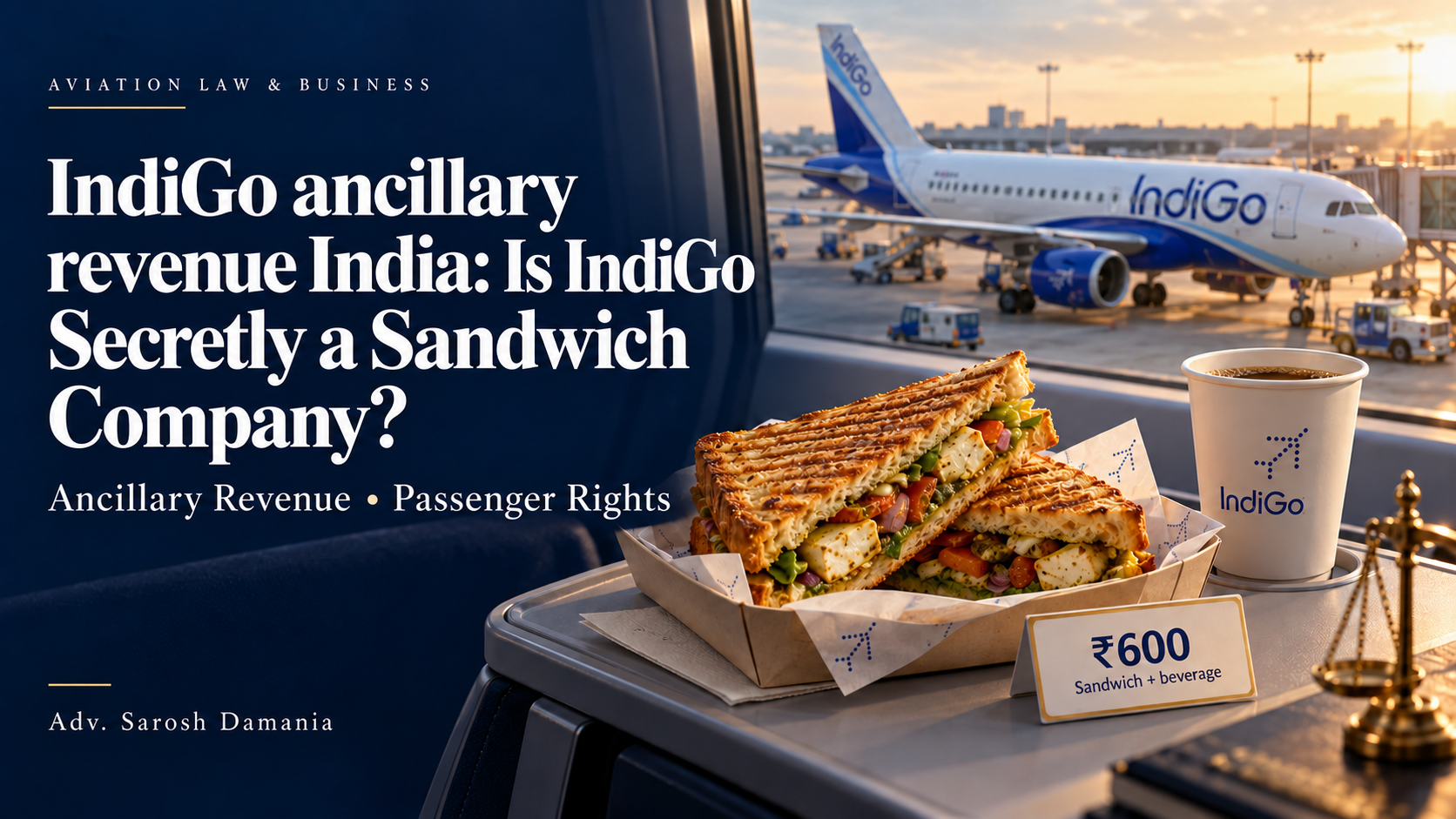
Consider a real quoted onboard menu price: one Chicken Junglee Sandwich or one Paneer Tikka Sandwich together with a beverage costs Rs. 600. If 60 passengers on a flight purchase this combination, gross sales are Rs. 36,000. Across 1,000 comparable flights, gross sales would be Rs. 3.60 crore. These are illustrative volume assumptions, not actual IndiGo sales or profit figures; the Rs. 600 combination price is the stated actual price. Actual revenue depends on take-up, product availability, refunds, accounting and costs.
A useful airline metric is ancillary revenue per passenger: total relevant ancillary revenue divided by passengers carried. Analysts must use consistent definitions and distinguish catering from baggage, seating and other fees.
5. The PVR Analogy: Convenience and Captive Commerce
Cinema concessions, stadium refreshments, airport retail, resorts and cruise ships illustrate the same broad principle: operators sell complementary products to people already using a primary service. The social media post also cited Rs. 1,827 crore in cinema food-and-beverage sales, a figure that similarly requires verification against the relevant company’s disclosures.
The degree of customer restriction varies. A cinema patron may be able to leave the venue; an airborne passenger cannot. These differences matter when analysing market power and customer choice.
6. Can an Airline Charge Any Price for Onboard Food?
Airlines ordinarily have commercial discretion in pricing optional services, subject to applicable statutory rules, disclosures and contractual commitments. An expensive sandwich is not automatically an unlawful sandwich. The legal issues arise where conduct involves misleading pricing, incorrect billing, unsafe products or other prohibited practices.
Consumer Protection Act, 2019
The Consumer Protection Act, 2019 provides a framework for claims involving defective goods, deficiency in services and unfair trade practices, where statutory requirements are satisfied. Sections 2(7), 2(11) and 2(47) contain relevant definitions. Whether an airline food complaint is actionable depends on the transaction, representations, evidence and alleged loss.
Food Safety and Standards Act, 2006
Applicable food safety rules govern food business operators, including those involved in preparing, supplying or selling onboard food. Section 26 concerns responsibilities of food business operators. Liability of an airline, caterer or supplier requires examination of their actual roles and the statutory provisions applicable to each.
Legal Metrology and Aviation Rules
Certain packaged commodities may attract declaration and pricing requirements under the Legal Metrology Act, 2009 and the Legal Metrology (Packaged Commodities) Rules, 2011. Applicability depends on packaging, transaction structure and exceptions; not every prepared onboard meal is treated identically. Relevant DGCA requirements and the airline’s disclosed terms should also be considered. There is no basis to assume a universal DGCA-fixed maximum sandwich price.
7. Does a Captive Audience Mean Abuse of Dominance?
Section 4 of the Competition Act, 2002 prohibits abuse of a dominant position. But an airline being the only seller during its own flight does not automatically prove dominance in a properly defined relevant market, much less abuse. Competition-law analysis examines market definition, power and the impugned conduct. Commercial exclusivity and legal dominance are not synonymous.
8. What If the Food Is Unsafe or Misrepresented?
A passenger receiving spoiled or unsafe food may complain to the airline and, where appropriate, food safety authorities or a consumer commission. Useful evidence includes receipts, packaging, photographs, flight details, contemporaneous correspondence and medical records where injury is alleged. Claims for compensation require a proper legal foundation and proof of relevant loss or harm; dissatisfaction with taste alone is not necessarily a compensable wrong.
9. International Flights and the Montreal Convention
International carriage may raise separate questions under the Montreal Convention, 1999, given effect in India through the Carriage by Air Act, 1972, as amended. Article 17 addresses specified passenger bodily-injury claims where an accident occurs onboard or in embarking or disembarking operations. Whether a particular food-related injury meets that standard is fact-sensitive; an ordinary complaint about a disappointing meal does not automatically fall within the Convention.
Article 29 concerns actions for damages within the Convention framework, and Article 35 prescribes a two-year period for bringing such actions, calculated in accordance with its terms. Applicable law, forum, limitation and causation should be assessed before commencing proceedings.
10. Why the Model Makes Commercial Sense
Ancillary sales help airlines separate the basic fare from optional extras. A passenger who does not want a meal need not necessarily fund that choice through a bundled fare. For airlines facing high operating costs and price competition, supplementary sales can support financial resilience. The model is commercially legitimate when executed with transparent terms and regulatory compliance.
11. The Risk of Taking Passengers for Granted
Limited immediate choice can create a short-term pricing opportunity but not long-term loyalty. A passenger who feels overcharged or poorly treated may choose a competing airline on the next journey. Social media scrutiny, consumer complaints and reputational damage can outweigh gains from an individual sale. The most durable ancillary strategy is one that combines convenience with quality, fair dealing and clear disclosure.
The Rs. 600 Sandwich-and-Beverage Combination: What a Family Actually Pays
At the stated actual price, one Chicken Junglee Sandwich or Paneer Tikka Sandwich with a beverage costs Rs. 600. Two combinations cost Rs. 1,200; four cost Rs. 2,400; and six cost Rs. 3,600. For a family of four, the Rs. 2,400 catering bill is additional to airfares, baggage and any other optional services. This makes pricing disclosure particularly important at the point of purchase.
Pricing is not the same as profiteering
A Rs. 600 onboard combination cannot be judged solely by comparing it with the price of a sandwich at a street-side café. Catering involves airport access, screening, loading, food handling, temperature controls, limited shelf life and unsold inventory. At the same time, the passenger has fewer immediate alternatives. The sound legal analysis asks whether the price was properly disclosed, the food met applicable standards, and the actual transaction complied with law—not whether the price merely feels expensive.
What the Rs. 600 figure does—and does not—prove
The Rs. 600 figure is an actual menu price supplied for this article, but it is not evidence of the airline’s profit per order. Nor does it establish how many passengers buy the combination or whether it is available on every route. Revenue illustrations must therefore remain separate from audited financial results. For publication, the menu price should be accompanied by the date of observation and, ideally, a retained photograph or receipt.
Practical passenger protections
Passengers should check the displayed menu price before ordering, retain digital or paper receipts, promptly report incorrect billing, and preserve packaging or photographs if a product appears unsafe. In any complaint, record the flight number, travel date, route, product name and nature of the concern. An airline should maintain clear menus, traceable catering processes and an accessible grievance channel.
12. Conclusion: Distribution Creates Opportunity; Trust Creates Loyalty
IndiGo is fundamentally an aviation enterprise, not a sandwich retailer. The viral comparison nevertheless captures a valuable insight: airlines can monetise customer access through ancillary services alongside the transportation they principally provide. The significance lies in distribution, convenience and the existing passenger relationship—not in an assumption that sandwich sales are necessarily more profitable than a café business.
From an aviation-law perspective, the ability to sell to passengers in a restricted environment comes with responsibilities. Pricing must be assessed against applicable disclosures and consumer law; food must meet relevant safety standards; and allegations of unfair conduct require careful analysis rather than automatic conclusions.
An airline may make an immediate sale because a passenger has limited alternatives. It earns repeat business because that passenger trusts the airline. Distribution creates opportunity. Convenience creates revenue. Transparency, safety and fair treatment create enduring commercial value.
About the Author
Adv. Sarosh Damania is an aviation lawyer based in Mumbai and practises through Sarosh Damania & Co., Advocates. His work includes aviation-related consumer disputes, airline liability, commercial litigation, arbitration and legal advisory.
Email: legal@saroshdamania.com | Telephone: 022-47197088
Publication Disclaimer
This article is general legal and commercial commentary, not legal or investment advice. Social-media financial comparisons are attributed and have not been independently audited or established as comparable. Applicable legal outcomes depend on the facts, relevant regulations and current law.

Advocate Sarosh Damania is the founder of Sarosh Damania & Co., a premier law firm based in Mumbai, recognized for its exceptional legal services to corporations, individuals, and international clients worldwide. With a rich blend of experience and expertise, Adv. Damania and his team specialize in a wide array of legal disciplines, including Civil Law, Criminal Law, Aviation Law, Arbitration, Consumer Law, RERA, Company Law, Succession Law, Wills, Intellectual Property Law, Property Law, Housing Society Law, Debt Recovery, and Banking Law.