Major Legal Victory for Qatar Airways Cargo: Consumer Commission Dismisses Rs. 12.09 Lakh Claim Following Defence by Advocate Sarosh Damania
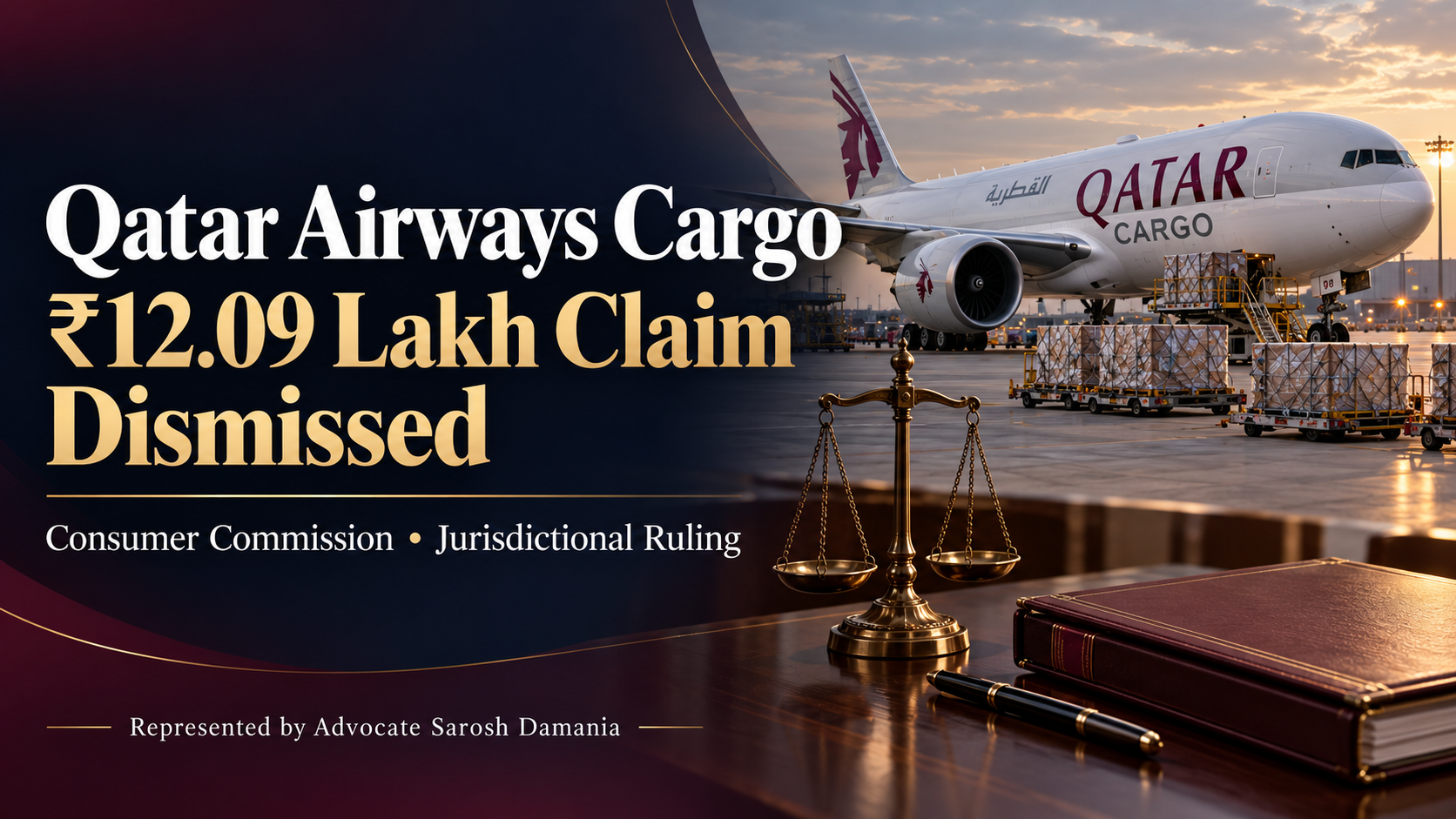
In a significant favourable judgment for Qatar Airways Cargo, the District Consumer Disputes Redressal Commission, Mumbai Suburban, has dismissed a consumer complaint involving a claim of approximately Rs. 12.09 lakh arising from an international air cargo shipment. Qatar Airways Cargo was represented by Advocate Sarosh Damania of Sarosh Damania & Co., Advocates, Mumbai.
The judgment dated 4 September 2026, delivered in Sidharth Nareshchand Sogani v. Qatar Airways Cargo, Consumer Complaint No. 375 of 2016, reinforces an important distinction under Indian consumer protection law between transactions undertaken for commercial profit and services availed of by consumers within the meaning of the Consumer Protection Act, 1986.
Click here to view and download the final order in the Siddharth Nareshchandra case.
The Commission accepted the central jurisdictional defence advanced on behalf of Qatar Airways Cargo and held that the complainant, being engaged in commercial export activities for profit, did not qualify as a consumer under the Act.
Consequently, the complaint was dismissed in its entirety, with the parties directed to bear their own costs.
Advocate Sarosh Damania Successfully Defends Qatar Airways Cargo
Advocate Sarosh Damania, appearing for Qatar Airways Cargo, successfully defended the airline against allegations of deficiency in service, unfair trade practice, delayed cargo delivery and consequential business losses.
The defence raised several important legal objections, including the commercial nature of the transaction, the jurisdiction of the Consumer Commission, the applicability of international air carriage conditions and the Montreal Convention, and the absence of contractual liability for alleged losses arising from an independent commercial arrangement between the exporter and its overseas purchaser.
The Commission ultimately accepted the principal contention that the dispute arose from a commercial transaction undertaken for profit and was therefore outside the jurisdiction of the Consumer Commission.
The judgment represents a significant favourable outcome for Qatar Airways Cargo and highlights the importance of identifying jurisdictional objections at the outset of aviation and international cargo disputes.
Background: International Cargo Shipment from Mumbai to New York
The dispute originated from an international cargo shipment booked on 18 March 2015 by M/s. Sidharth Silk Mills, a manufacturer and exporter of readymade garments.
The exporter had booked 140 boxes containing readymade T-shirts for transportation from Mumbai to John F. Kennedy International Airport, New York, through Doha.
The total declared value of the shipment was approximately USD 79,297, while the freight charges paid amounted to Rs. 3,92,586.
According to the complainant, only 137 of the 140 boxes were initially delivered at the destination on 29 March 2015, with the remaining three boxes being delayed.
The complainant alleged that the partial delivery caused its overseas customer to refuse the delayed consignment and cancel a subsequent commercial order involving 2,000 boxes of garments.
Claiming financial losses, freight charges, compensation and litigation expenses, the exporter approached the Consumer Commission seeking approximately Rs. 12,09,210.47.
Qatar Airways Cargo’s Defence Before the Commission
Through its legal representation, Qatar Airways Cargo contested the allegations and filed its written statement, evidence and legal submissions.
The airline explained that the shipment had encountered operational restrictions relating to payload capacity and cargo handling, resulting in adjustments to the transportation schedule.
It was submitted that 137 boxes were initially delivered and that the remaining three boxes were subsequently transported to New York in April 2015.
Qatar Airways Cargo maintained that all 140 boxes had ultimately been delivered intact and that the overseas recipient had confirmed receipt by 8 April 2015.
More importantly, the airline raised several substantive legal objections.
- Commercial transactions do not automatically qualify as consumer disputes
One of the principal arguments advanced on behalf of Qatar Airways Cargo was that the complainant was a manufacturer and exporter engaged in commercial business activities.
The transportation services had been obtained for the purpose of exporting merchandise to an overseas purchaser and generating commercial profit.
Accordingly, the complainant did not fall within the statutory definition of a consumer under Section 2(1)(d) of the Consumer Protection Act, 1986.
This contention formed the foundation of the airline’s successful defence.
- Consumer Commission lacked jurisdiction
Advocate Sarosh Damania’s defence relied upon the legal distinction between commercial contractual disputes and disputes maintainable under consumer protection legislation.
The airline referred to the decision of the National Consumer Disputes Redressal Commission in Albin Micheal v. Air Asia India Pvt. Ltd., Revision Petition No. 2564 of 2018, concerning the commercial nature of air cargo transactions.
The argument was that disputes arising from commercial export shipments undertaken for profit could not automatically be brought within consumer jurisdiction merely because transportation services had been engaged.
The Commission accepted this jurisdictional objection.
- Montreal Convention and cargo claim requirements
The defence also invoked the Conditions of Carriage and the Montreal Convention, 1999, governing international carriage by air.
Qatar Airways Cargo submitted that complaints concerning delayed cargo were required to be made in writing within the stipulated 21-day period.
The airline contended that the complainant’s claim had been submitted beyond the prescribed period.
This submission highlighted the importance of compliance with the procedural requirements governing international air cargo claims.
However, the Commission ultimately disposed of the complaint on jurisdictional grounds without adjudicating the merits of this objection.
- Alleged business losses under independent commercial contracts
Another important defence concerned the complainant’s claim for losses arising from the alleged cancellation of a subsequent export order.
Qatar Airways Cargo submitted that it was not a party to the separate commercial contract between the exporter and its overseas buyer.
The airline argued that there was no privity of contract concerning that independent transaction and that the alleged consequential losses could not be recovered through the consumer complaint in the manner sought.
These arguments formed part of the wider defence presented before the Commission.
Consumer Commission Accepts Qatar Airways Cargo’s Jurisdictional Defence
The matter was heard by the District Consumer Disputes Redressal Commission, Mumbai Suburban, comprising:
- Hon’ble Smt. Samindara R. Surve, President
- Hon’ble Shri Sameer S. Kamble, Member
After considering the pleadings, affidavits, documentary evidence, written arguments and oral submissions, the Commission framed three principal questions:
- Whether the complainant qualified as a consumer.
- Whether the Commission had jurisdiction to entertain the complaint.
- Whether the complainant was entitled to the reliefs sought.
All three questions were answered in the negative.
The Commission observed that the complainant was engaged in the manufacture and export of garments and that the shipment was undertaken for commercial purposes to earn profit.
It consequently held that the transaction did not fall within the protection available to consumers under the Consumer Protection Act, 1986.
In its findings, the Commission specifically observed:
“The person who carries out activities for the ‘commercial purpose’ for earning profit is not a Consumer and the dispute between the parties is not a consumer dispute.”
The Commission further held that it had no jurisdiction to entertain the complaint, as the dispute was commercial in nature.
Significantly, having determined the jurisdictional issue, the Commission expressly refrained from commenting on the merits of the underlying cargo dispute.
Final Order: Complaint Against Qatar Airways Cargo Dismissed
By its unanimous judgment dated 4 September 2026, the Commission ordered:
- The complaint is dismissed.
- The parties shall bear their own costs.
The order brought the consumer proceedings against Qatar Airways Cargo to an end before the District Commission, without any compensation or damages being awarded against the airline.
For Qatar Airways Cargo, the outcome was particularly favourable considering the financial claim advanced by the complainant and the allegations relating to international cargo operations.
Why This Judgment Matters for the Aviation and Logistics Industry
The judgment carries important implications for airlines, cargo operators, freight forwarders, exporters and businesses engaged in international transportation.
Commercial purpose is central to consumer jurisdiction
The decision reiterates that the nature and purpose of a transaction must be examined before determining whether a complainant qualifies as a consumer.
Merely engaging an airline or logistics service provider does not automatically confer the right to invoke consumer jurisdiction where the transaction is undertaken for commercial profit.
Jurisdictional objections can determine the outcome of litigation
The successful defence of Qatar Airways Cargo demonstrates the importance of examining the maintainability of proceedings before addressing extensive factual allegations concerning operational delays and commercial losses.
A properly founded jurisdictional defence may dispose of proceedings without requiring adjudication of the substantive allegations.
International cargo claims involve specialised contractual and legal frameworks
International air cargo transportation is governed by contractual conditions and, where applicable, international conventions.
Issues involving delivery, delay, written notice, liability limitations and consequential damages require careful examination within the applicable legal framework.
Although the Commission did not adjudicate the Montreal Convention defence on its merits, the proceedings demonstrate the relevance of such issues to international aviation litigation.
Commercial losses require an appropriate legal remedy
The decision also distinguishes between a consumer complaint and a commercial claim arising from an export transaction.
The dismissal does not amount to a final adjudication of every contractual allegation. Rather, it establishes that the particular complaint was not maintainable before the Consumer Commission.
Advocate Sarosh Damania’s Role in the Favourable Outcome
The successful defence of Qatar Airways Cargo was led by Advocate Sarosh Damania of Sarosh Damania & Co., Advocates, whose appearance on behalf of the airline is expressly recorded in the judgment.
The defence combined principles of consumer protection law, commercial contractual liability and international aviation carriage requirements.
By challenging the maintainability of the proceedings and emphasising the commercial character of the export transaction, the airline secured dismissal of the complaint without an adverse compensation order.
The outcome illustrates the value of specialised aviation litigation representation, particularly where claims involve overlapping issues of consumer jurisdiction, commercial contracts and international air transportation.
It also underscores the importance of presenting a clear legal defence supported by the statutory framework and relevant judicial precedents.
Conclusion: Significant Favourable Judgment for Qatar Airways Cargo
The dismissal of the approximately Rs. 12.09 lakh consumer claim against Qatar Airways Cargo marks a favourable legal outcome for the airline.
The District Consumer Disputes Redressal Commission, Mumbai Suburban, accepted the central jurisdictional objection advanced on behalf of Qatar Airways Cargo and held that the complainant’s export transaction was commercial in nature and outside the scope of the Consumer Protection Act, 1986.
With Advocate Sarosh Damania representing Qatar Airways Cargo, the airline successfully secured dismissal of the proceedings, with no compensation awarded against it.
The judgment reinforces the importance of distinguishing genuine consumer disputes from commercial transactions and demonstrates how an effective jurisdictional defence can play a decisive role in aviation litigation.
About Advocate Sarosh Damania
Advocate Sarosh Damania is a Mumbai-based advocate and the founder of Sarosh Damania & Co., Advocates, a law firm handling matters before the Bombay High Court, Supreme Court of India, Consumer Commissions and other judicial and quasi-judicial forums.
His practice includes aviation law, airline litigation, consumer disputes, commercial litigation, arbitration and regulatory matters.
The firm represents aviation industry clients in disputes involving passenger claims, international carriage, cargo operations, consumer protection legislation and related legal proceedings.
Sarosh Damania & Co., Advocates
Mumbai, Maharashtra, India
Email: legal@saroshdamania.com
Telephone: +91 22 4719 7088

Advocate Sarosh Damania is the founder of Sarosh Damania & Co., a premier law firm based in Mumbai, recognized for its exceptional legal services to corporations, individuals, and international clients worldwide. With a rich blend of experience and expertise, Adv. Damania and his team specialize in a wide array of legal disciplines, including Civil Law, Criminal Law, Aviation Law, Arbitration, Consumer Law, RERA, Company Law, Succession Law, Wills, Intellectual Property Law, Property Law, Housing Society Law, Debt Recovery, and Banking Law.