Why Every Respondent in a POSH Inquiry Should Seek Independent Legal Advice – A Legal Perspective
By Adv. Sarosh Damania
(Prevention, Prohibition and Redressal) Act, 2013 (“POSH Act”)
was a landmark step towards providing women with a safe working
environment and implementing the principles laid down by the Supreme
Court in Vishaka & Ors. v. State of Rajasthan (1997) 6 SCC 241.The objective of the Act is undoubtedly salutary. However, the inquiry
conducted by the Internal Committee (“IC”) is not merely an internal HR
exercise. It is a statutory inquiry capable of resulting in severe civil
and employment consequences against the respondent, including dismissal
from service, loss of career opportunities, damage to reputation, and
financial consequences.
Ironically, while complainants are increasingly guided by HR
professionals, consultants and legal advisors before filing complaints,
many respondents continue to believe that they cannot obtain legal advice
because lawyers are generally not permitted to appear before the Internal
Committee.
This belief is legally incorrect.
The POSH Act does not prohibit a respondent from consulting an advocate.
What is generally prohibited is legal representation during the
proceedings before the Internal Committee, unless the employer’s service
rules or the applicable inquiry procedure specifically permit it.
The distinction is extremely important.
The POSH Act Does Not Bar Legal Advice
A careful reading of the POSH Act and the Sexual Harassment of Women at
Workplace (Prevention, Prohibition and Redressal) Rules, 2013 reveals an
important fact.
There is no provision anywhere in the Act or the Rules prohibiting a
respondent from obtaining independent legal advice.
The Act creates:
- Rights.
- Obligations.
- Procedural safeguards.
- Timelines.
- Powers of the Internal Committee.
However, it nowhere states that a respondent cannot consult an advocate
before submitting a reply or during the pendency of the inquiry.
Many employers adopt Internal Committee procedures which provide that
parties shall appear personally and shall not be represented by legal
practitioners before the Committee. Such procedural restrictions regulate
appearance before the Committee, not consultation outside the inquiry.
What May Not Be Permitted
- An advocate arguing the case before the Internal Committee.
- Cross-examining witnesses on behalf of the respondent.
- Conducting the inquiry.
What Is Perfectly Permissible
- Consulting an advocate.
- Obtaining legal advice.
- Having the written reply drafted or vetted by an advocate.
- Receiving legal strategy throughout the inquiry.
- Seeking advice regarding evidence, procedure and applicable law.
There is no statutory prohibition against any of these activities.
Why the First Reply Is the Most Important Document
Once a complaint is received, Section 11 of the POSH Act requires the
Internal Committee to conduct an inquiry in accordance with the applicable
service rules or, where no such rules exist, in the prescribed manner.
Before the inquiry effectively begins, the respondent is normally
required to submit a written explanation.
This document often determines the future course of the inquiry.
An unprepared respondent frequently commits mistakes such as:
- Making unnecessary admissions.
- Providing inconsistent versions of events.
- Failing to deny incorrect allegations specifically.
- Omitting relevant facts.
- Overlooking documentary evidence.
- Forwarding WhatsApp messages or emails without proper context.
- Adopting an emotional rather than factual approach.
These mistakes become part of the official record and are often
impossible to rectify later.
A legally drafted reply ensures that the defence is presented clearly,
accurately and consistently.
The Internal Committee Exercises Significant Statutory Powers
Many employees underestimate the powers vested in the Internal Committee.
Under Section 11(3) of the POSH Act, the Internal Committee possesses
powers similar to those of a civil court in respect of:
- Summoning and enforcing attendance of witnesses.
- Requiring discovery and production of documents.
- Other prescribed matters.
These are significant statutory powers.
Although an IC is not a civil court, its findings frequently become the
basis for disciplinary action by the employer.
Therefore, respondents should never treat the proceedings casually.
Serious Consequences Under Section 13
After completion of the inquiry, Section 13 requires the Internal
Committee to submit its findings to the employer.
If the allegations are proved, the Committee may recommend disciplinary
action in accordance with the applicable service rules.
Depending upon the employer’s disciplinary framework, this may include:
- Written warning.
- Adverse remarks.
- Withholding promotions.
- Suspension.
- Demotion.
- Compulsory transfer.
- Reduction in benefits.
- Termination of employment.
The Committee may also recommend compensation payable by the respondent
in accordance with Section 15 of the Act.
The consequences therefore extend far beyond an internal HR issue.
Importance of Procedural Fairness
The POSH Act is founded on principles of natural justice.
Every respondent is entitled to:
- Know the allegations.
- Receive a reasonable opportunity to respond.
- Produce documentary evidence.
- Identify witnesses.
- Challenge inconsistencies.
- Participate in the inquiry fairly.
- Receive a reasoned finding.
Failure to follow due process may vitiate the inquiry and expose the
employer’s decision to judicial scrutiny.
An experienced lawyer can assist the respondent in identifying procedural
irregularities without interfering with the inquiry itself.
Preservation of Evidence
One of the earliest pieces of legal advice usually concerns preservation
of evidence.
Modern workplace disputes frequently involve:
- Emails.
- Microsoft Teams chats.
- WhatsApp messages.
- CCTV footage.
- Access card logs.
- Travel records.
- Attendance records.
- Meeting invitations.
- Phone records.
- Electronic metadata.
Respondents often delete messages believing them to be insignificant,
only to discover later that they were crucial to the defence.
Legal advice at an early stage helps identify and preserve relevant
material before it is lost.
Confidentiality Under Section 16
Section 16 of the POSH Act prohibits publication or disclosure of the
identity of the parties, witnesses, contents of the complaint, inquiry
proceedings and recommendations, except in the limited circumstances
permitted by law.
Many respondents unknowingly breach these confidentiality obligations by
forwarding complaints or discussing the matter widely within the
organisation.
Legal advice helps respondents understand the limits imposed by Section 16
while simultaneously protecting their own rights.
Lawyers May Not Appear—But They Can Advise
There is an important legal distinction that every employee should
understand.
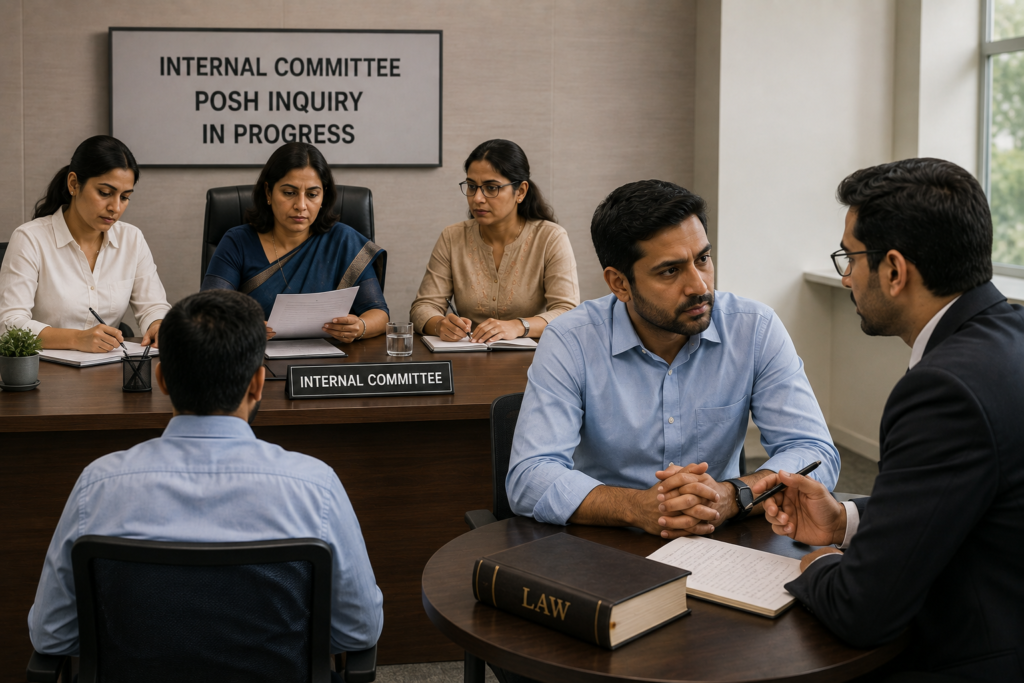
An Internal Committee inquiry is intended to be an internal statutory
mechanism rather than adversarial litigation.
Consequently, many employers prohibit legal practitioners from appearing
before the Committee.
However, this does not mean respondents must defend themselves without
legal assistance.
Just as parties in commercial negotiations routinely seek legal advice
before signing agreements, respondents in POSH proceedings may seek
professional legal advice before:
- Submitting replies.
- Producing documents.
- Answering allegations.
- Responding to procedural directions.
- Considering further legal remedies.
Legal consultation occurs outside the inquiry and does not interfere with
the Internal Committee’s functioning.
Judicial Review Remains Available
The findings of the Internal Committee are not immune from judicial
scrutiny.
Depending on the facts of the case, courts have examined inquiries where
there has been:
- Violation of principles of natural justice.
- Procedural irregularity.
- Perversity of findings.
- Absence of evidence.
- Denial of reasonable opportunity.
- Failure to comply with statutory requirements.
Early legal advice helps ensure that these issues are properly documented
during the inquiry itself, should judicial review become necessary at a
later stage.
Practical Advice for Every POSH Respondent
If you receive a notice from an Internal Committee:
- Do not panic.
- Do not respond immediately in anger or haste.
- Read the complaint carefully.
- Preserve all documents and electronic evidence.
- Maintain confidentiality as required under Section 16.
- Avoid contacting witnesses unless legally appropriate.
- Seek independent legal advice before submitting your written response.
- Ensure that every factual statement made by you is accurate and capable of being substantiated.
Conclusion
The POSH Act seeks to balance two equally important objectives: providing
an effective mechanism for addressing workplace sexual harassment while
ensuring that inquiries are conducted fairly and in accordance with the
principles of natural justice.
A respondent’s right to seek independent legal advice is entirely
consistent with that objective. Although an advocate may not ordinarily
appear before the Internal Committee, nothing in the POSH Act or the Rules
prevents a respondent from consulting a lawyer, obtaining legal guidance,
or having a reply professionally drafted and vetted.
Given that a POSH inquiry may culminate in termination of employment,
financial liability under Sections 13 and 15, and long-term reputational
consequences, seeking timely legal advice is not a sign of avoiding the
process; it is an exercise of the respondent’s right to a fair and informed
defence.
Every respondent should therefore remember one fundamental principle:
“You may have to face the Internal Committee alone, but you should
never prepare your defence alone.”
– Adv. Sarosh Damania
informational purposes only and does not constitute legal advice. The
views expressed are personal to the author. Each POSH matter depends upon
its own facts, the employer’s service rules, applicable standing orders,
and the law as interpreted by the competent courts.