

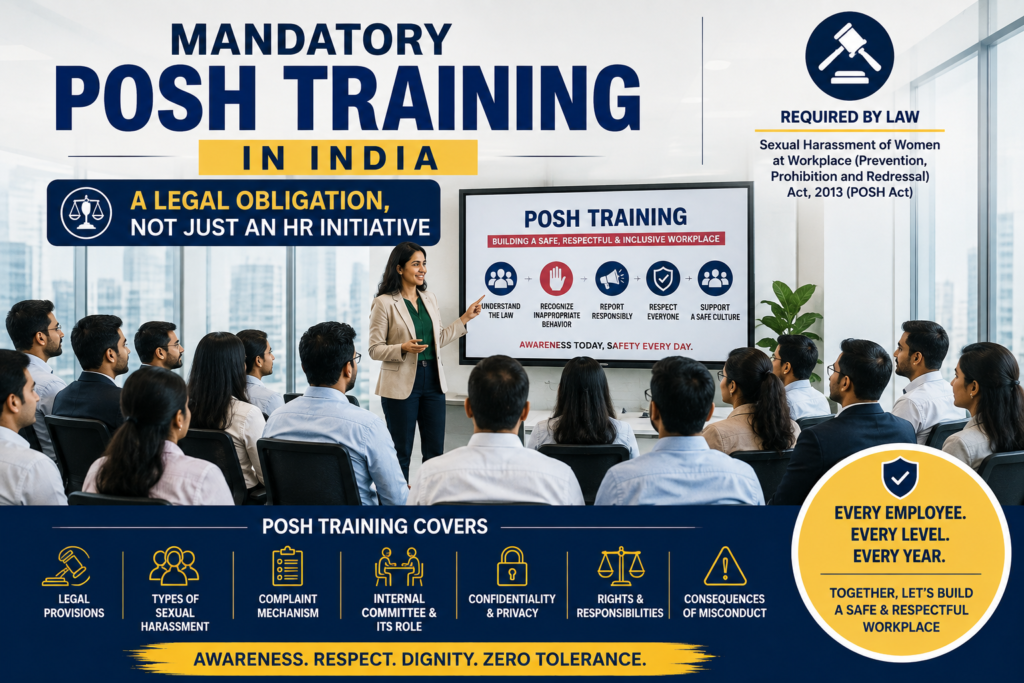
Mandatory POSH Training: A Legal Obligation, Not Just an HR Initiative
By Adv. Sarosh Damania
Many organisations still view Prevention of Sexual Harassment (POSH) training as an annual
HR activity or a compliance formality. In reality, conducting regular POSH awareness
programmes is a statutory obligation imposed by the Sexual Harassment of Women at Workplace
(Prevention, Prohibition and Redressal) Act, 2013 (“POSH Act”).
Failure to comply can expose an employer to penalties, adverse findings during inspections,
and even affect the employer’s defence if a workplace sexual harassment complaint reaches a
court or tribunal.
A workplace can only be considered safe when employees understand what constitutes sexual
harassment, how to report it, and the consequences of engaging in inappropriate conduct.
Prevention is the cornerstone of the POSH Act, and training is one of the most effective
preventive measures.
The Objective of the POSH Act
The POSH Act was enacted to give effect to the principles laid down by the Supreme Court in
Vishaka & Ors. v. State of Rajasthan (1997) 6 SCC 241, recognising every
woman’s fundamental right to work in an environment free from sexual harassment.
The Act seeks not only to provide a redressal mechanism for complaints but also to ensure
that employers actively prevent incidents of sexual harassment through awareness, education,
and policy implementation.
Employer’s Statutory Duty
Section 19 of the POSH Act sets out the duties of every employer. Amongst these duties are
obligations to:
- Provide a safe working environment.
- Display the penal consequences of sexual harassment and details of the Internal Committee at conspicuous places.
- Organise workshops and awareness programmes for employees at regular intervals.
- Organise orientation programmes for members of the Internal Committee.
- Provide necessary facilities to the Internal Committee for conducting inquiries.
- Assist in securing the attendance of witnesses and production of documents.
- Treat sexual harassment as misconduct under the applicable service rules.
- Monitor the timely submission of reports by the Internal Committee.
The language used in Section 19 is mandatory. The Act does not treat employee awareness
programmes as optional or discretionary.
What Does “Regular Intervals” Mean?
The Act requires employers to organise workshops and awareness programmes at “regular
intervals” but does not prescribe a fixed frequency.
As a matter of good governance and industry practice, employers should consider:
- Induction training for every new employee.
- Annual refresher training for all employees.
- Specialised orientation programmes for Internal Committee members.
- Additional sessions whenever there are significant legal developments or amendments to internal policies.
- Targeted training for managers and supervisors who are often the first point of contact for complaints.
Organisations that conduct only one session every few years may find it difficult to
demonstrate compliance with Section 19.
Why POSH Training Is So Important
A significant number of workplace disputes arise not because of deliberate misconduct but
because employees are unaware of acceptable workplace behaviour.
Training helps employees understand:
- What amounts to sexual harassment under Section 2(n) of the Act.
- Examples of physical, verbal, non-verbal and digital misconduct.
- Workplace conduct during travel, office events, virtual meetings and messaging platforms.
- How to make a complaint.
- Rights of both the complainant and the respondent.
- Confidentiality obligations under Section 16.
- The inquiry process before the Internal Committee.
- The consequences of making false complaints or false evidence under Section 14.
An informed workforce is less likely to engage in inappropriate conduct and more likely to
report genuine incidents promptly.
Internal Committee Training Is Equally Essential
Many organisations focus solely on employee awareness while overlooking training for
Internal Committee members.
This is a serious mistake.
Members of the Internal Committee perform quasi-judicial functions. They are expected to
conduct inquiries fairly, comply with the principles of natural justice, evaluate evidence
objectively, prepare reasoned findings, and make recommendations in accordance with Sections
11, 13 and 15 of the Act.
Improperly trained Internal Committee members may inadvertently commit procedural errors
that could undermine the validity of the inquiry.
Regular orientation programmes are therefore not merely advisable—they are expressly
required under Section 19.
Consequences of Non-Compliance
Failure to comply with the provisions of the POSH Act may attract penalties under Section 26.
Where an employer fails to:
- Constitute an Internal Committee.
- Comply with the duties imposed by the Act.
- Contravene any provision of the Act or Rules.
The employer may be liable to a monetary penalty of up to ₹50,000.
For repeated violations, the consequences may be more severe, including:
- Enhanced penalties.
- Cancellation or withdrawal of licences, registrations or approvals, where permissible under applicable law.
- Increased regulatory scrutiny.
Beyond statutory penalties, inadequate training may expose an employer to reputational
damage, employee dissatisfaction, and avoidable litigation.
POSH Training Should Be Practical, Not Mechanical
Many organisations merely circulate a PowerPoint presentation or ask employees to click
through an online module.
That approach defeats the purpose of the legislation.
Effective POSH training should include:
- Practical workplace scenarios.
- Real-life examples.
- Interactive discussions.
- Explanation of employee rights and obligations.
- Guidance on reporting mechanisms.
- Confidentiality requirements.
- Role of the Internal Committee.
- Question-and-answer sessions.
Employees should leave the session with a clear understanding of what behaviour is
unacceptable and how concerns will be addressed.
Maintaining Proper POSH Training Records
Employers should maintain comprehensive records of every training programme, including:
- Date and duration of the session.
- Trainer details.
- Agenda and training material.
- Attendance records.
- Acknowledgements from participants.
- Photographs or screenshots for virtual sessions.
These records may become valuable evidence of compliance during inspections, audits, or
legal proceedings.
POSH Training in the Era of Hybrid Work
With hybrid and remote working becoming commonplace, organisations should ensure that POSH
training also addresses:
- Conduct during virtual meetings.
- Inappropriate messages on communication platforms.
- Social media interactions between colleagues.
- Workplace harassment outside the physical office.
- Official travel and off-site events.
The concept of a “workplace” under the POSH Act is broad and extends well beyond the
traditional office premises.
Best Practices for Employers
- Conduct induction training for every new employee.
- Hold annual refresher programmes for all employees.
- Provide specialised training for Internal Committee members.
- Update training material to reflect recent judicial decisions and organisational policies.
- Maintain proper attendance and training records.
- Review the effectiveness of training through feedback and periodic assessments.
- Ensure senior management actively participates in promoting a respectful workplace culture.
Conclusion
The success of the POSH Act depends not only on the effective handling of complaints but
also on preventing misconduct before it occurs.
Mandatory POSH training is therefore not a symbolic exercise or an annual HR checklist—it is
a statutory responsibility under Section 19 of the POSH Act and a vital component of good
corporate governance.
Organisations that invest in meaningful and regular POSH training foster safer workplaces,
reduce legal risk, strengthen employee confidence, and demonstrate a genuine commitment to
dignity and equality at work.
Compliance with the POSH Act begins long before a complaint is filed. It begins with awareness.
About the Author
Adv. Sarosh Damania is an Advocate practising before the Bombay High Court,
arbitral tribunals and various judicial forums across India.
He regularly advises multinational corporations, aviation companies, employers and Internal
Committees on labour law, employment law, POSH compliance, domestic inquiries, workplace
investigations and corporate governance.
does not constitute legal advice. Organisations should obtain legal advice specific to their
facts, policies and applicable service rules before implementing compliance measures.