
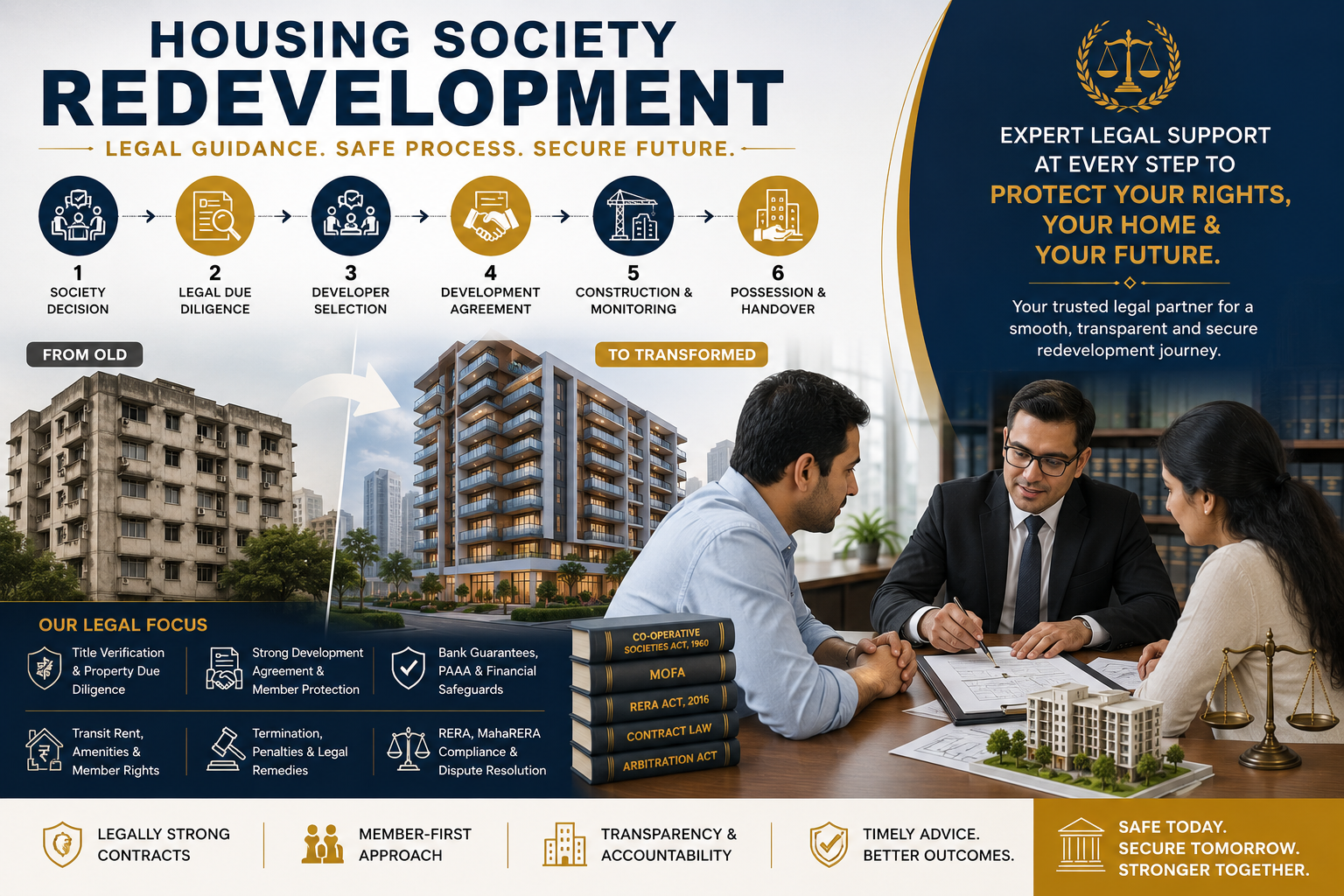
Housing Society Redevelopment Lawyer in Mumbai: Why Your Society Needs an Advocate – Legal Checklist 2026
By Adv. Sarosh Damania
Advocate, Bombay High Court
Updated: August 2026
Redevelopment of a co-operative housing society in Mumbai can transform an old building into a safer, larger and more valuable property. But it is also one of the most significant legal and financial decisions that a housing society and its members will ever take.
A society may be handing over development rights worth several crores of rupees. Members may be required to vacate homes occupied by their families for decades. The existing building may then be demolished, leaving members dependent upon the developer’s contractual promise to pay rent and reconstruct their new homes within the agreed period.
For this reason, housing society redevelopment is not merely a construction project. It is a major legal, contractual, financial and property transaction.
Most societies understand the importance of appointing an architect or Project Management Consultant (“PMC”). Far fewer appreciate the importance of appointing an independent advocate for society redevelopment at the beginning of the process.
So, does a housing society legally need a lawyer for redevelopment in Mumbai?
The better question is:
Should a housing society entrust property worth crores to a developer without having its own independent legal adviser?
In most redevelopment projects, that would be an unnecessary and significant risk.
Does a Housing Society Need an Advocate for Redevelopment in Mumbai?
There is no single provision stating that every housing society must appoint an advocate before redevelopment.
However, society redevelopment in Maharashtra involves several areas of law and regulation, which may include:
- Maharashtra Co-operative Societies Act, 1960;
- directions issued by the State Government;
- society bye-laws;
- property and title law;
- Maharashtra Ownership Flats Act (“MOFA”), where applicable;
- Real Estate (Regulation and Development) Act, 2016 (“RERA”);
- MahaRERA requirements;
- Development Control and Promotion Regulations;
- municipal permissions;
- registration and stamp laws;
- contract law;
- arbitration law; and
- various Government Resolutions, circulars and redevelopment directions.
Redevelopment procedures have also changed over time. Societies should therefore be careful about relying on old internet checklists or documents used in redevelopment projects several years earlier.
The advocate’s role is not simply to prepare a Development Agreement.
A good society redevelopment lawyer in Mumbai should advise the society from the stage of title verification and developer selection through negotiation, documentation, vacation, construction, possession and final handover.
PMC vs Advocate in Society Redevelopment: What Is the Difference?
One of the most common questions asked by managing committees is:
“We have already appointed a PMC. Why do we also need an advocate?”
The answer is that the PMC and advocate perform different functions.
Role of the PMC
The PMC ordinarily deals with technical and project-related matters such as:
- feasibility of redevelopment;
- development potential;
- FSI and TDR calculations;
- preparation of tender documents;
- architectural planning;
- construction specifications;
- amenities;
- evaluation of technical bids;
- construction milestones; and
- supervision of construction quality.
Role of the Housing Society Redevelopment Lawyer
The advocate looks at the legal and contractual risks.
For example:
- Does the society have proper title to the property?
- Has conveyance or deemed conveyance been completed?
- Does the developer have the financial capability to undertake the project?
- What rights is the society granting the developer?
- Can the developer mortgage the property?
- Can development rights be assigned to someone else?
- What happens if rent payments stop?
- What security does the society have?
- When can members safely vacate?
- What happens if construction stops?
- How can the developer be terminated?
- Can another developer be appointed?
- Who owns additional development potential?
- How are disputes resolved?
- What happens if the developer becomes insolvent?
- What happens if an Occupation Certificate is delayed?
These are principally legal issues rather than architectural issues.
A properly structured redevelopment should therefore have the PMC and advocate working together while independently protecting their respective areas.
When Should a Society Appoint a Housing Society Redevelopment Lawyer in Mumbai?
Ideally, before the developer is selected.
Societies sometimes approach an advocate only after:
- the tender has been issued;
- negotiations have concluded;
- the developer has been selected;
- an LOI has been issued; and
- the developer has circulated its Development Agreement.
By then, several important commercial decisions may already have become difficult to renegotiate.
The society’s advocate should ideally be involved from the beginning so that legal safeguards are built into the tender itself.
- Legal Title Check Before Society Redevelopment
Before asking developers what they will offer, the society should first understand what property and development rights it actually owns.
The advocate should examine the society’s title and relevant records.
Documents may include:
- Conveyance Deed;
- deemed conveyance documents;
- Property Card;
- City Survey records;
- land revenue records;
- original title deeds;
- lease documents, where applicable;
- original development agreements;
- sanctioned plans;
- Occupation Certificate;
- Completion Certificate;
- property tax documents;
- layout approvals;
- easements;
- rights of way;
- reservations;
- mortgages or charges; and
- pending litigation affecting the property.
Why Is Title Verification Important?
Imagine selecting a developer on the assumption that the society can utilise a particular parcel of land or development potential, only to discover later that:
- the society does not own part of the land;
- conveyance was never completed;
- a third party has development rights;
- an old mortgage remains recorded;
- there is a reservation affecting the property; or
- the sanctioned layout differs from the physical property.
Such issues can delay redevelopment for years.
A redevelopment advocate should therefore examine title before major contractual commitments are made.
- Drafting the Redevelopment Tender Correctly
A redevelopment tender should not be treated as only a technical document.
Many of the most important contractual terms originate in the tender.
The tender should clearly address issues such as:
- additional carpet area;
- corpus;
- monthly transit rent;
- annual rent escalation;
- brokerage;
- shifting charges;
- hardship compensation;
- bank guarantee;
- construction period;
- grace period;
- parking;
- amenities;
- specifications;
- taxes;
- maintenance;
- developer eligibility;
- developer funding;
- project timelines;
- default consequences;
- termination rights; and
- dispute resolution.
For example, a tender stating merely:
“Developer shall provide suitable bank security.”
is significantly weaker than defining:
- the amount;
- nature;
- issuing bank;
- validity;
- renewal obligation; and
- invocation conditions.
The redevelopment advocate should therefore work with the PMC while the tender is being prepared.
- Legal Due Diligence of the Redeveloper
Selecting the developer is arguably the single most important commercial decision in redevelopment.
A developer should not be selected only because it offers:
- the highest additional area;
- the largest corpus;
- the highest rent; or
- the most attractive presentation.
A fantastic commercial offer has little value if the developer cannot complete the project.
What Should a Society Check About a Developer?
Legal and commercial due diligence may include:
- constitution of the developer entity;
- directors or partners;
- group companies;
- completed redevelopment projects;
- ongoing redevelopment projects;
- delayed projects;
- abandoned projects;
- pending litigation;
- MahaRERA proceedings;
- insolvency proceedings;
- secured borrowing;
- financial capability;
- lender relationships; and
- previous disputes with housing societies.
The purpose is not necessarily to find a developer who has never faced litigation.
Large developers may naturally have cases involving them.
The real question is whether the due diligence reveals a pattern of delay, default, financial distress or redevelopment disputes.
- Should a Society Sign a Letter of Intent to the Developer?
After the developer is selected, societies commonly issue a Letter of Intent (“LOI”).
An LOI should not casually be treated as a harmless preliminary letter.
Depending upon its wording, it may create contractual rights.
A properly drafted LOI should state:
- that appointment is subject to definitive agreements;
- the conditions precedent;
- timelines;
- security requirements;
- whether exclusivity exists;
- circumstances permitting withdrawal;
- consequences of failure to execute documents; and
- whether the developer acquires any development right merely because the LOI has been issued.
The society should avoid creating an unintended irrevocable appointment before the Development Agreement has even been negotiated.
- Development Agreement for Society Redevelopment
The Development Agreement (“DA”) is the most important contract in a housing society redevelopment project.
The tender may contain promises.
The developer’s presentation may contain promises.
Negotiation meetings may contain promises.
WhatsApp messages and emails may contain assurances.
But the society should ensure that every important commercial promise is translated into a legally enforceable contractual obligation.
Important Clauses in a Redevelopment Development Agreement
A Development Agreement should ordinarily deal with:
- development rights;
- additional carpet area;
- free-sale component;
- FSI;
- TDR;
- fungible FSI;
- future development potential;
- corpus;
- rent;
- rent escalation;
- brokerage;
- shifting charges;
- bank guarantee;
- approvals;
- construction period;
- milestones;
- grace period;
- possession;
- parking;
- specifications;
- amenities;
- developer financing;
- mortgage rights;
- assignment;
- RERA compliance;
- delay compensation;
- events of default;
- termination;
- consequences of termination;
- arbitration; and
- jurisdiction.
A society should avoid simply signing the developer’s “standard Development Agreement”.
In redevelopment, there is no standard risk profile.
Every property and every redevelopment project has different legal issues.
- Additional Carpet Area: It Must Be Precisely Defined
One of the biggest attractions of redevelopment is additional area.
But the agreement should clearly identify what the developer is actually promising.
Terms such as:
- carpet area;
- RERA carpet area;
- built-up area;
- fungible area;
- balcony;
- flower bed;
- deck; and
- enclosed area
should not be casually interchanged.
If a member is promised an existing area plus an additional area, the exact measurement basis should be written into the contract.
Members should know:
“What will be the legally measurable carpet area of my new flat?”
—not merely what the marketing brochure says.
- Corpus in Society Redevelopment
Corpus is often one of the most heavily negotiated commercial components of redevelopment.
The Development Agreement should specify:
- total corpus payable;
- whether it is payable to the society or members;
- amount payable per member;
- payment stages;
- due dates;
- whether payment is linked to vacation;
- consequences of delay; and
- whether the developer can make any deductions.
Vague phrases such as:
“Corpus will be paid at an appropriate stage.”
should be avoided.
In redevelopment, uncertainty usually benefits the party required to perform later.
- Transit Rent: Protect Members Before They Vacate
Once members vacate the building, they may remain in rented accommodation for several years.
Transit rent therefore becomes one of the most important protections in the Development Agreement.
The agreement should clearly state:
- monthly rent;
- advance rent;
- annual escalation;
- due date every month;
- security deposit;
- brokerage;
- shifting charges;
- hardship compensation;
- interest or consequences for delayed payment;
- rent during contractual construction period;
- rent during grace period; and
- enhanced consequences if delay continues beyond the agreed period.
The society should also examine:
What happens if the developer stops paying rent altogether?
A promise to pay rent is useful.
A promise supported by enforceable financial security is far safer.
- Bank Guarantee in Society Redevelopment
A developer may promise:
- larger flats;
- rent;
- corpus;
- new amenities;
- parking;
- completion within three or four years.
But the crucial question is:
What security does the society have if those promises are broken?
A properly drafted bank guarantee can be an important redevelopment safeguard.
The society’s advocate should check:
- guaranteed amount;
- issuing bank;
- unconditional or conditional nature;
- validity period;
- automatic renewal obligations;
- invocation conditions;
- reduction schedule;
- notice requirements; and
- consequences of non-renewal.
A bank guarantee that expires midway through construction or is extremely difficult to invoke may offer considerably less protection than members expect.
- Permanent Alternate Accommodation Agreement — PAAA
Individual members will normally receive documentation recording their entitlement to the new premises.
This is often referred to as the Permanent Alternate Accommodation Agreement (“PAAA”).
The PAAA should be consistent with the society’s Development Agreement.
It should clearly identify:
- existing premises;
- member’s entitlement;
- new carpet area;
- configuration;
- floor, where agreed;
- parking rights;
- specifications;
- amenities;
- transit rent;
- escalation;
- possession timeline;
- delay compensation;
- registration;
- stamp duty;
- maintenance liability;
- defect liability; and
- possession procedure.
The Development Agreement should not contain one protection while the member’s PAAA quietly takes it away.
- When Should Members Vacate for Redevelopment?
This is one of the most critical redevelopment questions.
Once members hand over possession and the building is demolished, their practical bargaining position changes significantly.
Members should therefore not ordinarily vacate simply because the developer says:
“Everything else will be done after demolition.”
The Development Agreement should identify clear conditions precedent to vacation.
Depending upon the project, these may include:
- execution of Development Agreement;
- registration of documents;
- execution of PAAA;
- specified municipal approvals;
- bank guarantee;
- payment of agreed corpus instalment;
- payment of advance rent;
- security deposits;
- financing arrangements;
- insurance requirements;
- demolition permissions; and
- other agreed contractual protections.
The society’s advocate should confirm whether the contractual conditions have been fulfilled before members surrender possession.
- Can a Redevelopment Developer Mortgage Society Property?
Developers frequently require project finance.
The lender may ask for security over the developer’s rights or sale component.
The society should be extremely careful before granting a general or unrestricted right to mortgage the redevelopment property.
The agreement should address:
- what can be mortgaged;
- what cannot be mortgaged;
- whether society consent is required;
- lender’s rights;
- members’ rehabilitation premises;
- rehabilitation land;
- enforcement rights;
- release of security; and
- consequences of developer default.
The society should understand a fundamental point:
The developer’s financing requirement should not unnecessarily expose members’ rehabilitation rights to lender risk.
- Can the Developer Transfer or Assign Redevelopment Rights?
Suppose members select Developer A because of its:
- reputation;
- financial strength;
- completed projects; and
- management team.
The society should not discover a year later that Developer A has effectively transferred the project to Developer B without members having any say.
Assignment, transfer, partnership changes or creation of third-party development rights should therefore be carefully regulated.
Otherwise, the society may ultimately be dealing with a party it never evaluated or selected.
- Does RERA Apply to Society Redevelopment?
RERA may apply to redevelopment projects depending upon how the project is structured.
The Real Estate (Regulation and Development) Act, 2016 contains an exemption relating to renovation, repair or redevelopment where there is no marketing, advertising, selling or new allotment of apartments, plots or buildings.
Where a redevelopment contains a sale component, however, the applicability of RERA and MahaRERA requirements should be carefully examined.
Societies should therefore not assume that:
“Redevelopment means RERA does not apply.”
The RERA position should be examined project by project.
- What Happens if the Developer Delays the Redevelopment?
A good redevelopment agreement must be drafted for two situations:
- when everything goes according to plan; and
- when everything does not.
The second situation is where legal drafting becomes most valuable.
Developer Defaults May Include
- failure to obtain approvals;
- failure to commence construction;
- repeated rent default;
- prolonged stoppage of work;
- abandonment;
- failure to renew bank guarantee;
- unauthorised mortgage;
- unauthorised assignment;
- insolvency;
- breach of sanctioned plans;
- failure to meet milestones; and
- failure to complete within the contractual period.
The Development Agreement should then answer:
- When does an event of default occur?
- Is a cure notice required?
- What is the cure period?
- When can the society terminate?
- Can the society invoke the bank guarantee?
- Can it appoint another developer?
- What happens to existing approvals?
- What happens to project plans?
- What happens to construction already completed?
- What happens to unsold flats?
- What happens to lender rights?
- How do members continue receiving rent after termination?
A redevelopment agreement should never make termination practically impossible.
- Termination Clause in Redevelopment Agreement
This is an area societies often overlook at the beginning because everyone expects the redevelopment to succeed.
But the termination clause becomes critical if the project fails.
The agreement should properly provide for:
- material breach;
- rent default;
- construction delay;
- insolvency;
- non-renewal of security;
- abandonment;
- unauthorised assignment;
- cure period;
- termination procedure;
- consequences of termination;
- handover of project documents;
- cooperation with replacement developer; and
- survival of members’ rights.
The society should also avoid an agreement where the developer can terminate easily but the society cannot.
- Arbitration Clause in Society Redevelopment
Most redevelopment agreements contain an arbitration clause.
The clause should not simply be copied from another agreement.
It should address:
- governing law;
- appointment of arbitrator;
- seat of arbitration;
- venue;
- jurisdiction;
- interim relief;
- costs; and
- continuation of essential obligations during disputes.
For projects located in Mumbai, parties commonly consider Mumbai as the seat and venue, subject to the circumstances of the transaction and legal advice.
Poorly drafted arbitration clauses can create litigation even before the actual redevelopment dispute is heard.
- Majority Members vs Dissenting Members in Redevelopment
Society redevelopment sometimes leads to disagreements between a majority supporting redevelopment and one or more dissenting members.
The society should therefore maintain a transparent record of:
- notices;
- Special General Meetings;
- quorum;
- attendance;
- tenders;
- comparative statements;
- voting;
- objections;
- resolutions;
- negotiations;
- developer selection; and
- correspondence.
Proper procedure does more than comply with governance requirements.
It creates the documentary record that may later become crucial if the redevelopment decision is challenged.
- Can the Society Use the Developer’s Lawyer?
A developer may sometimes tell a society:
“You don’t need to appoint another lawyer. Our advocate will prepare all the documents.”
The developer’s advocate is entitled to protect the developer’s interests.
The society requires someone to independently protect its interests and the interests of its members.
There is nothing inherently wrong with the developer’s lawyer circulating the first draft of a Development Agreement.
The problem arises if the society signs it without independent legal scrutiny.
The society’s redevelopment lawyer should independently:
- review;
- negotiate;
- amend;
- advise upon; and
- approve
the legal documentation from the society’s perspective.
- Why the Cheapest Redevelopment Lawyer May Not Be the Best Choice
A redevelopment project may involve a property worth tens or even hundreds of crores of rupees.
Legal advice from a housing society redevelopment lawyer in Mumbai should not therefore be evaluated solely on the basis of:
“Who will draft the agreement for the lowest fee?”
The work may involve:
- title investigation;
- redevelopment strategy;
- review of society resolutions;
- tender drafting;
- tender negotiations;
- developer due diligence;
- LOI;
- Development Agreement;
- PAAA;
- Power of Attorney;
- bank guarantee;
- finance documents;
- mortgage documents;
- member queries;
- dispute prevention;
- vacation documentation;
- construction-stage advice;
- default notices;
- possession documentation; and
- completion and handover.
The advocate may remain involved for several years.
The relevant comparison should therefore be between the professional cost and the value and risk of the redevelopment transaction.
Housing Society Redevelopment Legal Checklist 2026
Before Starting Redevelopment
- Verify society title
- Check conveyance/deemed conveyance
- Review Property Card
- Examine sanctioned plans
- Identify litigation
- Assess development potential
- Review applicable redevelopment procedure
- Appoint independent professionals
Before Inviting Developers
- Prepare proper tender
- Define additional carpet area
- Fix minimum corpus expectation
- Set rent requirements
- Define bank guarantee
- Prescribe developer eligibility
- Establish completion period
- Define financial capability requirements
Before Selecting the Developer
- Conduct legal due diligence
- Check completed projects
- Check delayed projects
- Review MahaRERA history
- Review litigation
- Examine financial capacity
- Compare final offers
- Record negotiations transparently
Before Issuing the LOI
- Finalise commercial terms
- State conditions precedent
- Limit exclusivity
- Define expiry
- Restrict creation of development rights
- Provide consequences of developer default
Before Signing the Development Agreement
Check:
- additional carpet area;
- corpus;
- rent;
- escalation;
- bank guarantee;
- construction period;
- grace period;
- FSI/TDR;
- future potential;
- parking;
- amenities;
- developer finance;
- mortgage;
- assignment;
- RERA;
- delay;
- termination;
- arbitration; and
- jurisdiction.
Before Members Vacate
Confirm:
- Development Agreement is completed;
- PAAA documents are completed;
- required registrations are done;
- agreed permissions are obtained;
- bank guarantee is received;
- advance rent is paid;
- deposits are paid;
- agreed corpus stage is complied with;
- finance documents are checked;
- possession documentation is ready; and
- all contractual conditions precedent have been satisfied.
During Construction
Monitor:
- monthly rent;
- bank guarantee validity;
- construction milestones;
- sanctioned plans;
- RERA compliance;
- financing;
- changes in developer entity;
- specifications;
- amenities; and
- project delay.
Before Taking Possession
Check:
- Occupation Certificate;
- actual carpet area;
- specifications;
- amenities;
- defects;
- parking;
- common areas;
- society office;
- accounts;
- title documentation;
- plans and approvals;
- warranties;
- developer handover documents; and
- release of appropriate securities.
Frequently Asked Questions About Housing Society Redevelopment Lawyer in Mumbai
- Is a lawyer compulsory for housing society redevelopment?
There is no general rule simply stating that every society must appoint an advocate for redevelopment. However, because redevelopment involves title, contracts, development rights, member rights, financial security, RERA, termination and dispute resolution, independent legal representation is strongly advisable.
- When should a society appoint a redevelopment advocate?
Ideally, before preparing the final tender and before selecting the developer.
- Can a PMC draft the Development Agreement?
A PMC can assist with technical and commercial requirements, but legal drafting and legal rights should ordinarily be reviewed by an independent advocate.
- What documents should a redevelopment lawyer check?
The advocate may review title documents, society records, tender documents, developer due diligence, LOI, Development Agreement, PAAA, Power of Attorney, bank guarantee, finance documents and possession documents.
- Should members vacate before all approvals are obtained?
Members should vacate only after the contractual conditions precedent agreed for the redevelopment have been satisfied. The exact requirements depend on the project.
- Is a bank guarantee necessary in society redevelopment?
A properly structured bank guarantee can provide important financial protection against certain developer defaults. Its amount, wording, validity and invocation terms are critical.
- What happens if the developer stops paying rent?
The Development Agreement should provide consequences for rent default, including contractual remedies and, where appropriate, recourse to financial security.
- Can a redevelopment developer mortgage the society property?
Developer financing may be permitted in appropriately structured transactions, but mortgage rights should be carefully restricted so that members’ rehabilitation rights are protected.
- Can the developer transfer redevelopment rights to another builder?
The Development Agreement should regulate assignment or transfer. The society should not automatically permit unrestricted transfer of rights to an entity it never selected.
- Does MahaRERA apply to society redevelopment?
It depends on the nature and structure of the redevelopment, including whether there is a sale component. The applicability of RERA should be examined in each project.
- What happens if the developer does not complete redevelopment on time?
The Development Agreement should contain milestone, delay, compensation, default and termination provisions enabling the society to take effective action.
- Can a housing society terminate a redevelopment developer?
Depending upon the contract and circumstances, termination may be possible for specified defaults. This is why the Development Agreement should contain clearly drafted termination and post-termination provisions.
- Can the society appoint the developer’s lawyer?
The society should ordinarily have independent legal representation because the developer’s advocate is engaged to protect the developer’s interests.
- What is the most important document in society redevelopment?
The Development Agreement is generally the principal contract governing the relationship between the society and developer. Individual member agreements such as the PAAA are also extremely important.
- What should members check before vacating for redevelopment?
Members should ensure that the contractual pre-vacation protections—including documents, security, rent and specified approvals—have been complied with.
Final Word: Do Not Wait for a Redevelopment Dispute to Appoint a Lawyer
A housing society redevelopment lawyer in Mumbai is most valuable before there is litigation.
Once members have vacated, the building has been demolished and a dispute has begun, the lawyer can only work with the rights contained in the documents already signed.
The better approach is to create those rights correctly from the beginning.
A redevelopment advocate should help the society:
- identify legal risks;
- negotiate stronger protections;
- document developer commitments;
- secure member rights;
- provide exit mechanisms if things go wrong; and
- reduce the possibility of future litigation.
A redevelopment transaction may determine where hundreds of families live and how one of the society’s most valuable assets is utilised for decades.
The society should therefore have its own independent legal adviser from the beginning of the redevelopment process until final possession and handover.
Because in housing society redevelopment, the best legal dispute is often the one that careful drafting prevents.
Disclaimer: This article is intended only for general legal information and does not constitute legal advice. Redevelopment requirements depend upon the facts, title, property, society documents, applicable planning regulations and contractual structure of each project. Independent professional advice should be obtained before taking any redevelopment decision.

Advocate Sarosh Damania is the founder of Sarosh Damania & Co., a premier law firm based in Mumbai, recognized for its exceptional legal services to corporations, individuals, and international clients worldwide. With a rich blend of experience and expertise, Adv. Damania and his team specialize in a wide array of legal disciplines, including Civil Law, Criminal Law, Aviation Law, Arbitration, Consumer Law, RERA, Company Law, Succession Law, Wills, Intellectual Property Law, Property Law, Housing Society Law, Debt Recovery, and Banking Law.
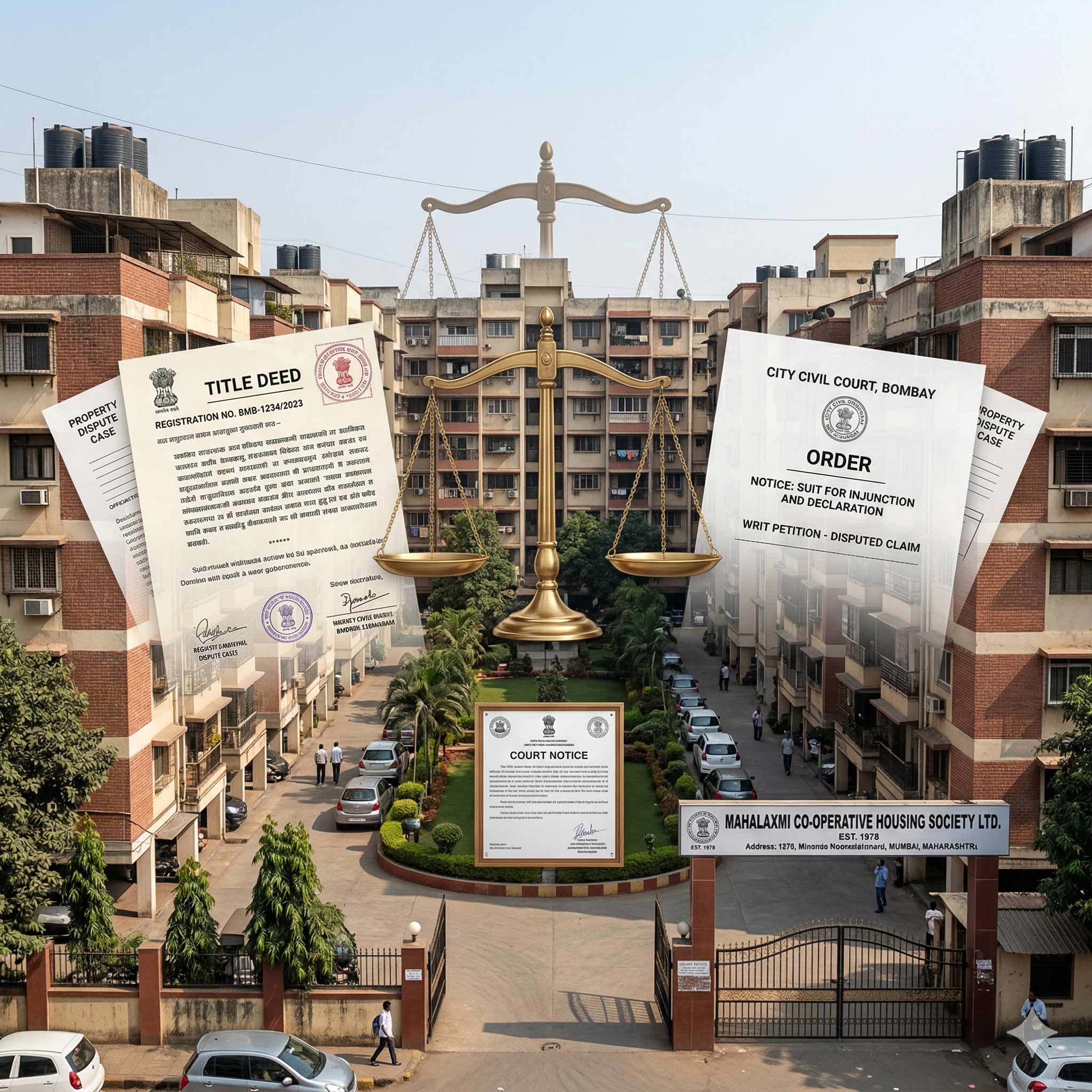
Civil Disputes & Housing Society Matters in Mumbai: A Complete Legal Guide for Property Owners
Mumbai is one of the most densely populated cities in the world, and the majority of residential buildings operate through co-operative housing societies. Because of this unique structure, housing society disputes and civil litigation matters are among the most frequently searched legal issues in Mumbai.
From flat succession disputes, society membership issues, recovery cases, contract disputes, and injunction proceedings, residents often require legal assistance to protect their property and financial rights.
This article provides a comprehensive legal guide to civil disputes and housing society matters in Mumbai, explaining common issues faced by residents and the legal remedies available under Indian law.
Legal Framework Governing Housing Societies in Mumbai
Housing societies in Maharashtra are primarily governed by the Maharashtra Co-operative Societies Act, 1960, which regulates the formation, management, and functioning of co-operative housing societies.
Disputes arising between society members, managing committees, developers, and property owners are typically resolved through the Deputy Registrar of Co-operative Societies, Co-operative Courts, or higher judicial forums such as the Bombay High Court.
Understanding the legal structure of housing societies is essential for resolving conflicts efficiently.
Flat Succession & Ownership Disputes in Housing Societies
One of the most common civil disputes in Mumbai arises when a flat owner passes away and multiple family members claim ownership rights.
Typical issues include:
- Transfer of membership to legal heirs
- Conflicts between family members regarding property ownership
- Disputes over nomination in society records
- Delay in issuing or transferring share certificates
Many society members assume that a nominee automatically becomes the legal owner of a flat. However, under Indian law, a nominee usually holds the property as a trustee for the legal heirs, unless there is a valid will determining ownership.
In such cases, legal processes may involve:
- Probate proceedings
- Succession certificates
- Legal heirship verification
- Civil litigation for declaration of ownership
Because property values in Mumbai are extremely high, these disputes frequently escalate into civil suits before the courts.
Housing Society Membership Disputes
Another frequent legal issue in Mumbai occurs when housing societies refuse membership to legitimate flat purchasers.
Societies sometimes deny membership due to:
- Internal disputes among managing committee members
- Objections raised against the sale transaction
- Documentation deficiencies
- Developer-related conflicts
However, under cooperative housing laws, a society cannot arbitrarily deny membership to a lawful purchaser who has acquired the property through a valid sale transaction.
If membership is wrongfully denied, the buyer can approach the Registrar of Co-operative Societies or initiate legal proceedings to enforce their rights.
Such disputes are particularly common in older buildings undergoing redevelopment or buildings with unresolved title histories.
Civil Recovery Cases in Mumbai
Civil recovery disputes are another major category of litigation in Mumbai. These cases typically arise when one party fails to repay money owed under an agreement or financial transaction.
Examples include:
- Recovery of unpaid loans or advances
- Non-payment under business agreements
- Failure to repay friendly loans
- Builder-buyer financial disputes
- Payment defaults under service contracts
In such cases, the aggrieved party may file a civil suit for recovery of money, seeking a court decree directing the defaulting party to repay the outstanding amount along with interest and costs.
Civil recovery proceedings may also involve attachment of assets and execution of court orders if payment is not made voluntarily.
Contract Disputes in Property and Business Transactions
Mumbai is India’s financial capital, and disputes arising from contracts and agreements are extremely common.
Contract disputes often arise from:
- Real estate agreements
- Development agreements
- Partnership contracts
- Service agreements
- Joint venture arrangements
Typical legal issues include:
- Breach of contractual obligations
- Delay in project completion
- Failure to make agreed payments
- Misrepresentation during contract negotiations
Courts generally examine the terms of the agreement, evidence of breach, and financial losses suffered by the affected party.
Depending on the case, the court may award damages, compensation, or specific performance of the contract.
Injunctions in Civil and Property Disputes
An injunction is one of the most powerful remedies available under civil law.
It is a court order restraining a person from performing a particular act, such as:
- Interfering with property possession
- Carrying out illegal construction
- Selling disputed property
- Demolishing structures during redevelopment disputes
Courts may grant:
Temporary Injunctions – Preventing a party from taking certain actions until the dispute is resolved.
Permanent Injunctions – A final order restraining unlawful conduct.
In Mumbai, injunctions are frequently sought in disputes involving:
- Redevelopment projects
- Housing society management conflicts
- Property ownership disputes
- Illegal occupation or trespassing
Because injunctions are urgent legal remedies, immediate legal action is often required to protect property rights.
Why Housing Society Litigation is Increasing in Mumbai
The number of civil disputes relating to housing societies continues to rise due to several factors:
1. High Real Estate Values
Mumbai’s property market is among the most expensive in India, making ownership disputes financially significant.
2. Redevelopment of Old Buildings
Thousands of aging buildings are undergoing redevelopment, leading to conflicts between developers, societies, and members.
3. Complex Title Histories
Many properties have decades-old ownership records, resulting in inheritance disputes.
4. Society Governance Issues
Mismanagement by managing committees and lack of transparency often trigger legal disputes among members.
When Should You Consult a Civil Lawyer in Mumbai?
You should consider seeking legal advice if you face situations such as:
- Housing society refusing to transfer membership
- Property ownership disputes among family members
- Recovery of unpaid money or financial dues
- Breach of contracts causing financial loss
- Urgent need for court injunctions in property matters
Early legal intervention can often prevent disputes from escalating into lengthy and expensive litigation.
Conclusion
Civil disputes and housing society matters are among the most common legal challenges faced by property owners in Mumbai. With high property values, complex ownership histories, and increasing redevelopment activity, legal conflicts are becoming more frequent.
Whether the issue involves flat succession, society membership disputes, recovery litigation, contract breaches, or injunction proceedings, proper legal guidance is essential to safeguard your rights.
Seeking advice from an experienced civil litigation lawyer can help resolve disputes efficiently and ensure compliance with the applicable laws governing housing societies in Mumbai.
Frequently Asked Questions (FAQs)
Can a housing society refuse to transfer a flat to a buyer?
A housing society cannot arbitrarily refuse membership if the property has been legally transferred and the required documentation has been submitted.
Does a nominee become the legal owner of a flat?
No. A nominee usually acts as a trustee for the legal heirs unless ownership is determined through a will or succession process.
What legal action can be taken if someone interferes with property possession?
A civil suit seeking an injunction can be filed to restrain unlawful interference with property rights.
Where are housing society disputes resolved in Mumbai?
Such disputes may be addressed before the Registrar of Co-operative Societies, Co-operative Courts, Civil Courts, or the Bombay High Court depending on the nature of the dispute.
Advocate Sarosh Damania is the founder of Sarosh Damania & Co., a premier law firm based in Mumbai, recognized for its exceptional legal services to corporations, individuals, and international clients worldwide. With a rich blend of experience and expertise, Adv. Damania and his team specialize in a wide array of legal disciplines, including Civil Law, Criminal Law, Aviation Law, Arbitration, Consumer Law, RERA, Company Law, Succession Law, Wills, Intellectual Property Law, Property Law, Housing Society Law, Debt Recovery, and Banking Law.