
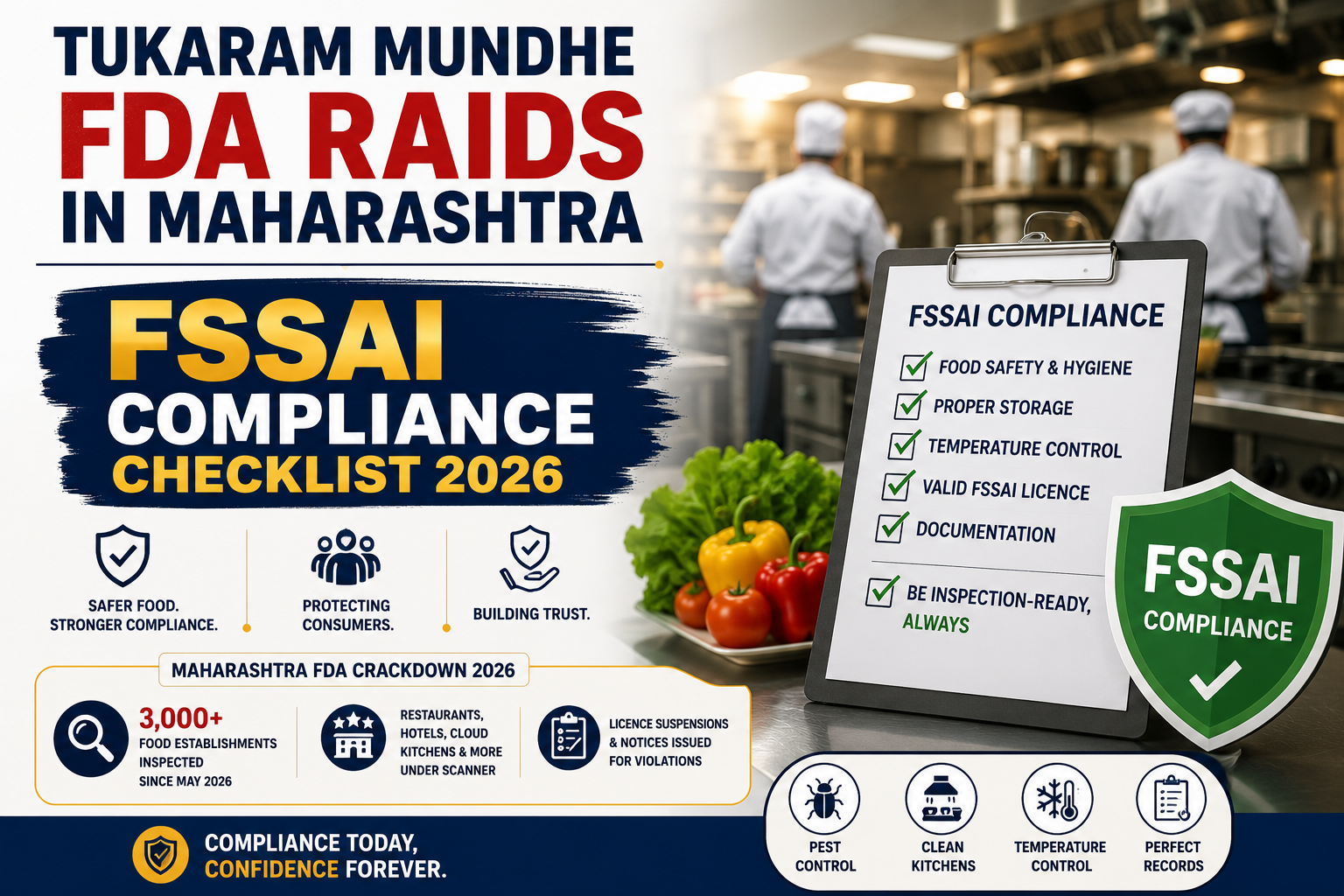
Tukaram Mundhe FDA Raids in Maharashtra: FSSAI Compliance and Inspection Checklist 2026
Food businesses across Maharashtra are facing a significantly stricter regulatory environment in 2026.
Since the Tukaram Mundhe FDA raids began following his appointment as Maharashtra’s Food Safety Commissioner in May 2026, the Maharashtra Food and Drug Administration (FDA) has intensified inspections of restaurants, hotels, cafés, cloud kitchens, dairies, warehouses, food manufacturers, retailers and other Food Business Operators (FBOs).
The scale of the enforcement drive has been considerable. Between 25 May and 31 July 2026, the Maharashtra FDA inspected 3,137 food establishments and suspended 165 licences. Published figures also indicated that 764 improvement notices were issued during this period.
Significantly, the majority of establishments inspected did not require corrective action, showing that the exercise is not merely about closures but about verifying actual compliance.
The enforcement campaign has continued into August 2026, with inspections and regulatory action involving restaurants, clubs, warehouses and major food-service brands.
For restaurants, hotels and every other FBO, the message is clear: an FSSAI licence is not, by itself, proof of continuing compliance.
Food businesses must be able to demonstrate, on an ordinary working day, that their premises, food-storage systems, kitchens, employees, documentation and operating practices comply with applicable food-safety requirements.
This article explains what is driving the Tukaram Mundhe FDA raids crackdown in 2026, the violations attracting regulatory attention, the powers of Food Safety Officers, the difference between an improvement notice and immediate licence suspension, legal remedies against FSSAI licence suspension, and a detailed pre-inspection checklist for restaurants, hotels and other food businesses.
Why Have Maharashtra FDA Inspections Increased in 2026?
Tukaram Mundhe assumed charge as Maharashtra’s Food Safety Commissioner in May 2026 and has since overseen a substantially intensified food-safety enforcement drive. The exercise has not been confined to smaller or unorganised businesses.
Tukaram Mundhe FDA raids inspections have extended across the food sector, including well-known restaurants, clubs, large chains, warehouses and businesses associated with food-delivery platforms.
Recent enforcement has highlighted alleged issues including expired food, pest infestation, unhygienic premises, improper storage, deficient temperature management and unsafe food-handling practices.
The Maharashtra FDA’s stated approach is that enforcement is based upon compliance with food-safety requirements rather than the identity, reputation or size of the establishment. Brand reputation therefore provides no regulatory immunity. A five-star hotel, nationally recognised restaurant, cloud kitchen or small neighborhood eatery must comply with the food-safety standards applicable to its particular operations.
Which Food Businesses Are Being Inspected?
The current Maharashtra FDA crackdown in 2026 is relevant to a wide range of Food Business Operators, including:
• Restaurants, cafés and eateries
• Hotels and commercial kitchens
• Bakeries and sweet shops
• Cloud kitchens
• Caterers and institutional canteens
• Dairies and milk-product businesses
• Food manufacturers and processors
• Retail food businesses
• Warehouses and storage facilities
• Food distributors
• Businesses supplying through online delivery platforms
• Quick-commerce and e-commerce food operations
• Clubs, gymkhanas and other establishments operating kitchens or food-service facilities
The compliance requirement is not limited to businesses that directly serve customers at a dining table. Where food is manufactured, processed, prepared, stored, distributed, transported or sold, the relevant business must determine and comply with the food-safety requirements applicable to its operation.
What Are Maharashtra FDA Inspectors Finding During Inspections?
Possession of a valid FSSAI licence is only one aspect of compliance. During an FDA inspection, the actual physical and operational conditions of the establishment may be examined.
Recent Maharashtra enforcement has highlighted alleged deficiencies involving:
• Expired food products
• Cockroaches, flies and other pests
• Improper refrigeration
• Poor sanitation
• Unsafe food-storage practices
• Inappropriate food handling
• Inadequate staff-health or compliance documentation
• Misbranding or other food-related regulatory violations
1. Expired Food and Poor Stock Management
Expired ingredients or food retained beyond an applicable use-by or shelf-life date can create an immediate compliance issue.
Every restaurant or commercial kitchen should maintain a systematic procedure for checking stock. Depending upon the food involved, businesses should consider appropriate inventory controls such as FIFO (First In, First Out) or FEFO (First Expire, First Out).
The objective is simple: stock approaching expiry should not remain unnoticed in refrigerators, freezers, dry-storage areas or warehouses. Routine documented expiry checks are far safer than discovering expired stock during an FDA inspection.
2. Pest Infestation
Cockroaches, rodents, flies and other pests in a food-preparation or storage area can constitute a serious food-safety concern.
An effective pest-control system should ordinarily include:
• Periodic professional treatment
• Records of treatment
• Pest-monitoring procedures
• Control of entry points
• Proper waste management
• Maintenance of drains
• Cleanliness behind equipment and storage units
• Documented corrective action where pest activity is detected
A pest-control invoice alone is not necessarily sufficient if the physical condition of the premises demonstrates continuing infestation.
3. Poor Kitchen Hygiene and Sanitation
An FDA inspection may examine much more than visible food-preparation counters. Areas requiring attention may include:
• Kitchen floors
• Walls and ceilings
• Food-preparation surfaces
• Cutting boards
• Utensils
• Food-contact equipment
• Washing areas
• Drains
• Waste-storage areas
• Refrigeration units
• Dry-storage areas
• Cleaning and sanitisation systems
Food businesses should have cleaning schedules appropriate to the nature and scale of their operation and should be capable of demonstrating that those schedules are actually implemented.
4. Improper Storage and Cross-Contamination
Raw food, cooked food and ready-to-eat food should be stored in a manner that reduces contamination risks. Common areas requiring attention include:
• Segregation of raw and cooked products
• Separation of vegetarian and non-vegetarian products where applicable
• Covered food containers
• Appropriate food-grade containers
• Correct labelling
• Date marking
• Allergen management where applicable
• Segregation of chemicals from food
• Cleanliness of refrigerators and storage racks
• Prevention of dripping or leakage between stored items
Cross-contamination is an operational food-safety issue and cannot be solved merely through paperwork.
5. Refrigeration and Temperature Control
Having a refrigerator or freezer does not by itself establish compliance. Businesses handling temperature-sensitive food should ensure that refrigeration, freezing and hot/cold holding systems operate within requirements appropriate to the food concerned.
Management should consider maintaining:
• Refrigerator temperature records
• Freezer temperature records
• Hot-holding records where applicable
• Equipment-maintenance records
• Procedures for refrigeration breakdowns
• Documented corrective action where temperature deviations occur
6. Staff Hygiene and Food-Safety Practices
Employees are an essential part of food-safety compliance.
Depending upon the operation and applicable requirements, businesses should review:
• Personal cleanliness
• Protective clothing
• Handwashing practices
• Illness-reporting procedures
• Hair restraints where required
• Handling of ready-to-eat food
• Cross-contamination awareness
• Training requirements
• Food-safety supervision
What Law Governs Maharashtra FDA Restaurant Inspections?
The principal legislation governing food safety in India is the Food Safety and Standards Act, 2006 (FSS Act).
It operates together with rules and regulations issued under the Act, including the Food Safety and Standards (Licensing and Registration of Food Businesses) Regulations, 2011. A particularly important component is Schedule 4, which prescribes hygienic and sanitary practices applicable to different categories of food businesses. Licensed food businesses are expected to maintain appropriate Food Safety Management Systems and comply with applicable Schedule 4 requirements.
For restaurant and hotel operators, three statutory roles are particularly important:
Food Business Operator (FBO): The person or entity responsible for ensuring compliance with food law in respect of the food business under its control.
Food Safety Officer (FSO): An authorised officer exercising statutory functions relating to food-safety inspection, sampling, seizure and investigation.
Designated Officer: The authority exercising significant licensing and enforcement functions, including functions relating to improvement notices and suspension or cancellation of licences.
Understanding the distinction is important because an FDA inspection does not automatically result in licence cancellation. The statutory response depends upon the nature and seriousness of the alleged non-compliance.
What Powers Does a Food Safety Officer Have?
Section 38 of the Food Safety and Standards Act gives Food Safety Officers significant statutory powers. These powers are substantial, but they must be exercised within the framework of the Act.
Entry and Inspection
A Food Safety Officer may inspect premises where food is manufactured, stored for sale, sold or exposed for sale in accordance with the Act. For a restaurant or hotel, the inspection may therefore extend beyond the customer-facing dining space.
• Kitchens
• Storerooms
• Cold-storage areas
• Refrigerators
• Freezers
• Preparation areas
• Food-handling areas
• Other areas forming part of the food operation
Taking Samples
A Food Safety Officer may take samples in circumstances authorised by the Act. Where samples are taken, the prescribed statutory procedure becomes important because the sample may subsequently form evidence in regulatory or prosecution proceedings. The Food Business Operator should therefore retain copies of all documents provided during the sampling process.
Seizure
The Act also grants powers relating to seizure where food or other material is believed to contravene applicable requirements. Special issues may arise where food is perishable, deteriorated or alleged to be unfit for human consumption.
Inspection of Records
Relevant books, documents and records may also be inspected where authorised under the statutory framework. This is why an establishment’s compliance file is almost as important as its physical kitchen.
What Can Happen After an FDA Inspection?
An inspection may result in several different outcomes depending upon what is found.
Inspection → Observations / Sampling → Documentation → Improvement Notice or Regulatory Action → Suspension / Cancellation / Further Proceedings
A relatively minor, rectifiable deficiency is not necessarily equivalent to contamination or another condition posing an immediate danger to public health. The nature and gravity of the alleged violation can become critical when assessing whether regulatory action is justified and proportionate.
Every Food Business Operator should therefore retain:
• Inspection report
• Photographs
• Inspection notes
• Sample-related documents
• Seizure documents
• Laboratory reports
• Notices
• Emails and correspondence
• Invoices
• Pest-control reports
• Cleaning records
• Evidence of corrective action
These documents may become crucial if the establishment subsequently needs to challenge a suspension or demonstrate compliance.
Improvement Notice vs Immediate FSSAI Licence Suspension
Improvement Notice Under Section 32
Section 32 of the Food Safety and Standards Act provides for an improvement notice where a Designated Officer has reasonable grounds to believe that an FBO has failed to comply with regulations to which the section applies. The notice is required to identify the grounds of non-compliance and specify the measures required to secure compliance.
Importantly, the period allowed for compliance is required to be reasonable and cannot ordinarily be less than 14 days.
Non-compliance identified → Improvement notice → Opportunity to rectify → Failure to comply → Suspension → Continued non-compliance → Possible cancellation
This is the ordinary progressive enforcement structure, but Section 32 also recognises circumstances in which immediate suspension may be justified.
Can the FDA Suspend an FSSAI Licence Immediately?
Yes, in an appropriate case.
Section 32 permits a Designated Officer to suspend a licence forthwith in the interest of public health, with reasons recorded in writing.
This exception is particularly significant. The legal question in a particular case may therefore not simply be whether there was any violation.
The more important questions may include:
• What exactly was the violation?
• Did it create a genuine public-health concern?
• Was immediate suspension legally justified?
• Were reasons recorded?
• Was the statutory procedure followed?
• Was an improvement notice required in the circumstances?
• Was the action proportionate to the deficiency identified?
This distinction has generated significant litigation before the Bombay High Court during 2026.
Bombay High Court and Maharashtra FDA Licence Suspensions
The Bombay High Court has considered several challenges arising from immediate licence suspensions during the 2026 enforcement drive.
By early August 2026, reports indicated that the Court had stayed or reversed FDA suspension orders in at least nine cases, including matters involving dairies, milk vendors, a hotel and an eatery. Judicial scrutiny included whether immediate closure without first providing an opportunity for corrective action was justified by a genuine public-health risk.
This does not mean that immediate suspension will automatically be interfered with. In August 2026, the Bombay High Court declined immediate relief to a Thane restaurant in proceedings arising from allegations concerning analogue paneer.
The emerging practical distinction is important: the existence of a deficiency and the legality of the enforcement measure taken in response to it are two separate issues.
The outcome of any challenge will depend upon:
• The nature of the food involved
• Seriousness of the alleged violation
• Risk to public health
• Evidence collected during inspection
• Statutory provisions invoked
• Procedure followed
• Reasons recorded by the authority
• Corrective action taken by the FBO
• Precise relief sought
Can an FSSAI Licence Suspension in Maharashtra Be Appealed?
Yes.
Section 32 provides an appellate remedy against specified decisions including an improvement notice and suspension, cancellation or revocation of a licence. An aggrieved person may appeal to the Commissioner of Food Safety.
The deadline is extremely important. The statutory appeal period is generally 15 days from the date on which notice of the decision is served.
In the case of an improvement notice, the effective period for taking action may be shorter where the compliance period specified in the notice expires earlier.
An establishment receiving an FDA suspension order should therefore not wait until business operations have already remained shut for several days before obtaining advice. Immediate review of the order is advisable.
Can a Restaurant Approach the Bombay High Court Against FDA Action?
Potentially, yes. Regulatory decisions are capable of judicial review where appropriate grounds exist. Depending upon the facts, issues could potentially arise concerning:
• Jurisdiction
• Compliance with statutory procedure
• Absence of reasons
• Breach of natural justice
• Arbitrary decision-making
• Disproportionality
• Failure to distinguish between rectifiable defects and immediate public-health risks
• Other errors in exercise of statutory power
However, a writ petition is not a substitute for assuming that every FDA action is invalid. Where the violation itself involves a serious danger to consumers, the Court may decline interim protection. The appropriate remedy must therefore be determined on the facts of each case.
Received an FDA Notice or Licence Suspension? What Should a Restaurant Do Immediately?
1. Read the Entire Notice: Identify every alleged violation, statutory provision, the authority issuing the notice, the date of service, corrective measures required, compliance deadline, consequences of non-compliance and available appellate remedy.
2. Calculate the Deadline Immediately: Do not calculate the deadline several days later. Improvement notices and suspension orders may carry very short statutory timelines. An appeal under Section 32 may ordinarily need to be filed within 15 days of service.
3. Preserve the Complete Inspection Record: Retain inspection reports, photographs, CCTV footage where relevant, sampling documents, seizure records, notices, laboratory reports, invoices, supplier records, pest-control reports, cleaning registers, temperature logs, staff-health records and all communication with FDA officials.
4. Correct Genuine Deficiencies Immediately: A legal challenge should not become an excuse for leaving a genuine food-safety problem uncorrected. Pest infestation, expired stock, refrigeration problems, improper segregation, poor sanitation and other correctable defects should be addressed immediately.
5. Create Evidence of Rectification: Maintain before-and-after photographs, dated invoices, pest-control reports, deep-cleaning records, disposal records, repair invoices, temperature logs and management inspection reports.
6. Examine Whether Statutory Procedure Was Followed: Where a licence has been suspended immediately, examine whether an improvement notice was issued, what public-health risk was stated, whether reasons were recorded, what material supported immediate suspension, whether the officer acted within statutory powers and whether procedural safeguards were followed.
7. Decide the Appropriate Remedy Promptly: Depending upon the circumstances, the appropriate course may involve a compliance response, representation, application for restoration, statutory appeal, urgent interim relief or proceedings before the appropriate Court.
A food business facing substantial interruption should obtain timely advice rather than allowing a statutory deadline to expire.
FSSAI Inspection Checklist 2026 for Restaurants, Hotels and Food Businesses
The most effective response to the current Tukaram Mundhe FDA inspections in Maharashtra is to remain inspection-ready every day. The following practical checklist can assist management.
A. FSSAI Licence and Statutory Documentation
• ☐ FSSAI registration/licence is valid and has not expired.
• ☐ Licence corresponds to the correct premises.
• ☐ Correct category of food-business activity is covered.
• ☐ Required FSSAI licence details are prominently displayed.
• ☐ Supplier invoices are maintained systematically.
• ☐ Purchase records are traceable.
• ☐ Food-safety records are updated.
• ☐ Previous FDA notices have been complied with.
• ☐ Corrective-action reports are available.
• ☐ Applicable FoSTaC/training requirements have been reviewed.
• ☐ Responsible managerial personnel know where compliance documents are stored.
B. Kitchen Hygiene
• ☐ Floors are clean and appropriately maintained.
• ☐ Walls and ceilings are free from avoidable contamination.
• ☐ Work surfaces are sanitised.
• ☐ Food-contact surfaces are clean.
• ☐ Equipment is maintained hygienically.
• ☐ Utensils are properly washed and stored.
• ☐ Drains are maintained.
• ☐ Washing areas are clean.
• ☐ Cleaning chemicals are properly stored.
• ☐ Cleaning schedules are implemented.
• ☐ Deep-cleaning records are maintained where appropriate.
C. Pest-Control Compliance
• ☐ No visible cockroaches.
• ☐ No rodent activity.
• ☐ No excessive fly activity.
• ☐ Pest-control programme is current.
• ☐ Treatment certificates are available.
• ☐ Pest-monitoring records are maintained.
• ☐ Drain openings are controlled.
• ☐ Doors/windows are appropriately protected where required.
• ☐ Potential pest-entry points are periodically checked.
• ☐ Corrective action is documented following detection of pests.
D. Food Storage and Expiry Management
• ☐ No expired food is stored on the premises.
• ☐ Expiry/use-by dates are checked regularly.
• ☐ FIFO or FEFO systems are followed where appropriate.
• ☐ Raw food is appropriately segregated.
• ☐ Cooked food is protected from contamination.
• ☐ Ready-to-eat food is properly covered.
• ☐ Containers are food-safe.
• ☐ Stored products are labelled where required.
• ☐ Chemicals are physically segregated from food.
• ☐ Supplier traceability is available.
• ☐ Damaged or rejected food is separately identified and managed.
E. Refrigeration and Temperature Management
• ☐ Refrigerators are functioning correctly.
• ☐ Freezers are functioning correctly.
• ☐ Temperature-sensitive food is stored appropriately.
• ☐ Temperature monitoring is carried out where applicable.
• ☐ Temperature logs are retained.
• ☐ Hot-holding requirements are followed where applicable.
• ☐ Cold-holding requirements are followed where applicable.
• ☐ Staff know what to do after equipment failure.
• ☐ Corrective action following temperature deviation is documented.
F. Personal Hygiene of Food Handlers
• ☐ Employees maintain appropriate personal hygiene.
• ☐ Clean protective clothing is used where necessary.
• ☐ Appropriate handwashing facilities are available.
• ☐ Handwashing procedures are understood.
• ☐ Employees understand cross-contamination risks.
• ☐ Staff training is current where required.
• ☐ Health/medical documentation required by applicable provisions is maintained.
• ☐ Employees understand when illness should be reported.
G. Waste Management
• ☐ Waste containers are adequate.
• ☐ Waste is removed regularly.
• ☐ Waste areas do not create contamination risks.
• ☐ Food waste is segregated appropriately.
• ☐ Waste-storage areas are maintained hygienically.
• ☐ Pest access to waste areas is controlled.
H. Inspection Readiness and Management Responsibility
• ☐ One responsible manager is designated for food-safety compliance.
• ☐ Licence and statutory records can be produced immediately.
• ☐ Previous inspection observations have been closed.
• ☐ Corrective action is documented.
• ☐ Internal food-safety audits are conducted periodically.
• ☐ Senior management receives compliance reports.
• ☐ Each branch or outlet is audited separately.
• ☐ Serious deficiencies are escalated immediately.
• ☐ Management conducts follow-up inspections after rectification.
Special FSSAI Compliance Risks for Cloud Kitchens
Cloud kitchens deserve particular attention. Customers may never physically see the premises from which their food is prepared, but that does not reduce the operator’s food-safety responsibilities. Cloud-kitchen operators should pay particular attention to:
• Kitchen sanitation
• Pest management
• Ingredient traceability
• Expiry management
• Refrigeration
• Raw/cooked food segregation
• Packaging
• Food-handler hygiene
• Delivery staging areas
• Supplier documentation
• Temperature management
The commercial model may be digital. The food-safety obligations remain physical and operational.
Multi-Outlet Restaurants and Hotel Chains: One Weak Outlet Can Create a Brand-Wide Problem
A central compliance policy is useful, but it cannot substitute for outlet-level implementation. A restaurant chain may have an excellent national food-safety manual while an individual outlet still has expired stock, defective refrigeration, inadequate pest control, incomplete records or poor staff practices.
Multi-outlet businesses should therefore consider establishing:
• Central FSSAI compliance standards
• Outlet-specific responsibility
• Regular internal audits
• Surprise compliance inspections
• Centralised corrective-action reporting
• Expiry and temperature dashboards
• Vendor and supplier verification
• Periodic staff training
• Senior-management escalation for major deficiencies
The objective is not simply to prepare an outlet before an anticipated inspection. The objective is to make the outlet inspection-ready every day.
What the Tukaram Mundhe FDA Crackdown Means for Maharashtra Businesses
The 2026 enforcement drive represents more than a temporary series of headline-making restaurant inspections. For management, the safest approach is to move from reactive compliance to continuous compliance.
Businesses should consider implementing:
• Periodic kitchen audits
• Scheduled and surprise expiry checks
• Pest-control audits
• Refrigeration monitoring
• Sanitation schedules
• Staff food-safety training
• Supplier verification
• FSSAI licence reviews
• Documentary audits
• Written corrective-action systems
• Follow-up inspections after deficiencies are identified
Compliance cannot remain exclusively with the legal department. Food safety depends upon the combined conduct of management, kitchen personnel, procurement, housekeeping, stores, vendors, food handlers and compliance teams.
Frequently Asked Questions on Tukaram Mundhe FDA Raids in Maharashtra and FSSAI Compliance
1. Can Maharashtra FDA inspect a restaurant without prior notice?
Food Safety Officers possess statutory inspection powers under the Food Safety and Standards Act, 2006. Food businesses should therefore maintain compliance continuously rather than operate on the assumption that advance warning will necessarily be received. The legality and procedure of a particular inspection will depend upon the circumstances and statutory provisions involved.
2. Can Maharashtra FDA immediately suspend an FSSAI licence?
Yes, in an appropriate case. Section 32 provides a mechanism involving an improvement notice where an FBO has failed to comply with applicable requirements. However, it also permits the Designated Officer to suspend a licence forthwith in the interest of public health, with reasons recorded in writing. Whether immediate suspension is justified depends upon the nature and seriousness of the alleged violation.
3. How much time does an FBO get under an improvement notice?
Section 32 requires an improvement notice to provide a reasonable period for taking the specified corrective measures. That period is ordinarily required to be not less than 14 days. The actual notice should nevertheless be examined carefully because compliance and appellate deadlines can have important legal consequences.
4. Can an FSSAI licence suspension be appealed?
Yes. Section 32 provides an appellate remedy in respect of specified decisions including licence suspension, cancellation or revocation. The appeal period is generally 15 days from service of the decision, subject to the precise statutory provision applicable. Because this period is short, an affected business should act immediately.
5. Can the Bombay High Court stay Maharashtra FDA action?
Potentially. The Bombay High Court has considered a number of challenges against immediate licence suspensions during the 2026 enforcement campaign, including questions relating to statutory procedure and whether immediate closure was justified by the public-health risk alleged. However, relief is entirely fact-specific.
6. What should a restaurant check before an FDA inspection?
At a minimum, a restaurant should review its valid FSSAI licence, expiry dates, food-storage practices, kitchen hygiene, pest control, raw/cooked food segregation, refrigeration, temperature records, staff hygiene, waste disposal, supplier traceability, cleaning schedules, applicable training requirements and previous inspection observations. The exercise should be routine rather than undertaken only after an inspection becomes likely.
7. What should I do if my restaurant receives an FDA suspension order?
Immediately note the date and manner of service, identify the statutory provision relied upon, preserve all inspection evidence, rectify genuine food-safety deficiencies, document every corrective step, check whether reasons for immediate suspension have been recorded, calculate the statutory appeal deadline and obtain appropriate legal advice on restoration, appeal or judicial remedies.
8. Is an improvement notice compulsory before every licence suspension?
Not necessarily. Section 32 contemplates an improvement-notice process but also contains power for immediate suspension in the interest of public health. The legality of bypassing the improvement process will therefore depend upon the facts, the alleged danger to public health, the statutory basis invoked and the reasons recorded by the authority.
9. Does having an FSSAI licence mean my restaurant is compliant?
No. An FSSAI licence permits the food business to operate subject to applicable legal and licence conditions. Continuing compliance depends upon the actual manner in which food is prepared, handled, stored and served, together with compliance with applicable hygiene, sanitation, documentation and food-safety requirements.
10. Who is responsible for FSSAI compliance in a restaurant?
The Food Business Operator carries statutory responsibility for compliance within the food business under its control. Operationally, effective food-safety compliance normally requires coordinated responsibility among management, kitchen personnel, procurement teams, housekeeping, stores and food handlers.
Conclusion
The Tukaram Mundhe FDA raids and inspections in 2026 have placed food-safety compliance firmly on the management agenda of restaurants, hotels, cloud kitchens, manufacturers, warehouses and other Food Business Operators.
But the central lesson is not simply that Maharashtra FDA inspections have increased. The real lesson is that a food business must be capable of demonstrating compliance every day.
A valid FSSAI licence should be supported by actual systems dealing with hygiene, pest control, food storage, expiry management, temperature control, staff practices, supplier traceability, documentation and corrective action.
Where an establishment receives an FDA improvement notice, suspension order or other regulatory action, two issues should be addressed simultaneously.
First, genuine food-safety deficiencies should be corrected immediately and properly documented.
Second, the statutory basis, procedure, proportionality and available remedies against the regulatory action should be examined without delay.
With statutory appeal periods potentially as short as 15 days, waiting can itself become a serious legal disadvantage.
For restaurants, hotels and other food businesses in Maharashtra, the safest strategy in 2026 is straightforward: comply continuously, document compliance, audit internally and respond immediately when regulatory action is initiated.
Legal Disclaimer
This article is intended solely for general informational and educational purposes and does not constitute legal advice or create an advocate-client relationship. FSSAI requirements, FDA inspection procedures and the appropriate response to an improvement notice, licence suspension, cancellation, seizure or other regulatory action may vary according to the facts, category of food business, applicable licence conditions and law in force at the relevant time. Businesses facing regulatory action should obtain advice based upon the specific notice or order received.

Advocate Sarosh Damania is the founder of Sarosh Damania & Co., a premier law firm based in Mumbai, recognized for its exceptional legal services to corporations, individuals, and international clients worldwide. With a rich blend of experience and expertise, Adv. Damania and his team specialize in a wide array of legal disciplines, including Civil Law, Criminal Law, Aviation Law, Arbitration, Consumer Law, RERA, Company Law, Succession Law, Wills, Intellectual Property Law, Property Law, Housing Society Law, Debt Recovery, and Banking Law.