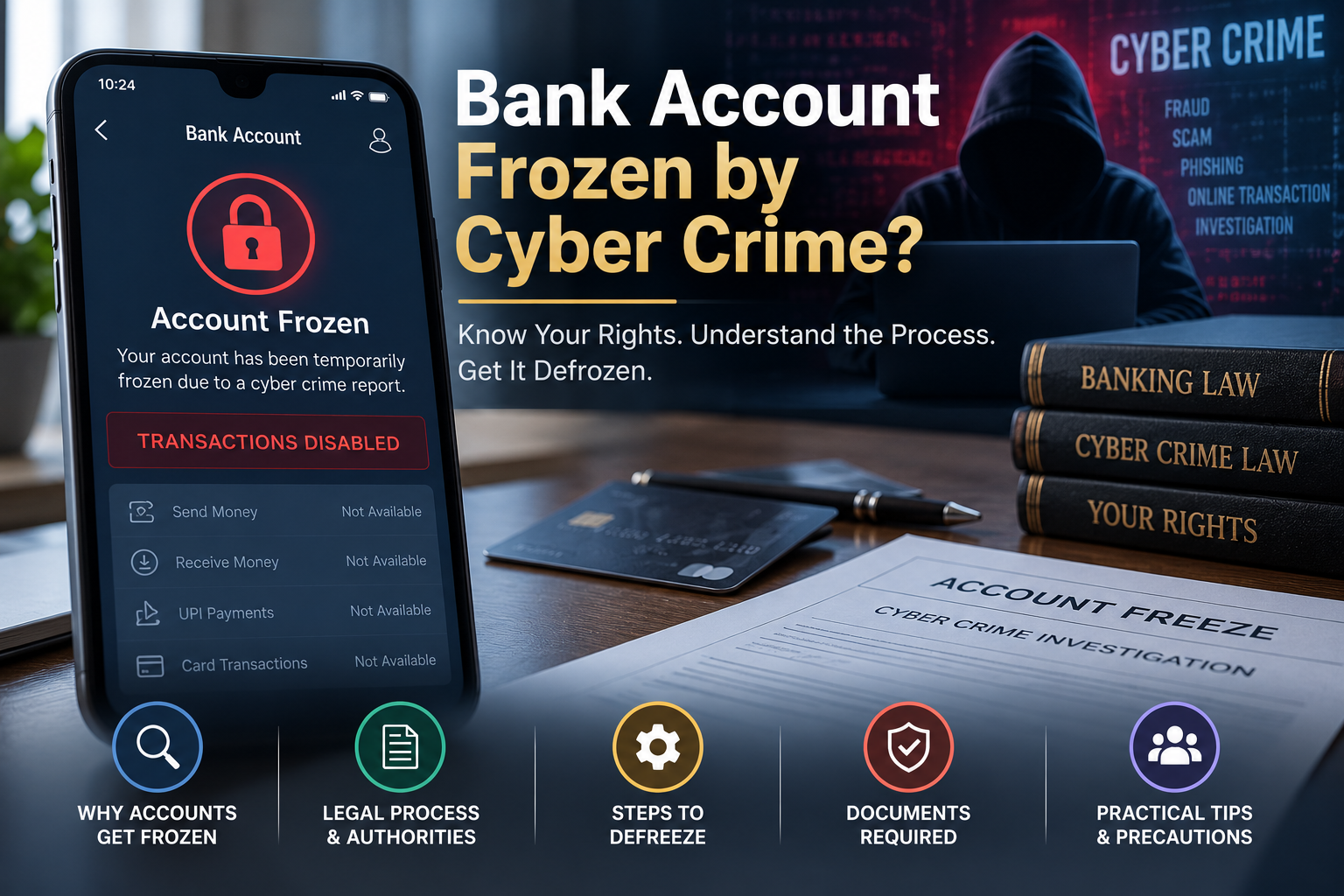
Is Your Bank Account Frozen by Cyber Crime India? [2026]
Bank Account Frozen by Cyber Crime Police? What It Means
If you discover your bank account frozen due to cyber crime, it does not automatically mean that you have committed cyber fraud or that you are even an accused in the underlying case. In many cases, the restriction arises because a transaction in your account has been identified somewhere in the money trail of an online financial-fraud complaint.
India’s Citizen Financial Cyber Fraud Reporting and Management System (CFCFRMS) enables rapid coordination between law-enforcement agencies, banks and financial intermediaries when financial cyber fraud is reported. Victims can report financial cyber fraud through the 1930 helpline and the National Cyber Crime Reporting Portal. The system is designed to help prevent suspected fraud proceeds from being moved further through the banking system. (Ministry of Home Affairs)
A typical transaction trail may look like this:
Cyber-fraud victim → First recipient account → Second account → Third account → Merchant / Business / Individual
As investigators trace the money, accounts appearing at different stages of the chain may be subjected to a lien, debit restriction or freeze. This can sometimes affect people who say they received the money through an otherwise genuine transaction and had no knowledge of the original fraud.
Recent High Court cases illustrate this problem. Courts have dealt with petitions from account holders who were not accused in the underlying cybercrime but whose accounts were restricted because an allegedly suspicious amount had passed through them. In some cases, courts have ordered the account to be made operational while keeping only the identified disputed amount blocked. (Indian Kanoon)
A Frozen Account Does Not Automatically Mean You Are an Accused
This distinction is important.
A bank account may appear in a cyber-fraud transaction trail because the account holder:
- Received payment for goods or services;
- Received money from a customer or client;
- Conducted an online marketplace transaction;
- Received a business or vendor payment; or
- Received funds from another account that had itself received allegedly fraudulent money.
The legal question is therefore not simply whether money entered the account. The account holder’s connection with the alleged offence, the source and purpose of the transaction, the amount involved and the legal basis for continuing the restriction can all become relevant.
The Punjab and Haryana High Court has observed in recent cases that innocent account holders should not be made to suffer merely because alleged proceeds of crime temporarily passed through their accounts, unless the investigation reveals complicity or conscious receipt of such funds. (Indian Kanoon)
So, if your account has been frozen, the first task is to determine why it was restricted, which transaction is under scrutiny, which authority requested the restriction and exactly how much money is disputed.
Why Has My Bank Account Been Frozen After a Cyber Crime Complaint?
A cyber crime bank account freeze often begins with a complaint concerning online financial fraud.
For example, a victim may report that Rs.1 lakh was fraudulently transferred from their account. Once the complaint is registered through the relevant cybercrime mechanism, investigators may attempt to trace where that Rs.1 lakh went.
The money may not remain in one account. It could be divided and transferred repeatedly:
Victim → Account A → Account B → Account C → Account D
By the time the transaction reaches Account C or D, the account holder may have no direct relationship with either the alleged fraudster or the original victim.
This is one reason cybercrime-related bank restrictions have generated considerable litigation.
Lien, Debit Freeze and Complete Freeze Are Not the Same
When a bank tells you that your account has been “frozen”, it is important to find out what restriction has actually been imposed.
Lien or amount-specific hold:
A particular amount is blocked. For example, if Rs.25,000 is identified as disputed, the bank may restrict that Rs.25,000 while allowing the account holder to use other available funds.
Debit freeze:
The account holder may be prevented from making outgoing transactions, even though money can remain or sometimes continue to be credited to the account.
Complete or blanket freeze:
The account effectively becomes unavailable for normal banking operations, potentially affecting funds well beyond the amount connected with the disputed transaction.
The distinction has major practical consequences.
Suppose a business account contains Rs.15 lakh, but only a Rs.20,000 transaction is identified in a cybercrime complaint. Blocking the entire account can prevent the business from paying employees, suppliers, taxes or other operating expenses even though most of the balance may have no alleged connection with the cyber fraud.
This is precisely the type of disproportionate restriction that High Courts have increasingly examined.
In a July 2026 Madhya Pradesh High Court case, for example, the disputed transaction was only Rs.980, while the petitioner’s current account contained more than Rs.2.51 crore. The Court addressed the broader problem of entire accounts being frozen where the suspicious amount represents only a small fraction of the available balance. (Indian Kanoon)
The Court’s guidelines stated that, as far as practicable, where the suspected amount can be identified, investigators should consider restricting the account only to that amount. A complete freeze was contemplated for exceptional circumstances where a partial restriction would not adequately protect the investigation, with reasons recorded. (Indian Kanoon)
This does not mean that an account holder is automatically entitled to a partial lien in every case. The appropriate restriction depends on the facts, the nature of the suspected offence, the account holder’s alleged involvement and the requirements of the investigation.
What Are Layer 1, Layer 2 and Layer 3 Bank Accounts in Cyber Crime Cases?
People dealing with a bank account lien due to cyber crime are frequently told by their bank or investigating officer that their account is at “Layer 1”, “Layer 2”, “Layer 3” or another level in the transaction chain.
The terminology essentially describes how money moved from the original disputed transaction through subsequent accounts.
A simplified example is:
Cyber-fraud victim
↓
Layer 1 account – directly receives the disputed funds
↓
Layer 2 account – receives money from Layer 1
↓
Layer 3 account – receives money from Layer 2
↓
Further downstream accounts
The deeper the layer, the further the account may be from the original victim transaction.
Being a Layer 2 or Layer 3 Account Does Not Automatically Prove Fraud
This is an important practical point.
Consider this example:
A fraudster transfers Rs.50,000 to Account A. Account A then uses Rs.15,000 to purchase legitimate goods from Business B. Business B later pays Rs.10,000 to Supplier C.
The transaction trail may therefore appear as:
Victim → A → Business B → Supplier C
Business B or Supplier C may consequently appear in the traced money trail even though they may claim to have received the funds through genuine commercial transactions.
The existence of a transaction link therefore needs to be distinguished from evidence that the downstream account holder knowingly participated in the underlying offence or consciously received proceeds of crime.
Recent High Court decisions have expressly considered situations involving account holders who were not accused in the underlying offence. Courts have stressed the importance of examining the account holder’s nexus with the alleged crime rather than mechanically continuing restrictions merely because a suspicious transaction appears in the account. (Indian Kanoon)
This is why invoices, GST records, contracts, payment receipts, delivery records, WhatsApp or email communications and other documents explaining why the money was received can become extremely important when seeking removal of a cybercrime-related bank restriction.
Can Cyber Crime Police Freeze Your Entire Bank Account?
This has become one of the most important questions in litigation involving cybercrime-related bank restrictions.
A blanket freeze can have serious consequences. A salaried person may lose access to salary and savings. A business may be unable to pay vendors, employees or statutory dues. A current account used for daily operations may become practically unusable.
Recent High Court decisions have therefore focused heavily on proportionality—particularly where the disputed cyber-fraud amount is clearly identifiable and represents only a small portion of the account balance.
Entire Account Frozen for a Small Disputed Amount
Consider this example:
Total balance: Rs.10,00,000
Amount linked to cyber complaint: Rs.25,000
The question is whether restricting the entire Rs.10 lakh is necessary when the investigation may be protected by securing Rs.25,000.
The answer cannot be stated as an absolute rule applicable to every investigation. However, several recent decisions show a clear judicial concern about indiscriminate blanket freezes.
In Archana v. State of Madhya Pradesh, decided on 27 July 2026, the Madhya Pradesh High Court dealt with an account containing more than Rs.2.51 crore where the disputed transaction was only Rs.980. The Court held that, as far as practicable, the investigating agency should identify the suspected amount and restrict only that amount. It said an entire account should ordinarily not be frozen where a lien or partial freeze can sufficiently protect the investigation. (Indian Kanoon)
Similar relief has appeared elsewhere. In Ajaypal Maan v. Union of India, the Punjab and Haryana High Court directed that the petitioner’s account be defrozen while Rs.26,450, the identified disputed amount, remained frozen. (Indian Kanoon)
Most recently, the Madhya Pradesh High Court dealt with another case in early September 2026 in which an SBI account had been blocked over approximately Rs.2.01 lakh allegedly connected with cyber fraud. The Court permitted the account to operate while directing that the disputed amount remain secured in a fixed deposit during the investigation. (The Indian Express)
The Emerging Principle: Secure What Is Necessary, Not Automatically Everything
These judgments support an increasingly important proportionality-based approach:
Identify the disputed amount → Secure the suspected funds → Examine the account holder’s connection → Avoid unnecessary restriction of unrelated funds
But this should not be misunderstood as a universal rule that cyber police can never restrict an entire account.
The Madhya Pradesh High Court’s July 2026 guidelines themselves recognise that a complete freeze may be justified in exceptional circumstances where securing only the disputed amount would not adequately safeguard the investigation. (Indian Kanoon)
The Rajasthan High Court has likewise emphasised that restraints should not continue mechanically or indefinitely and has directed authorities to distinguish between a suspected transaction, transaction-specific lien, seizure under Section 106 BNSS, and attachment of alleged proceeds of crime under Section 107 BNSS. (Indian Kanoon)
Therefore, when challenging a blanket bank account frozen due to cyber crime, the relevant questions include:
- How much money is actually disputed?
- Is that amount identifiable?
- Is the account holder an accused, suspect or merely a downstream recipient?
- Is there evidence connecting the account holder to the alleged fraud?
- Would a lien over the disputed amount adequately protect the investigation?
- What statutory power and procedure were used to impose the restriction?
These questions lead directly to the next major issue: what do Sections 106 and 107 of the BNSS actually permit, and why have High Courts drawn an important distinction between seizure and attachment of bank accounts?
Sections 106 and 107 BNSS: What Do Courts Say About Bank Account Freezing?
One of the most important legal issues in a cyber crime bank account freeze is the statutory power under which the restriction has been imposed.
Since the Bharatiya Nagarik Suraksha Sanhita, 2023 (BNSS) came into force, Sections 106 and 107 have become particularly relevant to disputes involving bank accounts and alleged proceeds of cyber fraud. However, the distinction between the two provisions is important, and recent High Court decisions have examined it closely.
What Does Section 106 BNSS Provide?
Section 106 BNSS deals with the power of police to seize certain property. Broadly, it permits a police officer to seize property alleged or suspected to have been stolen, or which is found in circumstances creating suspicion of the commission of an offence. The seizure must also be reported to the Magistrate.
The controversy is whether this power to “seize” property also permits police to direct a bank to debit-freeze or attach a customer’s bank account.
Recent judgments have questioned such an interpretation.
In a 2025 decision, the Bombay High Court held that Section 106 BNSS does not empower an investigating agency to attach or debit-freeze a bank account. The Court distinguished seizure under Section 106 from attachment of alleged proceeds of crime under Section 107.
The Delhi High Court adopted a similar approach in 2026, holding in the case before it that freezing bank accounts without following the procedure contemplated under Section 107 was not sustainable.
What Is Section 107 BNSS?
Section 107 deals more specifically with attachment, forfeiture or restoration of property believed to constitute proceeds of crime.
Importantly, it provides a judicial procedure. Where the investigating officer has reason to believe that property is derived or obtained directly or indirectly as a result of criminal activity, an application may be made to the competent Court or Magistrate for attachment.
This distinction matters because freezing access to a bank account can have effects similar to attachment.
At the same time, the position should not be oversimplified. The April 2026 SOP concerning cyber-fraud complaints, as discussed by High Courts, also contemplates action under Section 106 BNSS or other applicable laws in appropriate circumstances.
Therefore, rather than assuming that every cybercrime freeze is automatically lawful or unlawful under a particular provision, an account holder should identify:
- The provision invoked by the investigating agency;
- Whether the restriction is a transaction-specific lien, seizure, debit freeze or attachment;
- Whether the suspected amount has been identified;
- Whether the required Magistrate/Court procedure has been followed; and
- Whether the restriction is proportionate to the alleged proceeds of crime.
For anyone seeking to understand how to defreeze a bank account, establishing the precise legal basis of the restriction is often one of the first and most important steps.
What If You Are Not Accused in Cyber Fraud?
A common concern is: “My bank account has been frozen, but I have never been named as an accused. What can I do?”
This situation can arise because cyber-fraud investigations follow the movement of money, not merely the identity of the original fraudster.
For example:
Victim → Account A → Account B → Business C
If Business C legitimately sold goods to Account B and received payment, its bank account may nevertheless appear in the transaction trail.
The mere fact that money allegedly originating from cyber fraud eventually reached an account does not, by itself, establish that the account holder participated in the fraud.
Recent High Court decisions have therefore examined whether there is any material showing that a downstream recipient was actually involved in the offence or knowingly dealt with alleged proceeds of crime.
The Punjab and Haryana High Court has considered cases involving petitioners who were not accused in the underlying cybercrime and has emphasised that innocent account holders should not suffer indefinitely merely because suspected funds passed through their accounts, particularly where complicity is not shown.
Proving Why You Received the Money Is Important
If you are not an accused, documentary evidence explaining the transaction can become crucial.
For example, if Rs.75,000 entered your business account, you should ideally be able to show:
Rs.75,000 received
↓
Invoice / Purchase Order
↓
Goods or Services Supplied
↓
Delivery / Communication Records
↓
GST / Accounting Entry, where applicable
Relevant evidence may include invoices, GST records, purchase orders, contracts, delivery receipts, emails, WhatsApp conversations, marketplace records and bank statements.
The objective is to establish a legitimate commercial or personal explanation for receiving the money and to distinguish the account holder from persons allegedly involved in the original fraud.
Being not named as an accused does not automatically require the bank to defreeze the account immediately. The investigating agency may still need to trace or secure suspected proceeds. However, absence of alleged complicity, the account holder’s distance from the original fraud and the ability to identify the disputed amount can become important factors when seeking relief.
Can Only the Disputed Cyber-Fraud Amount Be Lien-Marked?
This is one of the most significant practical developments in recent bank-freezing litigation.
Suppose an account contains Rs.8 lakh, but investigators identify only Rs.40,000 as being connected with a cyber-fraud complaint.
Instead of blocking access to all Rs.8 lakh, can the authorities secure the Rs.40,000 and allow the account holder to use the remaining funds?
Recent High Court decisions show that such proportionate relief can be granted depending on the facts of the case.
Madhya Pradesh High Court: September 2026
A particularly recent example came from the Madhya Pradesh High Court on 3 September 2026.
The case concerned an SBI account affected because approximately Rs.2.01 lakh was alleged to have a connection with cyber fraud. Instead of keeping the entire account inaccessible, the Court permitted operation of the account while directing that the disputed amount be secured through a fixed deposit.
The practical result was:
Entire account restricted
↓
Rs.2.01 lakh disputed amount identified
↓
Disputed amount secured
↓
Account permitted to operate
A similar proportionality-based approach appeared in Ajaypal Maan v. Union of India, where the Punjab and Haryana High Court directed defreezing of the petitioner’s account while requiring the identified disputed amount of Rs.26,450 to remain frozen.
The Madhya Pradesh High Court’s July 2026 guidelines also stressed that, as far as practicable, where the suspected amount is identifiable, the restriction should ordinarily be limited to that amount rather than extending to the entire account.
Is a Limited Lien an Automatic Right?
No.
It would be inaccurate to suggest that every account holder can demand that the bank immediately convert a complete freeze into an amount-specific lien.
A broader restriction may potentially be justified where, for example:
- The entire balance is suspected to represent proceeds of crime;
- The account holder’s involvement itself is under investigation;
- Multiple suspicious transactions are involved;
- Funds are being rapidly transferred through multiple accounts; or
- A partial restriction would not adequately preserve the property under investigation.
The important principle emerging from recent cases is therefore proportionality, not an automatic right to defreezing.
Where only a small, clearly identifiable transaction is disputed, an account holder may have stronger grounds to request that only the disputed amount remain secured while normal operation of the account is restored.
How to Defreeze a Bank Account Frozen Due to Cyber Crime
If you want to know how to defreeze a bank account affected by a cybercrime complaint, the first step should usually be to identify the exact transaction and authority responsible for the restriction rather than immediately filing court proceedings.
The appropriate process will depend on the facts, but the following sequence provides a practical starting point.
Step 1: Ask Your Bank for the Freeze or Lien Details
Contact the bank and request available information concerning:
- The amount under lien or freeze;
- Date on which the restriction was imposed;
- NCRP/cybercrime complaint reference;
- Police station or cyber cell that issued the instruction;
- Investigating Officer’s details, where available;
- UTR/reference number of the disputed transaction; and
- Whether the restriction is an amount-specific lien, debit freeze or complete account restriction.
Do not rely only on a verbal statement that the account has been “cyber frozen”.
Step 2: Submit a Written Grievance to the Bank
The 10 April 2026 SOP concerning grievances relating to cybercrime-linked account restrictions has become particularly relevant.
In Archana v. State of Madhya Pradesh, the High Court discussed this SOP and described a structured grievance-redressal process involving banks, investigating officers and supervisory authorities.
Therefore, make the request in writing and retain proof of submission.
Step 3: Collect Documents Explaining the Disputed Transaction
Prepare evidence establishing:
- Who transferred the money;
- Why you received it;
- Whether goods or services were provided;
- Whether you knew the sender;
- Whether the transaction formed part of your normal business activity; and
- Whether you have any connection with the original cyber-fraud complainant.
Attach invoices, contracts, GST documents, delivery records, bank statements and relevant communications wherever applicable.
Step 4: Make a Representation to the Investigating Officer
Once the relevant cyber police station or Investigating Officer is identified, submit a written representation explaining the transaction.
Depending on the circumstances, request either:
Option A – Complete defreezing
Where there is no continuing justification for restricting the account.
or
Option B – Limited lien
Where the disputed amount can remain secured while the remaining account balance is released.
The second option can be particularly relevant where the disputed amount represents only a small fraction of the account balance.
Step 5: Use the Available Escalation Mechanism
If the grievance is not resolved, it may be escalated through the applicable bank/police grievance mechanism.
The Madhya Pradesh High Court’s July 2026 decision records the 2026 SOP as prescribing a structured process and timelines for dealing with grievances concerning cybercrime-related account restrictions.
These timelines should not be interpreted as guaranteeing that every bank account will be defrozen within a fixed number of days. The result depends on the investigation and facts of each case.
Step 6: Consider Judicial Remedies if the Freeze Continues
If representations do not resolve the matter, legal proceedings may become necessary.
Depending on the circumstances, relief may be sought before the appropriate Magistrate or High Court, particularly where it is alleged that:
- The entire account has been disproportionately frozen;
- The disputed amount is identifiable but unrelated funds remain blocked;
- The account holder is not an accused and no complicity is shown;
- The statutory procedure has not been followed;
- The restriction continues without adequate justification; or
- The freeze is causing serious business or livelihood consequences.
The correct forum depends on the nature of the restriction, the legal provision invoked and the procedural history of the case.
The key point is that a bank account frozen due to cyber crime should not be approached merely as a banking problem. It can involve the NCRP complaint, investigating agency, transaction trail, BNSS provisions and judicial remedies simultaneously. Identifying the precise reason for the restriction and documenting the legitimate source of the disputed transaction are therefore central to seeking effective relief.
What Documents Are Required to Defreeze a Bank Account?
When seeking removal of a cyber crime bank account freeze, documentation is often as important as the legal representation itself. The objective is to show where the disputed money came from, why it was received and whether the transaction had a legitimate commercial or personal purpose.
Depending on the circumstances, an account holder should keep the following documents ready:
- PAN, Aadhaar or other KYC documents;
- Bank statements showing the disputed transaction;
- UTR or transaction reference number;
- Copy or details of the freeze/lien communication available from the bank;
- NCRP or cybercrime complaint/reference number, if available;
- Invoices and purchase orders;
- GST invoices/returns and e-way bills, where relevant;
- Contracts or work orders;
- Proof of delivery of goods or completion of services;
- Emails, WhatsApp messages or other communications with the payer;
- Marketplace or payment-gateway records;
- Accounting entries and supporting business records; and
- Any earlier correspondence with the bank or Cyber Police.
The Madhya Pradesh High Court’s July 2026 decision in Archana v. State of Madhya Pradesh, while discussing the April 2026 SOP, specifically referred to supporting material such as KYC documents, an explanation of the disputed transaction, proof regarding the source of funds and relevant business, invoice, GST or tax records.
Prepare a Clear Transaction Explanation
Simply submitting a large bundle of documents may not be enough. The account holder should be able to explain the transaction chronologically.
For example:
Rs.85,000 received from X → Invoice No. 124 → Goods supplied → Delivery completed → Payment recorded in books/GST records
Where the account holder is a downstream recipient, the representation should also clearly state that there was no knowledge of or involvement in the alleged original cyber fraud, if that is factually correct.
The stronger the documentary trail explaining the disputed credit, the easier it becomes for the investigating authority or court to assess whether continuing a complete account restriction is necessary.
Should You Approach the Cyber Police, Magistrate or High Court?
There is no single forum that is automatically appropriate in every bank account frozen cyber crime case. The correct remedy depends on who imposed the restriction, the legal provision relied upon, the stage of investigation and whether administrative remedies have already been attempted.
First: Bank and Cyber Police
In many cases, the practical first step is to approach the bank and the investigating Cyber Police.
This route may be particularly appropriate where:
- The disputed transaction can be clearly identified;
- The account holder can explain its legitimate source;
- The account holder is not an accused;
- Only a small part of the account balance is disputed; or
- The issue may be resolved by replacing a blanket restriction with an amount-specific lien.
A written representation is preferable because it creates a record of the request and supporting documents submitted.
When Can the Magistrate Become Relevant?
The Magistrate becomes particularly important when the restriction involves the statutory procedure for seizure, attachment or release of property.
This is also where the distinction between Section 106 BNSS and Section 107 BNSS becomes significant.
As discussed earlier, recent High Court decisions have examined whether police can debit-freeze an account under Section 106 alone and have distinguished that power from the attachment procedure under Section 107, which contemplates an application to the competent Court or Magistrate.
The correct application and forum will depend on the precise nature of the police action and the proceedings already underway.
When Can You Approach the High Court?
A petition before the jurisdictional High Court may be considered where the restriction is alleged to be arbitrary, disproportionate or contrary to the statutory procedure.
Circumstances may include:
- The entire account remains frozen for a relatively small identifiable amount;
- There is no material showing the account holder’s involvement in the alleged fraud;
- The account holder is merely a downstream recipient;
- Representations to the bank and investigating agency have not resolved the matter;
- The restriction continues without adequate justification;
- The applicable statutory procedure is alleged not to have been followed; or
- The freeze is causing substantial livelihood or business hardship.
Recent High Court cases demonstrate that courts can fashion proportionate relief rather than simply choosing between keeping the entire account frozen and releasing everything. For example, courts have permitted accounts to operate while keeping the identified disputed amount secured.
However, approaching the High Court should not be presented as an automatic first step in every case. Jurisdiction, maintainability, alternative remedies and the factual record all matter.
How Long Does It Take to Defreeze a Cyber Crime Bank Account?
There is no universal period within which every cybercrime-related bank account must be defrozen.
The time required can vary significantly depending on:
- The nature and value of the alleged fraud;
- Whether the disputed transaction is clearly identifiable;
- Whether the account holder is an accused or merely a recipient;
- How many transaction layers are involved;
- Whether several cybercrime complaints are linked to the account;
- Whether different States or investigating agencies are involved;
- The quality of the documents submitted by the account holder;
- The response of the bank and Investigating Officer; and
- Whether judicial proceedings become necessary.
This is particularly important because online fraud proceeds can move rapidly through multiple accounts across different States.
What About the 2026 Grievance Timelines?
The Madhya Pradesh High Court’s July 2026 judgment discussed the 10 April 2026 SOP governing grievances concerning cybercrime-related account restrictions.
The framework recorded by the Court provides a structured grievance process. Among other things, it refers to the bank uploading the account holder’s grievance on the relevant portal within seven calendar days and the Investigating Officer thereafter considering the grievance and passing a reasoned decision within the prescribed framework, including a 15-day period discussed in the judgment.
These timelines are important because they create a more structured mechanism for affected account holders.
However, they should not be described as a guaranteed “7-day” or “15-day bank account defreeze.”
The investigation may continue, additional information may be required, or the authority may decide that some restriction remains necessary. In other cases, the account holder may need to pursue further administrative or judicial remedies.
Therefore, anyone asking how long it takes to defreeze a bank account should be cautious of agents or intermediaries promising a guaranteed release within a fixed number of days.
Common Mistakes to Avoid When Your Bank Account Is Frozen
A sudden bank freeze can cause considerable financial pressure, especially where the affected account is used for salary, business operations or daily expenses. However, hurried decisions can make the situation more difficult.
1. Ignoring the Freeze
Do not assume that the restriction will automatically disappear. Obtain the complaint, transaction and investigating-agency details available through the bank and begin the grievance process.
2. Relying Only on Verbal Communication
Phone calls with bank officials or police officers may be useful, but important requests should also be made in writing. Preserve emails, acknowledgements, complaint numbers and representations.
3. Deleting Messages or Transaction Records
Do not delete invoices, chats, emails, payment confirmations or other records connected with the disputed transaction. These documents may help demonstrate why the payment was received.
4. Giving Different Explanations to Different Authorities
The explanation provided to the bank, investigating officer and court should be factually accurate and consistent. Contradictory statements can create unnecessary complications.
5. Contacting the Original Cyber-Fraud Complainant Directly
Unless appropriately advised, attempting to pressure, persuade or privately “settle” with the complainant can create further issues. The grievance should generally be addressed through the proper bank, police and legal channels.
6. Paying Someone Who Promises an “Instant Defreeze”
Be cautious of individuals claiming that they can remove a cybercrime lien through unofficial payments or contacts. A legitimate process should involve identifiable authorities, written communications and proper legal procedure.
7. Assuming “I Am Not an Accused” Is Enough
Not being named as an accused can be highly relevant, but it does not necessarily result in immediate defreezing. The authorities may still be tracing alleged proceeds of crime.
The stronger approach is to demonstrate:
No alleged complicity + legitimate transaction + documentary proof + identifiable disputed amount + proportionate relief requested
8. Filing Proceedings Without Identifying the Actual Freeze
Before approaching a court, it is important to know whether the account is subject to a lien, debit freeze, complete freeze or attachment, the amount in dispute, the Cyber Police Station involved and, as far as ascertainable, the statutory basis for the restriction.
That information can materially affect both the appropriate legal remedy and the relief that should be sought.
Key Takeaways: Bank Account Frozen Due to Cyber Crime
A bank account frozen due to cyber crime can be extremely disruptive, but the existence of a freeze does not by itself establish that the account holder participated in the underlying fraud.
The key legal and practical points are:
- A frozen account does not automatically mean you are an accused. An account may be restricted because it appears somewhere in the transaction trail of a reported cyber fraud.
- Identify the disputed transaction first. Obtain the amount, UTR, complaint/NCRP reference, investigating agency and nature of the restriction from the bank as far as available.
- A lien and a complete debit freeze are different. Where the disputed amount can be identified, recent High Court decisions have examined whether restricting the entire account is disproportionate.
- Sections 106 and 107 BNSS must be distinguished carefully. Recent judgments have scrutinised the statutory basis and procedure used for freezing or attaching bank accounts.
- Proportionality is increasingly important. Courts have granted relief allowing accounts to operate while keeping only the identified disputed amount secured.
- Documentation matters. Invoices, GST records, contracts, bank statements and communications can help establish the legitimate purpose of a transaction.
- Court proceedings are not always the first step. Depending on the circumstances, the issue may first be taken up with the bank, Cyber Police and investigating officer through the applicable grievance process.
Most importantly, every case depends on its own facts. The amount involved, transaction layer, account holder’s alleged connection with the fraud and legal basis for the restriction can all affect the remedy available.
Conclusion
Cases involving a bank account frozen due to cyber crime highlight the need to balance two legitimate concerns: enabling law-enforcement agencies to trace and preserve suspected proceeds of online fraud while protecting innocent account holders from unnecessary or disproportionate financial restrictions.
The developing High Court jurisprudence in 2025–26 shows increasing scrutiny of blanket account freezes, particularly where the disputed amount is identifiable and represents only a fraction of the total balance. Recent decisions have also brought greater attention to the distinction between seizure under Section 106 BNSS and attachment of alleged proceeds of crime under Section 107 BNSS, including the procedural safeguards associated with such action.
For an affected account holder, the first priority should be to identify the disputed transaction and investigating agency, preserve supporting records and submit a properly documented representation. Where appropriate, relief may involve complete defreezing or allowing the account to operate while keeping only the disputed amount secured.
If administrative remedies do not resolve the issue, the legality, proportionality and continuation of the restriction may be examined before the appropriate court.
Frequently Asked Questions
1. Can Cyber Crime Police freeze my bank account if I am not an accused?
An account may be restricted during a cyber-fraud investigation even where the account holder has not been named as an accused, particularly if suspected funds are traced to that account.
However, being part of a transaction trail is not the same as being proved to have participated in the fraud. The account holder’s connection with the alleged offence, purpose of the transaction and supporting documents can become important when seeking defreezing or modification of the restriction.
Recent High Court decisions have considered the hardship caused to downstream account holders where there was no demonstrated complicity in the underlying offence.
2. Can the entire bank account be frozen for one disputed transaction?
This depends on the circumstances. A complete freeze may be considered necessary in some investigations, but it should not be assumed that the entire balance must always remain blocked simply because one disputed transaction entered the account.
Recent High Court decisions have applied principles of proportionality, particularly where the disputed amount is clearly identifiable. Courts have, in appropriate cases, allowed the account to operate while keeping only the disputed amount secured.
The Madhya Pradesh High Court’s September 2026 decision is a recent example of this approach, permitting operation of the account while approximately Rs.2.01 lakh connected with the alleged cyber fraud remained secured.
3. What is a cyber crime lien on a bank account?
A bank account lien in a cyber crime matter generally means that a specified amount in the account has been placed on hold or restricted because it has been linked to a disputed transaction.
For example, if an account contains Rs.5 lakh but Rs.30,000 is identified in the cyber-fraud transaction trail, a Rs.30,000 lien may prevent that amount from being withdrawn or transferred while leaving the remainder available, depending on the restriction imposed.
A lien should therefore be distinguished from a complete debit freeze of the account.
4. What does Layer 1, Layer 2 or Layer 3 mean in a cybercrime transaction?
These terms describe the movement of suspected funds through successive accounts.
A simplified chain could be:
Victim → Layer 1 → Layer 2 → Layer 3 → Further recipient
An account further down the transaction chain may have received funds indirectly rather than directly from the original victim. The layer by itself does not establish whether the account holder knowingly participated in the fraud.
5. How can I remove a cyber crime lien from my bank account?
If you are researching how to defreeze a bank account, begin by obtaining the details of the restriction from your bank.
Identify:
- The disputed amount and transaction;
- UTR/reference number;
- NCRP/cybercrime complaint details;
- Cyber Police Station or investigating agency;
- Nature of the restriction; and
- Investigating Officer’s details, where available.
You can then submit a written grievance supported by documents explaining the transaction. Depending on the circumstances, a representation may seek complete removal of the restriction or limitation of the lien to the disputed amount.
If the matter is not resolved through the bank and investigating agency, appropriate judicial remedies may be considered.
6. How long does it take to defreeze a cyber crime bank account?
There is no fixed period that applies to every case.
The time required depends on the investigation, number of complaints, transaction layers, agencies involved, documentation supplied and whether court proceedings become necessary.
Although the 2026 grievance framework discussed by the Madhya Pradesh High Court contains timelines for different stages of grievance processing, these should not be interpreted as guaranteeing that every account will be defrozen within seven, fifteen or any other fixed number of days.
7. Can I approach the High Court to defreeze my bank account?
Yes, a High Court may be approached in an appropriate case, subject to jurisdiction, maintainability and the facts involved.
High Court intervention may be sought where, for example, a restriction is alleged to be disproportionate or procedurally unlawful, unrelated funds remain blocked despite an identifiable disputed amount, or representations to the authorities have failed to resolve the issue.
However, a High Court petition is not necessarily the first or correct remedy in every case. The appropriate route should be determined after identifying the nature and legal basis of the restriction.
Disclaimer
This article is intended for general information and educational purposes only and does not constitute legal advice. Cybercrime-related bank account restrictions depend on the facts of each case, the nature of the alleged transaction, the investigating agency, applicable statutory provisions and judicial orders. The law and procedural mechanisms may also continue to develop. Persons affected by a bank account freeze should obtain advice based on the specific facts and documents of their case.

Advocate Sarosh Damania is the founder of Sarosh Damania & Co., a premier law firm based in Mumbai, recognized for its exceptional legal services to corporations, individuals, and international clients worldwide. With a rich blend of experience and expertise, Adv. Damania and his team specialize in a wide array of legal disciplines, including Civil Law, Criminal Law, Aviation Law, Arbitration, Consumer Law, RERA, Company Law, Succession Law, Wills, Intellectual Property Law, Property Law, Housing Society Law, Debt Recovery, and Banking Law.