Can Builders Cancel Flat Allotments for Delayed Payments? Legal Rights of Homebuyers Under RERA & Consumer Law
In the ever-expanding real estate market of India, disputes between homebuyers and builders have become increasingly common, particularly in metropolitan cities such as Mumbai, where property prices continue to escalate exponentially.
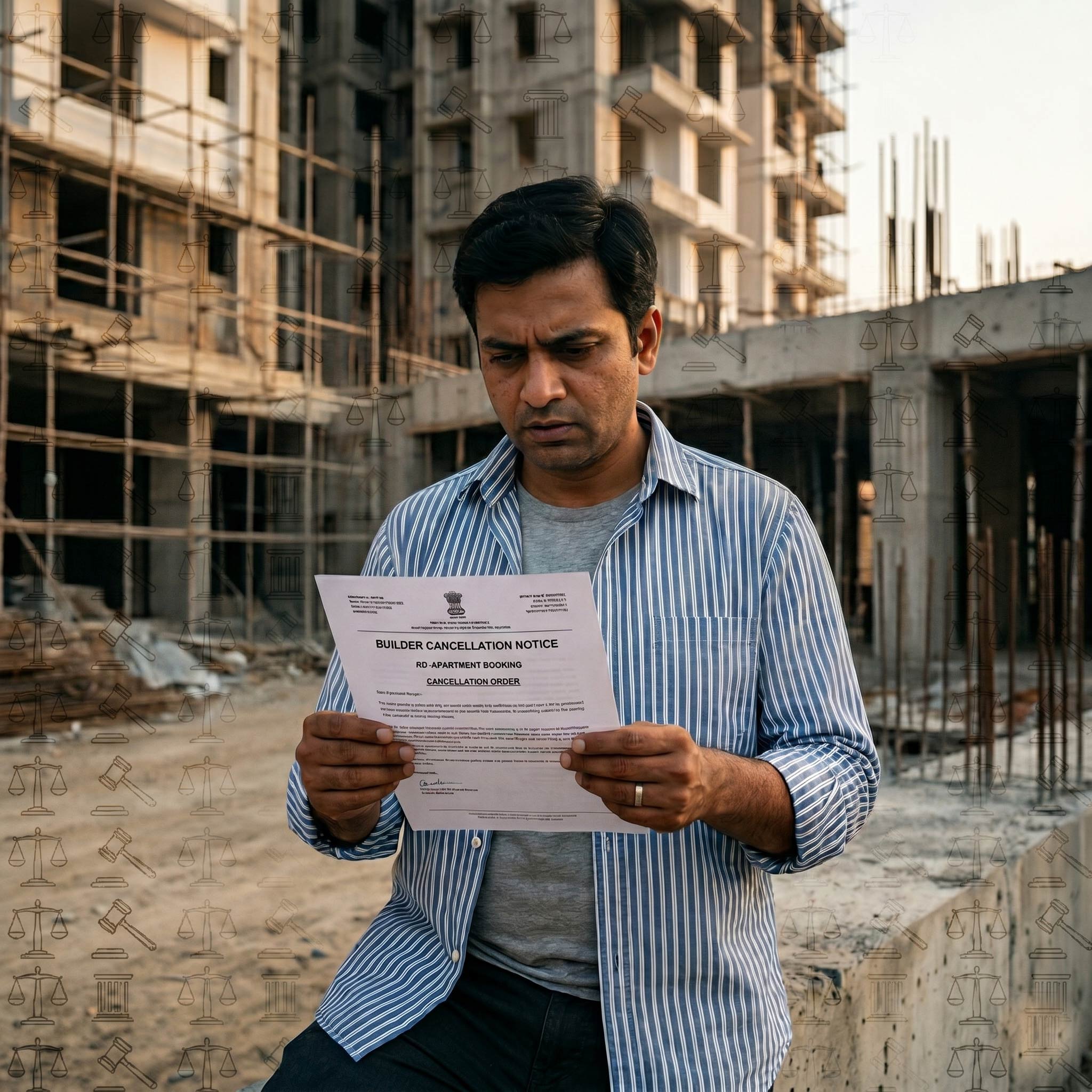
One of the most frequently arising disputes pertains to the unilateral cancellation of flat allotments by builders and developers on the alleged ground of delayed payment of instalments by purchasers.
Across India, purchasers dealing with leading real estate developers including:
- Lodha Group
- Godrej Properties
- Oberoi Realty
- Runwal Group
- Rustomjee
- Kalpataru Group
- Hiranandani Group
- Shapoorji Pallonji Real Estate
- Piramal Realty
- Mahindra Lifespaces
- Prestige Group
- DLF Limited
- Raheja Universal
- Arkade Developers
- Ajmera Realty
are frequently confronted with:
- arbitrary cancellation notices;
- coercive demand letters;
- illegal forfeiture of booking amounts;
- unilateral termination of allotments;
- refusal to refund monies;
- exorbitant interest demands;
- one-sided contractual clauses heavily favouring builders.
A recurring legal question therefore arises:
Whether a builder can legally cancel a flat allotment merely because there has been a delay in payment by the purchaser?
The answer, in law, is neither automatic nor absolute.
The legal position emerging from judicial precedents, consumer jurisprudence, RERA authorities, and High Court decisions clearly establishes that:
builders and developers cannot act arbitrarily, unfairly, oppressively, or in a manner contrary to settled principles of equity and natural justice while dealing with homebuyers.
This article seeks to analyse in detail:
- the legal rights of homebuyers;
- powers of builders;
- legality of cancellation clauses;
- forfeiture of booking amounts;
- RERA remedies;
- Consumer Court remedies;
- Bombay High Court jurisprudence;
- legal protections available against arbitrary builder action.
Prepared by:
Sarosh Damania & Co. – Advocates, Bombay High Court
STATUTORY FRAMEWORK GOVERNING BUILDER–PURCHASER DISPUTES
Disputes between builders and homebuyers are governed by a combination of statutory enactments, contractual principles, regulatory frameworks, and judicial precedents.
The principal legal framework includes:
I. REAL ESTATE (REGULATION AND DEVELOPMENT) ACT, 2016 (“RERA”)
The enactment of the Real Estate (Regulation and Development) Act, 2016 marked a watershed moment in Indian real estate jurisprudence.
The object and purpose of RERA is inter alia:
- to regulate the real estate sector;
- ensure transparency;
- protect homebuyers;
- prevent exploitation by developers;
- ensure timely completion of projects;
- regulate builder conduct.
In the State of Maharashtra, disputes are adjudicated by MahaRERA.
RERA has significantly curtailed arbitrary practices previously adopted by builders and developers.
II. CONSUMER PROTECTION ACT, 2019
It is now well settled that a homebuyer constitutes a “consumer” under the Consumer Protection Act, 2019.
Builders and developers may therefore be proceeded against for:
- deficiency in service;
- unfair trade practices;
- arbitrary cancellation;
- failure to hand over possession;
- illegal forfeiture;
- misrepresentation;
- oppressive contractual conduct.
Consumer Fora across India, including the Hon’ble National Consumer Disputes Redressal Commission (“NCDRC”), have repeatedly granted relief in favour of homebuyers against arbitrary builder conduct.
III. INDIAN CONTRACT ACT, 1872
Builder–buyer agreements are contractual in nature. However, Indian courts have repeatedly held that contractual clauses cannot be enforced mechanically where:
- the clauses are unconscionable;
- the terms are one-sided;
- bargaining power is unequal;
- the conduct of the builder is oppressive or arbitrary.
The doctrine of fairness, equity, reasonableness, and proportionality increasingly governs modern real estate disputes.
IV. MAHARASHTRA OWNERSHIP FLATS ACT, 1963 (“MOFA”)
In Maharashtra, builders are additionally governed by MOFA which imposes statutory obligations concerning:
- disclosures;
- agreements;
- sanctioned plans;
- possession obligations;
- conveyance;
- transparency towards flat purchasers.
WHETHER BUILDERS HAVE ABSOLUTE POWER TO CANCEL ALLOTMENTS?
Most builder-buyer agreements contain clauses permitting cancellation in the event of:
- non-payment of instalments;
- delayed payments;
- default in payment schedules;
- loan disbursement failures.
However, the mere existence of such a clause does not confer unfettered or arbitrary powers upon the builder.
Indian courts have repeatedly held that:
contractual powers must be exercised reasonably, bona fide, proportionately, and in accordance with principles of natural justice.
Accordingly:
a builder cannot mechanically terminate allotments merely to profiteer from rising market prices or to victimise purchasers.
FACTORS EXAMINED BY COURTS AND RERA AUTHORITIES
While adjudicating cancellation disputes, courts and authorities typically examine:
(i) Nature and extent of purchaser delay;
(ii) Whether delay was intentional or bona fide;
(iii) Conduct of the builder;
(iv) Stage of construction;
(v) Delay attributable to builder himself;
(vi) Whether proper notices were issued;
(vii) Whether purchaser had substantially complied with obligations;
(viii) Whether cancellation was disproportionate or arbitrary;
(ix) Whether the builder suffered actual prejudice;
(x) Whether cancellation was motivated by escalation in property prices.
BUILDERS CANNOT TAKE ADVANTAGE OF THEIR OWN WRONG
A builder who himself delays:
- construction;
- possession;
- approvals;
- occupation certificate;
- project completion;
cannot ordinarily seek to penalize purchasers for delayed instalments.
This principle has repeatedly been recognized by courts and consumer fora.
It is common in India for builders to:
- delay projects for years;
- alter sanctioned plans;
- fail to obtain approvals;
- delay occupation certificates;
- raise illegal or inflated demands;
and thereafter issue cancellation notices to purchasers.
Such conduct has repeatedly been deprecated by courts.
ILLEGAL FORFEITURE OF BOOKING AMOUNTS
Builders frequently attempt to:
- forfeit earnest money;
- deduct exorbitant cancellation charges;
- retain substantial sums already paid by purchasers.
However, forfeiture clauses are not automatically enforceable merely because they exist in agreements.
Courts frequently examine:
- whether actual loss has been suffered;
- whether forfeiture is penal in nature;
- whether the clause is unconscionable;
- whether the amount forfeited is disproportionate.
Arbitrary forfeiture may constitute:
- unfair trade practice;
- deficiency in service;
- unjust enrichment.
WHETHER A HOMEBUYER CAN SEEK RESTORATION OF ALLOTMENT?
Yes.
Depending upon facts and circumstances, purchasers may seek:
- restoration of allotment;
- injunction against cancellation;
- stay against resale;
- refund with interest;
- compensation;
- specific performance.
Such proceedings may be initiated before:
- MahaRERA;
- Consumer Commissions;
- Civil Courts;
- High Courts.
DELAYED HOME LOAN DISBURSEMENT – LEGAL POSITION
In numerous instances, delayed payments occur due to:
- bank processing delays;
- technical deficiencies;
- pending approvals;
- incomplete builder documentation;
- title-related issues.
Builders frequently attempt to hold purchasers solely responsible despite deficiencies attributable to the project itself.
Where delayed disbursement arises due to builder lapses, arbitrary cancellation may become legally unsustainable.
WHETHER BUILDERS CAN RESELL THE FLAT AFTER CANCELLATION?
A frequent concern amongst purchasers pertains to builders attempting to:
- cancel allotments;
- re-market the same flats;
- resell units at substantially escalated prices.
Courts carefully scrutinize whether:
- cancellation was bona fide;
- adequate opportunity was granted;
- builder acted fairly;
- resale was motivated purely by commercial profiteering.
CONSUMER COURT REMEDIES AGAINST BUILDERS
Consumer Commissions across India have consistently granted reliefs including:
- refund with interest;
- compensation for mental agony;
- litigation costs;
- possession reliefs;
- injunctions against cancellation.
Homebuyers are increasingly obtaining substantial reliefs against arbitrary builder conduct.
EMERGING JUDICIAL TREND IN INDIA
The judicial trend in India increasingly recognises that:
homebuyers are not speculative investors but consumers entitled to legal protection.
Courts are increasingly striking down:
- oppressive contractual clauses;
- arbitrary cancellation notices;
- one-sided builder agreements;
- excessive forfeiture provisions.
The era of unchecked builder dominance is gradually witnessing judicial correction.
IMPORTANT STEPS FOR HOMEBUYERS
Upon receipt of a cancellation notice, purchasers should immediately:
- preserve all emails and notices;
- review contractual documentation;
- preserve payment proofs;
- maintain loan correspondence;
- avoid signing coercive undertakings;
- seek immediate legal advice.
Failure to act promptly may prejudice legal remedies.
WHY PROFESSIONAL LEGAL ASSISTANCE IS CRITICAL
Builder disputes involve:
- complex contractual interpretation;
- technical legal issues;
- substantial financial exposure;
- evolving RERA jurisprudence.
Professional legal assistance helps:
- challenge arbitrary cancellation;
- seek injunctions;
- protect investments;
- initiate RERA proceedings;
- pursue consumer litigation;
- negotiate favourable settlements.
HOW Sarosh Damania & Co. ASSISTS HOMEBUYERS
Sarosh Damania & Co. regularly represents:
- homebuyers;
- societies;
- redevelopment occupants;
- NRI purchasers;
- investors;
- commercial purchasers.
The Firm handles disputes involving:
- arbitrary cancellation;
- delayed possession;
- RERA litigation;
- redevelopment disputes;
- illegal forfeiture;
- refund claims;
- consumer litigation;
- Bombay High Court proceedings.
The Firm appears before:
- MahaRERA;
- Consumer Commissions;
- Civil Courts;
- Bombay High Court.
CONCLUSION
The law does not permit builders and developers to act arbitrarily merely because a purchaser has delayed payment of certain instalments.
The rights of builders are not absolute and remain subject to:
- fairness;
- proportionality;
- contractual reasonableness;
- statutory protections;
- judicial scrutiny.
Homebuyers facing:
- cancellation notices;
- forfeiture threats;
- illegal demands;
- delayed possession;
- arbitrary builder conduct;
must immediately evaluate their legal remedies.
For legal assistance in builder disputes, RERA litigation, redevelopment disputes, allotment cancellation matters, consumer complaints, or real estate litigation, contact:
Sarosh Damania & Co. – Advocates, Bombay High Court
Practice Areas:
- RERA Litigation
- Builder Disputes
- Consumer Litigation
- Redevelopment Disputes
- Real Estate Litigation
- Bombay High Court Litigation
Office:
Mumbai
Website:
Frequently Asked Questions (FAQs)
Can a builder legally cancel a flat allotment for delayed payment?
Not automatically. Courts and RERA authorities examine fairness, proportionality, and builder conduct before upholding cancellation.
Can builders forfeit booking amounts?
Only reasonable forfeiture may be allowed. Arbitrary or excessive forfeiture can be challenged legally.
Can a buyer seek restoration of allotment?
Yes. Buyers may seek restoration, injunctions, refunds, or compensation before MahaRERA or Consumer Courts.
What if delay happened due to home loan issues?
If delays are linked to builder deficiencies or approval problems, cancellation may be legally unsustainable.
Can a builder resell the flat after cancellation?
Courts examine whether the cancellation was genuine or motivated by higher resale profits.

Advocate Sarosh Damania is the founder of Sarosh Damania & Co., a premier law firm based in Mumbai, recognized for its exceptional legal services to corporations, individuals, and international clients worldwide. With a rich blend of experience and expertise, Adv. Damania and his team specialize in a wide array of legal disciplines, including Civil Law, Criminal Law, Aviation Law, Arbitration, Consumer Law, RERA, Company Law, Succession Law, Wills, Intellectual Property Law, Property Law, Housing Society Law, Debt Recovery, and Banking Law.