
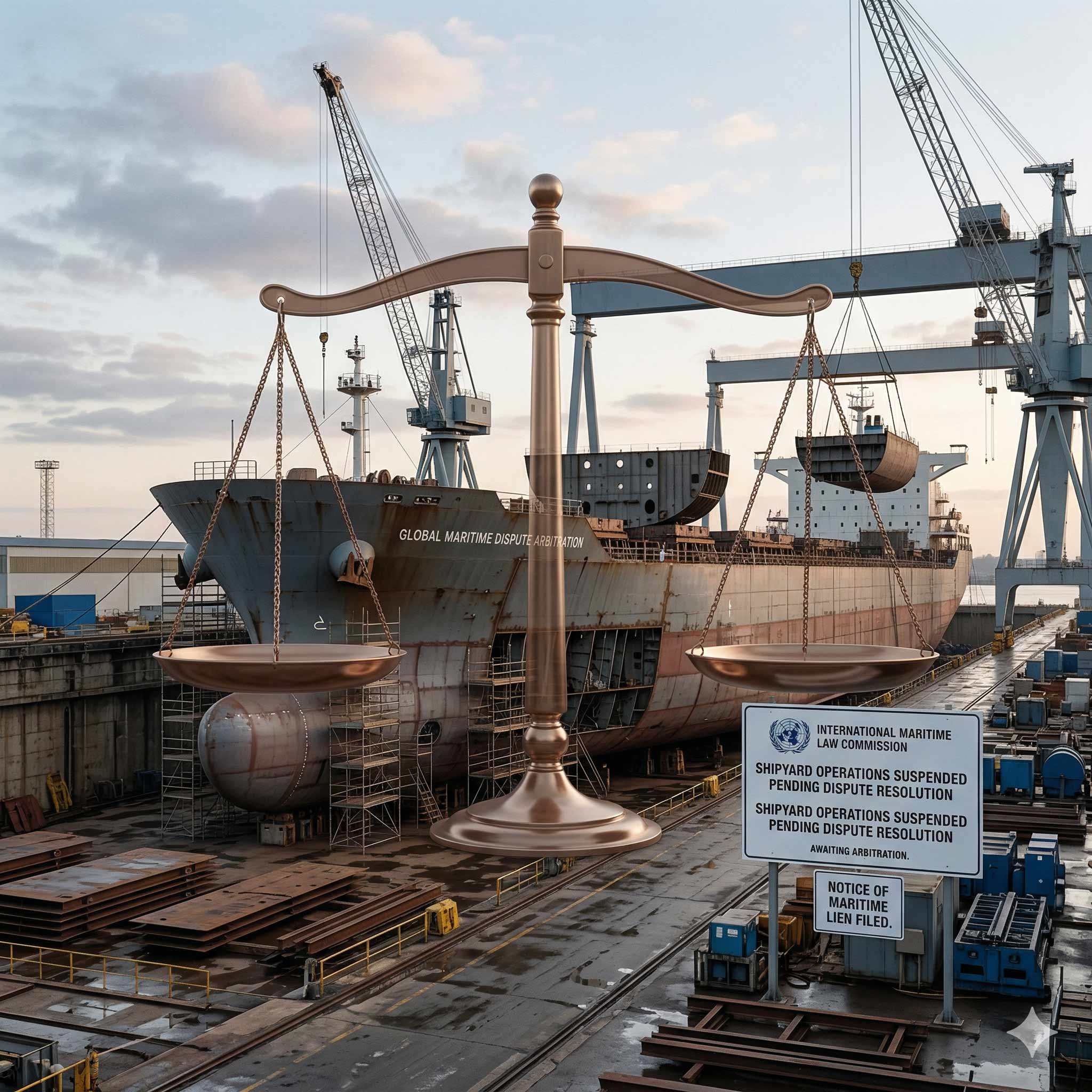
Shipbuilding Contract Disputes in India: Delay, Cost Escalation & Barge Detention – A Complete Legal Guide
India’s emergence as a significant player in the global shipbuilding and offshore engineering ecosystem has led to a substantial increase in high-value commercial contracts between shipyards, contractors, and international project owners. However, alongside this growth, there has been a parallel rise in complex disputes arising out of such contracts. These disputes are rarely straightforward. They involve multiple layers of technical, financial, and legal issues, often compounded by tight project timelines and pressure from end clients such as oil and gas companies or infrastructure developers.
Among the most pressing and commercially disruptive issues faced by contractors today are delays in vessel construction, disputes over escalation and variation claims, and, most critically, the refusal by shipyards to release barges or vessels despite substantial payments having been made. These situations place contractors in an extremely vulnerable position, where legal intervention becomes not only necessary but urgent. This article seeks to provide a comprehensive legal perspective on such disputes and outlines the most effective remedies available under Indian law.
1. Understanding Shipbuilding Contracts: Legal Character and Risk Allocation
Shipbuilding contracts are inherently complex and do not fall neatly within a single legal category. They are hybrid agreements that incorporate elements of a contract for sale, a works contract, and an engineering-procurement-construction (EPC) arrangement. This hybrid nature itself becomes a source of disputes, particularly when parties attempt to interpret obligations in a manner favourable to their commercial interests.
Typically, such contracts include detailed technical specifications, phased payment schedules linked to construction milestones, delivery timelines with provisions for liquidated damages, inspection and certification protocols, and dispute resolution mechanisms, most often arbitration. However, despite the presence of these clauses, disputes arise not because the contract is silent, but because of ambiguity in drafting, inconsistent conduct by parties, and commercial pressures that lead to deviations from agreed terms.
In practice, risk allocation under these contracts is often heavily negotiated, but not always clearly recorded. Issues such as who bears the risk of delay, how variations are to be approved, and under what circumstances a shipyard may exercise lien over the vessel are frequently left open to interpretation. It is this ambiguity that ultimately forms the foundation of most shipbuilding disputes.
2. Delay in Delivery: When It Becomes a Fundamental Breach
Delay in delivery is perhaps the most common and contentious issue in shipbuilding contracts. While some degree of delay may be anticipated in large-scale engineering projects, the law distinguishes between excusable and inexcusable delays. A delay becomes legally actionable when it exceeds the agreed contractual timeline without justification, particularly where it is not attributable to force majeure events or actions of the contractor.
From a legal standpoint, the key question is whether the delay strikes at the root of the contract. Where time is of the essence, and the delay significantly impacts the commercial viability of the project, it may be treated as a fundamental breach, entitling the aggrieved party to terminate the contract and claim damages.
Shipyards often attempt to justify delays by citing factors such as design changes, delayed payments, or supply chain disruptions. However, such defenses must be supported by clear contractual provisions and contemporaneous documentation. Indian courts and arbitral tribunals have increasingly adopted a strict approach, particularly in commercial contracts, recognising that delays in infrastructure and offshore projects can have cascading financial consequences.
In such cases, the contractor is entitled not only to liquidated damages, where provided, but also to claim actual losses, including loss of profits and additional costs incurred due to delay.
3. Cost Escalation and Variation Disputes
Another frequent source of conflict is the issue of cost escalation and variation claims. Shipyards often raise additional invoices during the course of construction, alleging changes in scope, increase in material costs, or additional work undertaken beyond the original contract.
While variation clauses are standard in such agreements, they typically require a defined process involving prior approval, documentation, and agreement on pricing. In the absence of compliance with this mechanism, unilateral claims for escalation are legally unsustainable.
Despite this, shipyards frequently use such claims as leverage, refusing to proceed with construction or withholding delivery until payments are made. From a legal perspective, this conduct is problematic. Disputed claims must be resolved through the contractual dispute resolution process and cannot be enforced through coercive means such as detention of the vessel.
The law is clear that a party cannot take advantage of its own breach or use possession of the asset as a tool to compel payment of disputed amounts.
4. Barge Detention: The Most Aggressive Pressure Tactic
The refusal to release a barge or vessel is arguably the most serious and commercially damaging action taken by a shipyard. In many cases, the contractor may have already paid a substantial portion if not the entirety of the contract value, yet the vessel remains in the physical control of the shipyard.
This detention is often justified on the basis of alleged outstanding dues or unresolved disputes. However, unless the contract expressly provides for a lien, and such lien is exercised in a lawful and proportionate manner, the detention is unlikely to be legally defensible.
Wrongful detention of a vessel amounts to a breach of contract and may also constitute wrongful possession. It disrupts the contractor’s ability to deploy the vessel, leading to loss of revenue, breach of downstream contracts, and reputational damage.
From a strategic standpoint, such detention is often used as a pressure tactic to force settlement. However, Indian courts have shown a clear willingness to intervene in such cases, particularly where the balance of convenience lies in favour of the contractor.
5. Immediate Legal Strategy: Securing Release of the Barge
In situations involving barge detention, time is of the essence. The most effective legal remedy available is an application under Section 9 of the Arbitration and Conciliation Act, 1996, which allows a party to seek interim measures from the court before or during arbitration.
Through such an application, the contractor can seek immediate release of the barge, restrain the shipyard from creating third-party rights, and, in appropriate cases, seek the appointment of a court receiver. The objective is to preserve the asset and prevent further commercial loss.
Indian courts have consistently granted such relief where the applicant is able to demonstrate a strong prima facie case, balance of convenience, and irreparable harm. In urgent matters, courts have been known to pass orders within a short span, recognising the commercial urgency involved.
In addition to Section 9, parties may also consider invoking the admiralty jurisdiction of High Courts, particularly where maritime considerations are involved. This provides an additional layer of legal protection and strategic leverage.
Once interim relief is secured, the substantive dispute is typically referred to arbitration, where detailed claims and counterclaims are adjudicated.
6. Strategic Errors That We Frequently Encounter
In advising clients on shipbuilding disputes, one recurring theme is that many disputes escalate due to avoidable strategic errors. Contractors often continue making payments despite clear indications of breach, without recording their objections or reserving their rights. This conduct can later be interpreted as acquiescence.
Another common issue is the failure to maintain proper documentation. In complex projects, contemporaneous records of communication, progress reports, and approvals are critical. Without such evidence, even a strong legal case may become difficult to establish.
Perhaps the most significant mistake is delay in taking legal action. Parties often attempt prolonged negotiations in the hope of an amicable resolution, during which time their position weakens. By the time legal proceedings are initiated, the commercial damage may already be substantial.
7. Contract Drafting: The First Line of Defence
Many of these disputes can be mitigated or even avoided through careful contract drafting. A well-drafted shipbuilding contract should clearly define delivery timelines and consequences of delay, including liquidated damages. It should set out a robust mechanism for approval of variations, leaving no scope for unilateral claims.
Equally important is the treatment of lien rights. The contract must explicitly state whether the shipyard has any right to retain possession of the vessel and, if so, under what conditions. In many cases, contractors may negotiate for a “no lien” clause or restrict such rights significantly.
The dispute resolution clause should also be carefully structured, ensuring that parties have access to interim relief and a neutral forum for adjudication.
8. Cross-Border Considerations for International Clients
For foreign contractors engaging with Indian shipyards, additional considerations come into play. It is essential to ensure that the contract provides for arbitration seated in India, with clear governing law provisions. This facilitates access to interim relief from Indian courts.
Foreign parties must also be mindful of maintaining a clear documentary trail, particularly in relation to payments and approvals. Indian courts are generally supportive of commercial claims, but the burden of proof remains on the party asserting its rights.
Importantly, India’s legal framework has evolved significantly, with courts adopting a pro-arbitration and commercially pragmatic approach. This makes India a viable and effective jurisdiction for enforcement of contractual rights.
9. Conclusion
Shipbuilding disputes, particularly those involving delay and barge detention, require a combination of legal expertise and strategic execution. The key lies in acting swiftly, preserving evidence, and leveraging the legal remedies available under Indian law.
With the right approach, it is entirely possible to secure immediate release of the vessel, protect commercial interests, and recover substantial damages. However, delay in action can significantly undermine these outcomes.
Frequently Asked Questions (FAQ) – Shipbuilding & Barge Disputes
1. Can a shipyard detain my barge for unpaid dues?
A shipyard can only detain a vessel if the contract expressly provides for such a right. Even then, the exercise of lien must be lawful, proportionate, and in good faith. Arbitrary detention is legally challengeable.
2. What is the fastest way to secure release of a detained barge?
The most effective remedy is filing a petition under Section 9 of the Arbitration and Conciliation Act, seeking immediate interim relief from the court.
3. Can I claim damages for delay in delivery?
Yes, provided the delay is unjustified. Claims may include loss of profits, additional costs, and other consequential damages.
4. What if the shipyard raises inflated or disputed claims?
Such claims must be resolved through arbitration. They do not justify withholding delivery of the vessel.
5. How important is documentation in such disputes?
Documentation is critical. Courts and tribunals rely heavily on contemporaneous records to determine the rights of parties.
6. Can foreign companies enforce their rights in India?
Yes. Indian courts recognise and enforce the rights of foreign parties in commercial disputes, particularly where arbitration clauses exist.
7. What is the biggest mistake contractors make?
The most common mistake is delaying legal action, which weakens their position and increases financial exposure.

Advocate Sarosh Damania is the founder of Sarosh Damania & Co., a premier law firm based in Mumbai, recognized for its exceptional legal services to corporations, individuals, and international clients worldwide. With a rich blend of experience and expertise, Adv. Damania and his team specialize in a wide array of legal disciplines, including Civil Law, Criminal Law, Aviation Law, Arbitration, Consumer Law, RERA, Company Law, Succession Law, Wills, Intellectual Property Law, Property Law, Housing Society Law, Debt Recovery, and Banking Law.