
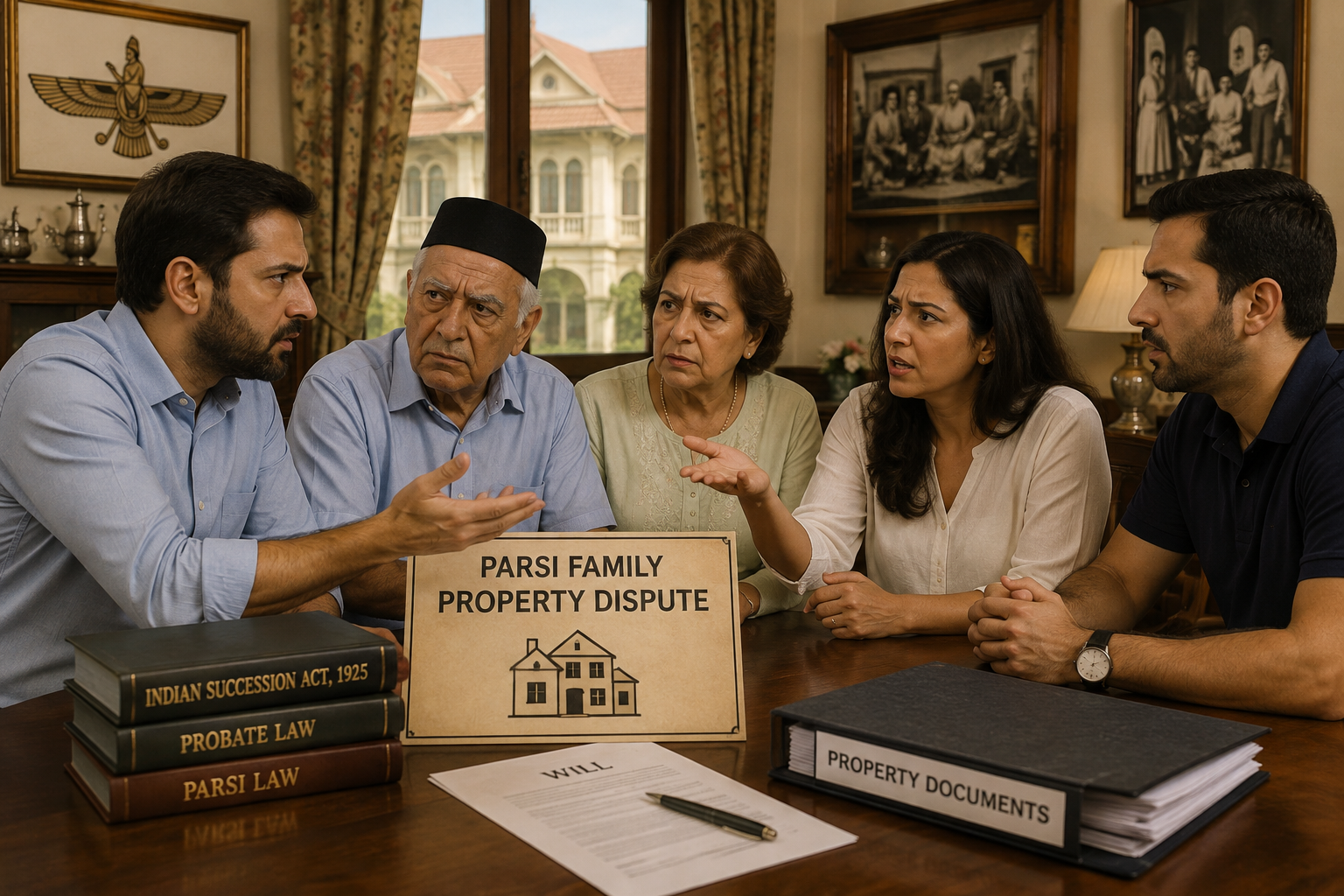
Parsi Succession & Property Disputes in India: Legal Rights Every Parsi Family Must Know
Detailed Legal Analysis on Parsi Inheritance, Probate Proceedings, Family Settlements, Redevelopment Disputes & Testamentary Litigation in India
By Adv. Sarosh Damania
Sarosh Damania & Co. – Advocates, Bombay High Court
INTRODUCTORY OVERVIEW
The Parsi community in India, though numerically small, has historically contributed immensely towards the commercial, industrial, legal, philanthropic, aviation, hospitality, and constitutional development of the country.
The legacy of the Parsi community is deeply intertwined with the growth of modern India through iconic personalities and institutions associated with:
- Jamsetji Tata
- J. R. D. Tata
- Ratan Tata
- Adi Godrej
- Nusli Wadia
- Pallonji Mistry
- Cyrus Mistry
- Field Marshal Sam Manekshaw
- Zubin Mehta
- Boman Irani
- Freddie Mercury
The legal fraternity in India has also witnessed towering Parsi legal luminaries including:
- Nani Palkhivala
- Fali S. Nariman
- Soli J. Sorabjee
- Rohinton Fali Nariman
- Darius Khambata
- Aspi Chinoy
- Janak Dwarkadas
- Zal Andhyarujina
- Karl Tamboly
- Percy Kavina
- A. D. Shroff
- Adv. Sarosh Damania
A substantial portion of the Parsi community continues to reside in:
- Mumbai
- Pune
- Surat
- Navsari
- Udvada
As property values in metropolitan cities such as Mumbai have escalated dramatically, disputes involving:
- inheritance;
- probate;
- succession;
- redevelopment;
- co-operative housing societies;
- family settlements;
- testamentary disputes;
- nomination disputes;
- Parsi matrimonial litigation;
have increased substantially.
A recurring legal question therefore arises:
What are the legal rights of Parsis concerning inheritance, succession, probate, Wills, redevelopment rights, and family property disputes in India?
This article seeks to provide a detailed legal analysis concerning:
- Parsi succession law;
- probate proceedings;
- inheritance rights;
- redevelopment disputes;
- nomination vs succession;
- testamentary litigation;
- co-operative housing disputes;
- Parsi matrimonial law;
- legal remedies available to Parsi families.
Prepared by:
Sarosh Damania & Co. – Advocates, Bombay High Court
PARSI SUCCESSION LAW IN INDIA
Succession amongst Parsis in India is primarily governed by:
Indian Succession Act, 1925
The Indian Succession Act contains specific provisions dealing with:
- intestate succession;
- testamentary succession;
- probate;
- administration of estates;
- inheritance rights of Parsis.
Parsi succession law in India differs materially from:
- Hindu succession law;
- Muslim personal law;
- Christian succession law.
WHAT HAPPENS IF A PARSI DIES WITHOUT A WILL?
Where a Parsi dies intestate, i.e., without leaving a valid Will:
succession devolves as per the intestate succession provisions under the Indian Succession Act.
The estate may devolve upon:
- spouse;
- children;
- parents;
- widow/widower;
- lineal descendants;
- statutory heirs prescribed under law.
Disputes frequently arise where:
- multiple heirs exist;
- old family arrangements are relied upon;
- redevelopment compensation becomes substantial;
- nomination conflicts arise.
WHETHER PARSI DAUGHTERS HAVE EQUAL INHERITANCE RIGHTS
Yes.
Parsi daughters possess inheritance rights under Indian law.
Modern courts increasingly recognize:
- constitutional equality principles;
- rights of female heirs;
- protection against discriminatory succession practices.
Disputes frequently arise where:
- male heirs seek exclusive control;
- oral understandings are alleged;
- old family customs are relied upon;
- redevelopment benefits are substantial.
PROBATE OF WILLS IN MUMBAI FOR PARSIS
One of the most significant aspects of Parsi succession law in:
- Mumbai
relates to:
probate of Wills.
Where immovable property situated in Mumbai is involved:
probate of a Will may become mandatory before rights can effectively be enforced.
Probate proceedings are generally instituted before:
Bombay High Court Testamentary & Intestate Jurisdiction.
COMMON DISPUTES RELATING TO PARSI WILLS
Parsi families frequently encounter disputes involving:
- forged Wills;
- fabricated signatures;
- suspicious circumstances;
- undue influence;
- coercion;
- exclusion of heirs;
- testamentary incapacity;
- disputes involving caregivers;
- second marriages;
- overseas heirs.
High-value South Mumbai properties frequently become subject matter of prolonged testamentary litigation.
WHETHER PARSIS CAN FREELY EXECUTE WILLS
Generally yes.
Parsis may execute Wills concerning:
- immovable properties;
- bank accounts;
- investments;
- shares;
- business interests;
- overseas assets.
However:
improperly drafted Wills frequently become subject matter of expensive and prolonged litigation.
Professional drafting becomes particularly important where:
- large estates exist;
- blended families exist;
- overseas assets exist;
- substantial redevelopment rights exist;
- multiple heirs exist.
NOMINATION VS SUCCESSION IN PARSI FAMILIES
A major misconception prevailing in society is:
the nominee becomes the absolute owner of the property.
This is legally incorrect in several situations.
A nominee frequently acts merely as:
- trustee;
- custodian;
- representative of legal heirs.
Actual succession rights may still devolve according to:
- the Will;
or - intestate succession law.
This issue commonly arises concerning:
- co-operative housing society flats;
- shares and securities;
- fixed deposits;
- bank accounts;
- redevelopment compensation.
PARSI REDEVELOPMENT DISPUTES IN MUMBAI
Numerous old Parsi colonies, buildings, and housing societies situated in:
- Mumbai
are presently undergoing:
- redevelopment;
- cluster redevelopment;
- self-redevelopment.
This has resulted in disputes involving:
- corpus compensation;
- permanent alternate accommodation;
- transit rent;
- tenancy rights;
- inheritance disputes;
- succession complications;
- membership disputes in co-operative societies.
Complications frequently arise where:
- original tenants are deceased;
- succession remains unresolved;
- multiple heirs claim entitlement;
- probate remains pending.
PARSI MATRIMONIAL DISPUTES
Parsi matrimonial disputes are governed by:
Parsi Marriage and Divorce Act, 1936
Such disputes may involve:
- divorce;
- judicial separation;
- cruelty;
- adultery;
- maintenance;
- custody disputes.
Parsi matrimonial proceedings remain historically unique and may involve:
Delegates in Parsi Matrimonial Courts.
NRI PARSI SUCCESSION & PROPERTY DISPUTES
A substantial number of Parsis presently reside in:
- United Kingdom
- United States
- Canada
- Australia
Cross-border succession disputes frequently involve:
- overseas Wills;
- probate complications;
- transfer of Indian assets;
- Power of Attorney;
- conflict of laws;
- inheritance disputes between overseas heirs.
Such matters require careful legal structuring and strategic litigation planning.
WHETHER ORAL FAMILY ARRANGEMENTS ARE VALID
In certain circumstances, oral family arrangements may be recognized by courts.
However:
absence of documentation frequently creates evidentiary complications.
High-value family properties should ideally be governed through:
- properly drafted Wills;
- written family settlements;
- registered agreements;
- structured succession planning.
DISPUTES IN PARSI CO-OPERATIVE HOUSING SOCIETIES
Parsi co-operative societies frequently encounter disputes involving:
- transfer of shares;
- nomination;
- inheritance;
- redevelopment;
- membership rights;
- probate requirements;
- succession certificates.
Such disputes frequently become:
- emotionally sensitive;
- document-intensive;
- commercially significant.
WHETHER PARSIS CAN CHALLENGE FRAUDULENT TRANSFERS
Yes.
Parsis may initiate:
- civil suits;
- probate proceedings;
- testamentary petitions;
- injunction applications;
- criminal complaints;
- partition suits.
Fraudulent transactions involving:
- forged signatures;
- fabricated Wills;
- misuse of Power of Attorney;
- unauthorized transfers;
- illegal sale deeds;
may be challenged before competent courts.
WHY PROFESSIONAL LEGAL REPRESENTATION IS IMPORTANT
Parsi succession disputes frequently involve:
- old title documents;
- probate complications;
- redevelopment issues;
- co-operative society disputes;
- family settlements;
- cross-border inheritance concerns.
Professional legal assistance helps:
- secure probate;
- structure succession planning;
- challenge fraudulent transfers;
- protect inheritance rights;
- avoid prolonged litigation.
HOW Sarosh Damania & Co. ASSISTS PARSI FAMILIES
Sarosh Damania & Co. regularly advises and represents clients in matters involving:
- Parsi succession disputes;
- probate proceedings;
- testamentary litigation;
- redevelopment disputes;
- inheritance litigation;
- co-operative society disputes;
- family settlements;
- matrimonial disputes.
The Firm appears before:
- Bombay High Court;
- City Civil Court;
- Co-operative Courts;
- Consumer Commissions;
- Family Courts.
CONCLUSION
Parsi succession law in India involves a unique interplay of:
- testamentary law;
- statutory succession;
- redevelopment rights;
- co-operative housing laws;
- family settlements;
- probate jurisprudence.
As real estate values continue to rise, disputes involving:
- Wills;
- probate;
- inheritance;
- redevelopment rights;
- succession;
- co-operative society transfers;
are becoming increasingly common within the Parsi community.
Accordingly:
professionally drafted Wills, timely succession planning, strategic legal structuring, and experienced legal representation become absolutely indispensable.
For legal assistance relating to:
- Parsi succession disputes;
- probate proceedings;
- redevelopment disputes;
- inheritance litigation;
- family settlements;
- testamentary disputes;
- Bombay High Court litigation,
contact:
Sarosh Damania & Co. – Advocates, Bombay High Court
Practice Areas:
- Testamentary & Probate Litigation
- Parsi Succession Law
- Redevelopment Disputes
- Property Litigation
- Family Settlements
- Bombay High Court Litigation
Office:
Mumbai
Website:

Advocate Sarosh Damania is the founder of Sarosh Damania & Co., a premier law firm based in Mumbai, recognized for its exceptional legal services to corporations, individuals, and international clients worldwide. With a rich blend of experience and expertise, Adv. Damania and his team specialize in a wide array of legal disciplines, including Civil Law, Criminal Law, Aviation Law, Arbitration, Consumer Law, RERA, Company Law, Succession Law, Wills, Intellectual Property Law, Property Law, Housing Society Law, Debt Recovery, and Banking Law.

No Probate of Will Required Anywhere in India After December 2025 And Why a Will Is Still Non-Negotiable
For decades, Indian families were burdened by a colonial-era rule that made probate of a Will compulsory for properties situated in Mumbai, Chennai, and Kolkata the former Presidency towns. This requirement often resulted in years of delay, unnecessary litigation, and avoidable legal costs, even where there was no dispute within the family.
📌 This position has now changed.
Following the December 2025 amendment to the Indian Succession Act, 1925, the concept of mandatory probate has been abolished entirely.
👉 Probate of a Will is no longer compulsory anywhere in India, including Mumbai, Chennai, and Kolkata.
This article explains the current legal position, how property transfers now work without probate, and why despite this major reform making a Will has become more important than ever.
What Is Probate of a Will?
Probate is a formal court certification of a Will, confirming:
- That the Will is genuine, and
- That the executor has authority to administer the estate.
Importantly, probate does not create rights. It merely recognises rights that already exist under a valid Will.
The Law Before vs After December 2025
Position Before the Amendment
- Probate was mandatory for Wills relating to property in:
- Mumbai
- Chennai
- Kolkata
- Even uncontested Wills required court proceedings
- Simple transfers were delayed for years
Position After the December 2025 Amendment
✅ Mandatory probate removed across India
✅ No distinction between Presidency towns and other cities
✅ Probate is now optional, not compulsory
This reform has finally aligned Indian succession law with modern realities and practical inheritance needs.
Is Probate of a Will Required Anywhere in India Today?
Clear Legal Position
👉 No. Probate is not mandatory anywhere in India.
This applies uniformly to:
- Mumbai
- Chennai
- Kolkata
- Delhi
- Bengaluru
- Hyderabad
- All other cities and towns across India
Can Probate Still Be Obtained?
Yes. Probate has not been abolished only the requirement to mandatorily obtain it has been removed.
Probate may still be voluntarily opted for in cases such as:
- High-value or complex estates
- Anticipated family disputes
- Multiple executors or beneficiaries
- Institutional, banking, or cross-border assets
Probate now functions as a protective legal option, not a compulsory hurdle.
How Property Is Transferred Without Probate Today
Post-amendment, authorities generally process inheritance-based transfers on the strength of:
- The original Will
- Death Certificate of the testator
- Legal Heir Certificate / Family Tree Affidavit
- Indemnity Bond
- No-Objection Certificates (where required)
- Verification by housing society / municipal or revenue authorities
This applies to:
- Flats in cooperative housing societies
- Land and revenue properties
- Redevelopment conveyances
- Sale of inherited property
If Probate Is Not Required, Why Is a Will Still Crucial?
This is the most misunderstood aspect of the amendment.
What the Amendment Does NOT Do
❌ It does not eliminate succession laws
❌ It does not simplify inheritance without a Will
❌ It does not prevent disputes by itself
What Happens If There Is No Will
- Property devolves strictly under personal succession laws
- Assets are mechanically divided among heirs
- Joint ownership causes sale and redevelopment deadlocks
- One dissenting heir can stall the entire property
- Litigation becomes unavoidable
Importance of a Will After the 2025 Amendment
In reality, the importance of a Will has increased, because:
- Authorities now rely directly on the Will without probate
- Clear Wills avoid the need for succession certificates
- Property titles become cleaner and more marketable
- Family intent is preserved
- Disputes are reduced at the very outset
💡 Probate becoming optional makes the drafting of a Will more not less critical.
A Dangerous Myth After the Amendment
“Now that probate is not required, we don’t need a Will.”
This assumption is legally incorrect and practically disastrous.
Without a Will:
- Transfers become document-heavy and uncertain
- Multiple heirs must consent at every stage
- Buyers and developers hesitate due to title risk
- Courts remain the final destination
Drafting a Strong Will: What Truly Matters
A legally sound Will should:
- Clearly identify all assets
- Clearly name beneficiaries
- Appoint an executor
- Use precise and unambiguous language
- Anticipate family and commercial realities
A poorly drafted Will can still invite disputes even without probate.
Key Takeaways
✔ Probate of a Will is not mandatory anywhere in India after December 2025
✔ Mumbai, Chennai, and Kolkata are no longer exceptions
✔ Probate is now a voluntary safeguard, not a legal requirement
✔ A Will remains the cornerstone of inheritance planning
✔ Proper drafting prevents disputes, delays, and litigation
Final Word
The December 2025 amendment has removed an outdated colonial requirement but it has not removed the need for foresight and planning.
In practice, families do not suffer because probate is required;
they suffer because no clear Will exists.
The law has simplified inheritance.
It is now up to individuals to use that simplicity wisely.
If you own property, have dependants, or wish to preserve family harmony,
a properly drafted Will is essential not optional.
Need Help Drafting or Reviewing a Will?
Get clear, legally sound estate planning advice tailored to your family and assets.
Sarosh Damania & Co.
📞 Call: +91 98338 44020
🌐 Consult: https://saroshdamania.com/contact/
Frequently Questions Asked (FAQs)
Is probate of a Will required anywhere in India after December 2025?
No. Probate is no longer mandatory anywhere in India.
Does the amendment eliminate the need for a Will?
No. A Will is more important than ever to avoid disputes.
Can probate still be obtained voluntarily?
Yes, especially for high-value or complex estates.
What happens if there is no Will?
Assets devolve under succession laws, often leading to disputes and litigation.
Is probate completely abolished?
No. Only mandatory probate has been removed.
Advocate Sarosh Damania is the founder of Sarosh Damania & Co., a premier law firm based in Mumbai, recognized for its exceptional legal services to corporations, individuals, and international clients worldwide. With a rich blend of experience and expertise, Adv. Damania and his team specialize in a wide array of legal disciplines, including Civil Law, Criminal Law, Aviation Law, Arbitration, Consumer Law, RERA, Company Law, Succession Law, Wills, Intellectual Property Law, Property Law, Housing Society Law, Debt Recovery, and Banking Law.