
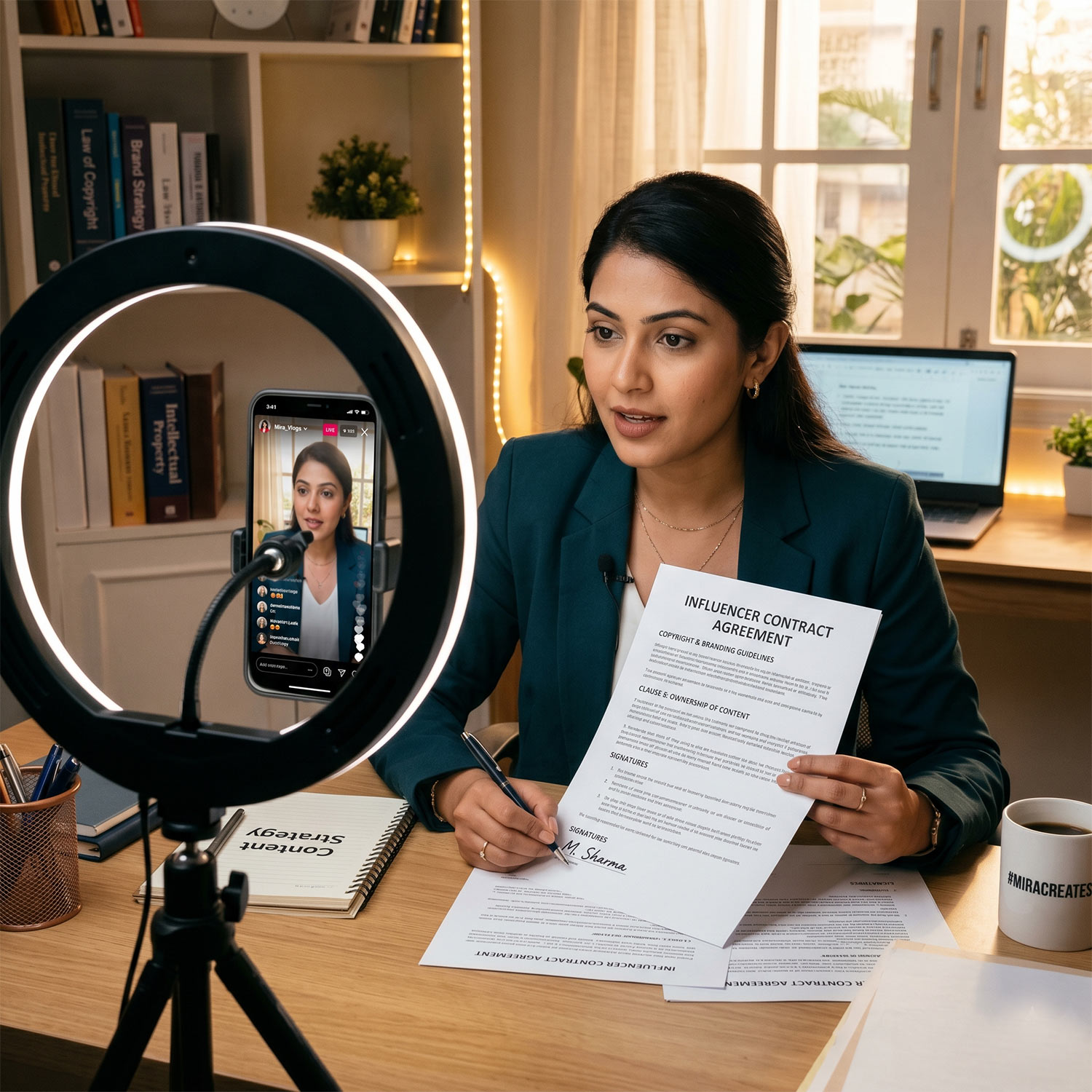
Instagram Influencer Agreements in India: Legal Clauses Every Creator, Influencer & Brand Must Know
Detailed Legal Analysis of Influencer Contracts, Brand Collaborations, Copyright Rights, Paid Promotions, Exclusivity Clauses & Social Media Disputes in India
The digital creator economy in India has, over the past decade, transformed into one of the fastest-growing commercial industries in the country.
Social media influencers, digital creators, lifestyle personalities, fashion bloggers, fitness influencers, comedians, gamers, beauty creators, travel vloggers, finance creators, and celebrity content creators today command enormous commercial influence across digital platforms including:
- YouTube
- Snapchat
- TikTok
- X
Influencers today are no longer merely social media personalities. They constitute:
- commercial entities;
- intellectual property owners;
- marketing channels;
- digital entrepreneurs;
- independent businesses.
Prominent Indian influencers and creators including:
- Kusha Kapila
- Komal Pandey
- Masoom Minawala
- Dolly Singh
- Prajakta Koli
- Bhuvan Bam
- Ashish Chanchlani
- CarryMinati
- Ranveer Allahbadia
- Ankush Bahuguna
- Mumbiker Nikhil
- Santoshi Shetty
regularly collaborate with major national and international brands including:
- Nykaa
- Myntra
- Amazon
- Flipkart
- Mamaearth
- Sugar Cosmetics
- Boat
- Samsung
- OnePlus
- Nike
- Adidas
- Zomato
- Swiggy
- L’Oréal
- H&M
- Zara
- Ajio
- Tata Cliq
- Airbnb
for:
- paid promotions;
- celebrity endorsements;
- digital campaigns;
- product launches;
- affiliate marketing;
- brand integrations;
- sponsored reels;
- event appearances;
- platform partnerships.
However, despite the enormous financial scale of influencer marketing in India, a substantial number of creators and influencers continue to operate:
- without legally vetted agreements;
- based solely upon WhatsApp communications;
- through oral assurances;
- without understanding copyright ownership;
- without proper payment protection mechanisms;
- without adequate legal safeguards.
This frequently results in:
- non-payment disputes;
- copyright violations;
- unauthorized commercial exploitation of influencer content;
- reputational misuse;
- exclusivity disputes;
- breach of collaboration terms;
- tax disputes;
- social media litigation;
- injunction proceedings;
- legal notices by brands or agencies.
Accordingly:
a properly drafted Influencer Agreement has become legally indispensable in modern digital commerce.
This article seeks to provide a detailed legal analysis concerning:
- influencer agreements in India;
- creator contracts;
- Instagram collaboration agreements;
- copyright ownership;
- exclusivity clauses;
- payment protection;
- social media advertising compliance;
- legal liabilities of influencers;
- dispute resolution mechanisms.
Prepared by:
Sarosh Damania & Co. – Advocates, Bombay High Court
LEGAL NATURE OF AN INSTAGRAM INFLUENCER AGREEMENT
An Instagram Influencer Agreement constitutes a legally enforceable commercial contract executed between:
- an influencer / creator / celebrity;
and - a brand / agency / advertiser / production company / marketing entity.
Such agreements regulate:
- commercial deliverables;
- content obligations;
- ownership rights;
- advertising obligations;
- exclusivity conditions;
- payment mechanisms;
- intellectual property rights;
- confidentiality obligations;
- termination rights.
In the absence of a properly drafted agreement, parties frequently encounter ambiguity and litigation.
WHY INFLUENCERS REQUIRE LEGALLY DRAFTED CONTRACTS
A common misconception amongst creators is that:
- Instagram DMs;
- WhatsApp chats;
- emails;
- informal oral discussions;
are sufficient to govern commercial collaborations.
Such assumptions frequently result in:
- delayed payments;
- outright payment defaults;
- unauthorized usage of reels and videos;
- copyright disputes;
- indefinite exploitation of influencer content;
- unauthorized paid advertisements using creator identity;
- reputational misuse.
Similarly, brands require legal safeguards against:
- non-performance;
- reputational controversies;
- misleading endorsements;
- breach of exclusivity obligations.
IMPORTANT LEGAL CLAUSES EVERY INFLUENCER AGREEMENT MUST CONTAIN

I. SCOPE OF WORK / DELIVERABLES CLAUSE
The agreement must clearly define:
- number of reels;
- posts;
- stories;
- videos;
- live sessions;
- event appearances;
- campaign timelines;
- tagging obligations;
- hashtags;
- call-to-action requirements;
- approval timelines.
Ambiguity in deliverables constitutes one of the most common causes of disputes in influencer marketing transactions.
II. PAYMENT TERMS CLAUSE
One of the most litigated issues in influencer collaborations concerns:
delayed, withheld, or unpaid compensation.
The agreement must clearly specify:
- commercial fee;
- advance payments;
- milestone-based payments;
- GST applicability;
- invoicing obligations;
- TDS deductions;
- payment timelines;
- consequences of delayed payment.
Influencers must avoid vague assurances such as:
“payment will be processed after campaign completion.”
III. COPYRIGHT OWNERSHIP & INTELLECTUAL PROPERTY RIGHTS
This is perhaps the single most important legal clause in influencer agreements.
A crucial legal issue frequently arises:
Whether the influencer retains ownership over the content created?
Under Indian copyright jurisprudence:
the creator ordinarily remains the first owner of copyright unless rights are specifically assigned.
Accordingly, the agreement must expressly define:
- ownership rights;
- licensing scope;
- duration of usage;
- territorial usage rights;
- advertising rights;
- commercial exploitation rights;
- sublicensing rights.
Absent proper contractual limitation, brands frequently:
- reuse influencer reels indefinitely;
- commercially exploit influencer identity;
- run paid advertisements using creator content;
- modify or repurpose creator videos without additional compensation.
IV. EXCLUSIVITY CLAUSE
Brands including Nike, Adidas, Mamaearth, Sugar Cosmetics and other commercial entities frequently insist upon exclusivity obligations.
Such clauses may prohibit influencers from promoting competing products or brands for a specified duration.
The agreement must therefore clearly define:
- duration of exclusivity;
- competing brands covered;
- product categories restricted;
- territorial applicability.
Overly broad exclusivity clauses may become commercially oppressive and legally unreasonable.
V. WHITELISTING / BOOSTING / PAID ADVERTISEMENT RIGHTS
Modern influencer agreements increasingly contain clauses permitting:
- whitelisting;
- paid boosting;
- sponsored advertisements;
- platform promotions using influencer identity.
Such clauses permit brands to commercially exploit influencer content beyond the original collaboration.
Influencers must therefore ensure:
- separate commercial compensation;
- limited duration;
- restricted platform usage;
- prior approval rights.
VI. ASCI & ADVERTISEMENT DISCLOSURE COMPLIANCE
The Advertising Standards Council of India mandates disclosure obligations relating to:
- paid promotions;
- sponsored collaborations;
- advertisements;
- brand endorsements.
Failure to disclose sponsored content may expose:
- influencers;
- creators;
- brands;
- agencies;
to regulatory scrutiny and legal consequences.
VII. MORALITY / REPUTATION CLAUSE
Brands increasingly insist upon morality clauses permitting termination in the event of:
- controversy;
- criminal allegations;
- offensive conduct;
- reputational backlash.
Such clauses must be:
- narrowly drafted;
- proportionate;
- reasonable;
- non-arbitrary.
VIII. TERMINATION CLAUSE
The agreement must clearly regulate:
- termination rights;
- cancellation consequences;
- refund obligations;
- post-termination content usage;
- payment liabilities.
Numerous disputes arise where brands terminate campaigns after content creation but refuse payment.
IX. CONFIDENTIALITY CLAUSE
Influencers frequently gain access to:
- confidential launches;
- unreleased products;
- campaign strategies;
- pricing structures;
- internal marketing information.
Confidentiality obligations therefore become commercially essential.
X. DISPUTE RESOLUTION & JURISDICTION CLAUSE
The agreement must specify:
- governing law;
- jurisdiction;
- arbitration mechanism;
- forum for dispute adjudication.
This assumes critical importance in cross-border influencer collaborations.
COMMON LEGAL DISPUTES FACED BY INFLUENCERS IN INDIA
Influencers frequently encounter disputes involving:
- unpaid collaborations;
- fake agencies;
- copyright infringement;
- unauthorized commercial usage;
- impersonation;
- misuse of image rights;
- defamatory online campaigns;
- breach of exclusivity;
- reputational misuse.
WHETHER INSTAGRAM DMS & WHATSAPP CHATS ARE LEGALLY ADMISSIBLE?
Yes.
Indian courts increasingly recognize:
- WhatsApp chats;
- Instagram messages;
- emails;
- electronic records;
as legally admissible evidence subject to proof requirements.
However:
a professionally drafted written agreement always provides significantly superior legal protection.
TAXATION & GST ISSUES FOR INFLUENCERS
Influencers and creators earning commercial revenue may require compliance concerning:
- Income Tax;
- GST registration;
- TDS deductions;
- foreign remittance compliance;
- invoicing requirements.
Improperly structured collaborations frequently create avoidable tax disputes.
WHETHER INFLUENCERS CAN INITIATE LEGAL ACTION FOR NON-PAYMENT?
Yes.
Influencers may initiate:
- legal notices;
- recovery proceedings;
- commercial litigation;
- arbitration proceedings;
- intellectual property actions.
Claims may include:
- unpaid fees;
- damages;
- injunctions;
- compensation.
WHY PROFESSIONAL LEGAL DRAFTING IS ESSENTIAL
Influencer agreements involve complex issues relating to:
- intellectual property rights;
- commercial law;
- advertising regulations;
- taxation;
- brand licensing;
- digital exploitation rights;
- commercial liability.
Improperly drafted agreements may expose creators to substantial financial and reputational risks.
Professional legal drafting assists in:
- protecting commercial rights;
- securing payments;
- safeguarding intellectual property;
- limiting liability exposure;
- preventing exploitation.
HOW Sarosh Damania & Co. ASSISTS INFLUENCERS, CREATORS & BRANDS
Sarosh Damania & Co. regularly advises:
- influencers;
- celebrities;
- creators;
- agencies;
- digital marketing companies;
- startups;
- luxury brands;
- hospitality groups;
- fashion businesses.
The Firm handles:
- influencer agreements;
- celebrity endorsement contracts;
- copyright disputes;
- intellectual property protection;
- payment recovery litigation;
- social media disputes;
- digital media litigation;
- commercial contract disputes.
The Firm appears before:
- Civil Courts;
- Commercial Courts;
- Arbitral Tribunals;
- Bombay High Court.
CONCLUSION
The influencer economy in India has evolved into a highly sophisticated commercial ecosystem involving substantial financial, intellectual property, and reputational stakes.
Influencers today are not merely content creators — they are:
- businesses;
- brands;
- intellectual property owners;
- commercial entities.
Accordingly:
legal protection has become absolutely indispensable.
A properly drafted influencer agreement protects:
- payments;
- intellectual property;
- commercial exploitation rights;
- reputation;
- advertising rights;
- dispute resolution mechanisms.
For legal assistance relating to:
- influencer agreements;
- Instagram collaboration contracts;
- celebrity endorsement agreements;
- copyright disputes;
- social media litigation;
- payment recovery;
- digital media disputes;
- intellectual property protection,
contact:
Sarosh Damania & Co. – Advocates, Bombay High Court
Practice Areas:
- Influencer Agreements
- Media & Entertainment Law
- Intellectual Property Law
- Commercial Contracts
- Digital Media Disputes
- Bombay High Court Litigation
Office:
Mumbai
Website:
Frequently Asked Questions (FAQs)
Are Instagram influencer agreements legally enforceable in India?
Yes. Influencer agreements are valid commercial contracts enforceable under Indian contract law.
Who owns the copyright of influencer content?
Generally, the creator remains the first owner unless rights are contractually assigned.
Are WhatsApp chats and Instagram DMs valid evidence?
Yes. Indian courts increasingly recognize electronic communications as admissible evidence.
Can influencers take legal action for non-payment?
Yes. Influencers may issue legal notices, initiate recovery proceedings, arbitration, or litigation.
What is an exclusivity clause in influencer contracts?
It restricts influencers from promoting competing brands for a specified period.

Advocate Sarosh Damania is the founder of Sarosh Damania & Co., a premier law firm based in Mumbai, recognized for its exceptional legal services to corporations, individuals, and international clients worldwide. With a rich blend of experience and expertise, Adv. Damania and his team specialize in a wide array of legal disciplines, including Civil Law, Criminal Law, Aviation Law, Arbitration, Consumer Law, RERA, Company Law, Succession Law, Wills, Intellectual Property Law, Property Law, Housing Society Law, Debt Recovery, and Banking Law.