
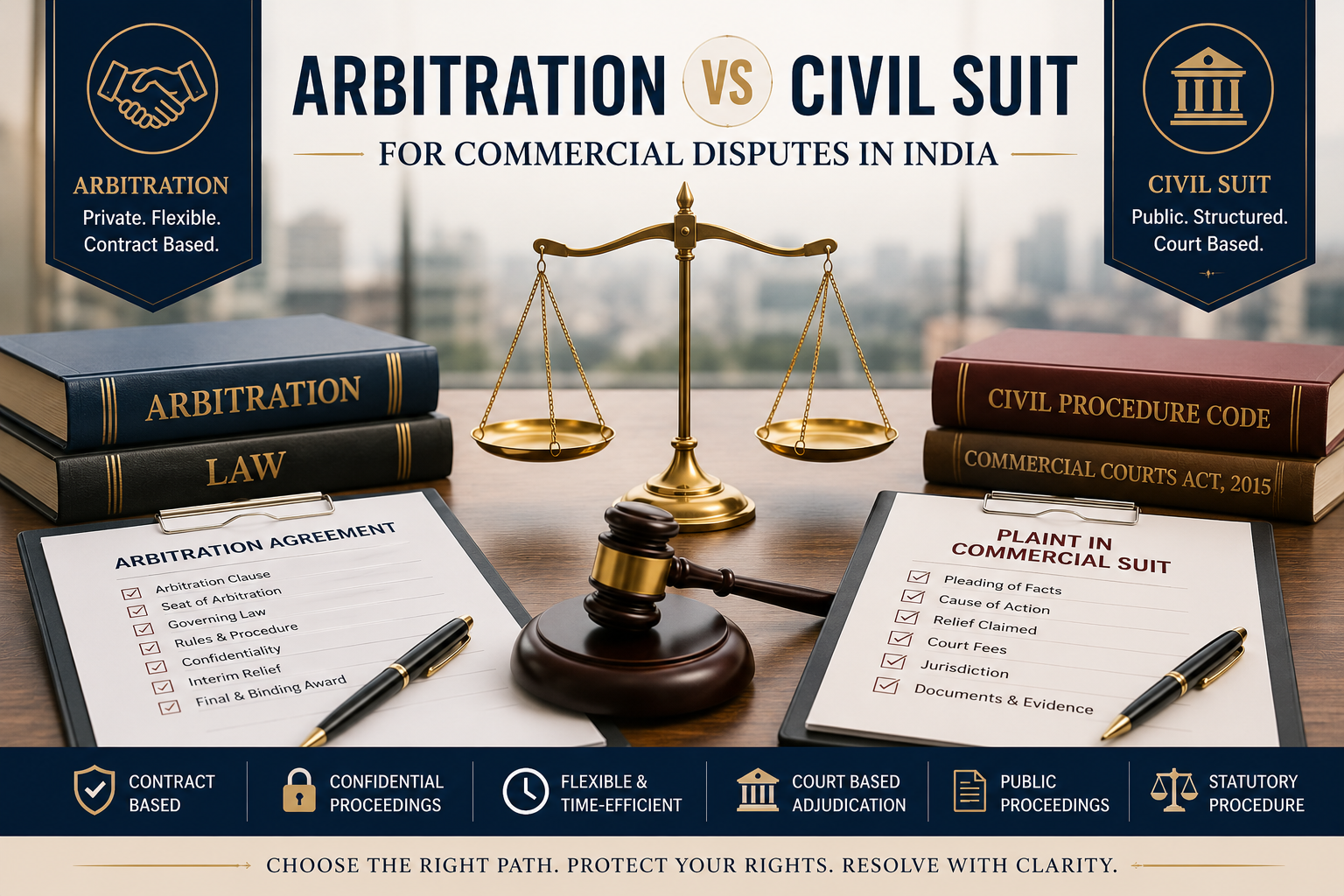
Arbitration vs Civil Suit for Commercial Disputes in India 2026
Commercial relationships are built around contracts, payments, obligations and expectations of performance. When disagreements arise and cannot be resolved commercially, the method chosen to resolve the dispute can become almost as important as the dispute itself.
Two important routes are arbitration and court proceedings. However, choosing between them is not simply a question of which appears faster or more convenient. The contract, nature of the dispute, existence of an arbitration agreement, jurisdiction, relief sought and applicable legal framework can all affect how the dispute may proceed.
Understanding arbitration vs civil suit for commercial disputes in India therefore requires looking beyond their basic definitions. Businesses should understand how each mechanism works, where the two differ, and why the dispute-resolution provisions contained in a commercial contract can become important long before an actual dispute arises.
What Are Commercial Disputes in India?
The expression “commercial dispute” has a specific statutory context in India. The Commercial Courts Act, 2015 provides for Commercial Courts, Commercial Divisions and Commercial Appellate Divisions for adjudication of commercial disputes of specified value. Section 2(1)(c) of the Act contains a detailed definition covering disputes arising from various forms of commercial transactions and relationships.
In everyday business language, a commercial dispute may be understood as a disagreement arising out of a commercial relationship or transaction. Legally, however, whether a particular dispute falls within the statutory definition requires consideration of the nature of the transaction and the applicable law.
The Commercial Courts Act covers a broad range of commercial relationships. These include, among other matters, disputes connected with ordinary transactions of merchants, bankers, financiers and traders; agreements relating to immovable property used exclusively in trade or commerce; construction and infrastructure contracts; franchising and distribution agreements; management and consultancy agreements; joint ventures; shareholders agreements; partnership agreements; intellectual property rights; insurance and other specified commercial relationships.
This breadth is important. Commercial disputes in India are not limited to unpaid invoices or straightforward breaches of contract. They can arise at virtually every stage of a business relationship- from the interpretation of contractual obligations to payment, performance, termination, ownership, commercial rights and enforcement.
Why Is the Classification as a Commercial Dispute Important?
A business disagreement does not necessarily proceed in the same manner as an ordinary civil dispute merely because one party decides to approach a court.
The Commercial Courts Act establishes a specialized framework for qualifying commercial disputes. It provides for Commercial Courts and, in appropriate jurisdictions, Commercial Divisions of High Courts, along with a specific procedural framework. Section 16 of the Act modifies provisions of the Code of Civil Procedure, 1908 in their application to commercial disputes.
The statutory specified value is also relevant. Following the 2018 amendments, the threshold under the central legislation was reduced from ₹1 crore to ₹3 lakh, although the applicable jurisdiction and pecuniary framework must still be considered in the particular forum and State.
There is another significant procedural consideration. Under Section 12A of the Commercial Courts Act, a commercial suit that does not contemplate urgent interim relief cannot be instituted unless the plaintiff first exhausts the prescribed pre-institution mediation process.
This makes it important to distinguish between:
- an ordinary disagreement between businesses;
- a dispute falling within the statutory definition of a commercial dispute;
- a commercial dispute that is subject to an arbitration agreement; and
- a dispute that may proceed before the appropriate court under the commercial-court framework.
These distinctions can materially affect the legal route available.
Commercial Disputes Often Begin With the Contract
For many business relationships, the contract is the first document that needs careful attention when a dispute arises.
A commercial agreement may contain provisions dealing with governing law, jurisdiction, notices, dispute resolution and arbitration. These provisions may determine or influence where and how disputes are required to be resolved.
That is why the question should not automatically be:
“Should we go to arbitration or file a civil suit?”
A more fundamental question is:
“What does the contract provide, and what legal mechanism is available for this particular dispute?”
This distinction becomes especially important when the agreement contains an arbitration clause.
Arbitration vs Civil Suit: What Is the Fundamental Difference?
At the simplest level, the difference concerns who adjudicates the dispute and under what legal framework.
In arbitration, parties agree to submit disputes falling within their arbitration agreement to an arbitrator or arbitral tribunal. In court litigation, the dispute is adjudicated through the judicial system by a competent court.
But the legal distinction goes considerably further.
What Is Arbitration?
Arbitration is a recognised method of dispute resolution governed in India principally by the Arbitration and Conciliation Act, 1996, as amended from time to time.
Section 7 of the Act defines an arbitration agreement as an agreement by the parties to submit to arbitration all or certain disputes that have arisen or may arise between them in respect of a defined legal relationship, whether contractual or otherwise. The arbitration agreement must be in writing, although the legislation recognises different ways in which that written requirement may be satisfied.
An arbitration clause may therefore form part of the main commercial contract, or the arbitration agreement may exist separately.
This leads to one of the most important principles when considering commercial arbitration in India:
Arbitration is fundamentally based on agreement.
A party generally cannot decide unilaterally, after a dispute has arisen, that it would prefer arbitration and simply require the other side to arbitrate. Whether arbitration is available requires examination of whether a valid arbitration agreement exists, who is bound by it, what disputes fall within its scope and whether the subject matter is capable of arbitration.
What Happens in Arbitration?
Broadly, arbitral proceedings involve referring the dispute covered by the arbitration agreement to an arbitrator or tribunal for adjudication.
The parties present their respective claims and defences, supporting documents and, where necessary, evidence and submissions. The tribunal considers the dispute and ultimately renders an arbitral award.
Although arbitration operates outside the ordinary court trial process, it should not be confused with an informal negotiation or mediation.
An arbitrator adjudicates the dispute.
That distinction matters. Mediation is directed towards helping parties reach a mutually acceptable settlement; arbitration ordinarily culminates in a determination by the arbitral tribunal.
Arbitration can provide parties with procedural flexibility and, subject to the governing framework, greater involvement in matters such as the constitution of the tribunal. It also has a statutory confidentiality framework: Section 42A of the Arbitration and Conciliation Act requires the arbitrator, arbitral institution and parties to maintain confidentiality of arbitral proceedings, subject to the statutory exception concerning disclosure of an award where necessary for implementation and enforcement.
However, arbitration should not automatically be described as faster, cheaper or simpler than litigation. The practical position depends on factors such as the complexity and value of the dispute, tribunal constitution, procedural history, evidence, hearings, applications, legal costs and subsequent proceedings concerning the award.
What Is a Civil or Commercial Suit?
A civil suit is a proceeding before a competent civil court seeking adjudication of a civil dispute and appropriate legal relief.
When the dispute qualifies as a commercial dispute of specified value, however, the Commercial Courts Act becomes particularly relevant.
The Act creates a specialised system consisting of Commercial Courts and Commercial Divisions, together with appellate mechanisms, for qualifying commercial disputes. It also contains specific procedural provisions intended to govern commercial litigation.
Therefore, when discussing arbitration vs civil suit for commercial disputes in India, it is more accurate in many contexts to compare arbitration with commercial court litigation, rather than assuming every business dispute proceeds as an ordinary civil suit.
Court proceedings also differ fundamentally from arbitration because their jurisdiction does not arise merely from an agreement between the parties to appoint a private adjudicator. The competent court and maintainability of proceedings depend upon applicable laws governing subject matter, territorial and pecuniary jurisdiction and other legal requirements.
The ultimate adjudication ordinarily takes the form of a judgment and, where applicable, a decree or order. The statutory framework governing appeals and challenges also differs materially from the framework applicable to an arbitral award.
This difference becomes particularly important later in the dispute. A challenge to an arbitral award under the Arbitration and Conciliation Act should not be treated as equivalent to an ordinary appeal against the merits of a court judgment.
What Is the Basic Legal Approach When a Commercial Dispute Arises?
One of the most common mistakes in discussions about arbitration vs litigation in India is to begin by asking which mechanism is “better.”
That question is too broad.
Before comparing speed, confidentiality, costs or convenience, the legal framework governing the dispute needs to be understood.
Start With the Governing Commercial Documents
Commercial disputes are often document-intensive.
Depending upon the business relationship, relevant records may include contracts, amendments, purchase orders, work orders, invoices, delivery records, correspondence, notices, payment records, technical documentation and other material generated during performance of the transaction.
The main agreement should be reviewed carefully for provisions dealing with:
Dispute resolution: Does the contract provide for arbitration, court proceedings, negotiation, mediation or a multi-stage dispute-resolution mechanism?
Arbitration: If an arbitration clause exists, what disputes does it cover?
Jurisdiction: Does the agreement contain provisions concerning the courts that are intended to have jurisdiction?
Governing law: Which law governs the contractual relationship?
Notices: Does the agreement prescribe how contractual or dispute-related notices are to be issued?
Other procedural provisions: Are there contractual steps that are intended to occur before formal proceedings begin?
These provisions should be read together rather than in isolation.
Determine Whether an Arbitration Agreement Exists
If the contract contains an arbitration clause, the existence and scope of that clause become central.
Section 7 of the Arbitration and Conciliation Act recognises that an arbitration agreement can be contained in a signed document, qualifying exchanges of communications, an exchange of statements of claim and defence in specified circumstances, or through incorporation by reference where the statutory requirements are satisfied.
This is why merely searching a contract for the word “arbitration” may not be enough.
Questions may arise concerning the existence and validity of the arbitration agreement, its scope, the parties bound by it and whether the dispute being raised falls within the matters agreed to be arbitrated.
Where there is no applicable arbitration agreement, a party cannot ordinarily impose arbitration simply because it considers arbitration commercially preferable. The parties may, of course, agree to arbitrate a dispute after it has arisen, provided the legal requirements for an arbitration agreement are satisfied.
If Court Proceedings Are Contemplated, Identify the Correct Legal Forum
The next question is not merely “Which court should the case be filed in?”
The nature and value of the dispute, territorial and pecuniary jurisdiction, contractual jurisdiction provisions and the statutory commercial-court framework may all require consideration.
The Commercial Courts Act expressly provides for the jurisdiction of Commercial Courts and Commercial Divisions and separately addresses jurisdiction in respect of arbitration matters.
For a qualifying commercial suit, pre-institution mediation must also be considered. As noted earlier, Section 12A provides that where the suit does not contemplate urgent interim relief, the plaintiff must exhaust the prescribed pre-institution mediation process before instituting the suit.
This requirement is important because commencing commercial litigation is not necessarily a matter of simply preparing a plaint and immediately filing it.
Consider the Relief That Is Actually Required
The appropriate dispute-resolution strategy is also connected to the legal relief being sought.
A commercial dispute may involve monetary claims, enforcement or interpretation of contractual obligations, injunction-related relief or other remedies recognised by law. In some disputes, interim protection may become important before the underlying dispute can finally be adjudicated.
Arbitration and commercial litigation contain different mechanisms for seeking relief, and the availability and appropriateness of a particular remedy must be considered under the applicable law.
For this reason, the procedural route should not be selected merely because one mechanism is perceived as faster.
Limitation Cannot Be an Afterthought
Commercial negotiations can continue for weeks or months, and parties sometimes hope that a disagreement will eventually resolve without formal proceedings.
That does not mean limitation issues can safely be ignored.
The applicable limitation period depends upon the nature of the claim and relevant legal provisions. Parties should therefore be cautious about assuming that ongoing correspondence, negotiations or settlement discussions automatically preserve their legal rights.
This is another reason why obtaining legal advice at an appropriate stage of a significant commercial dispute can be important. A lawyer reviewing the matter is not merely deciding whether to “go to court.” The initial task may involve examining the contract, dispute-resolution mechanism, jurisdiction, limitation, available remedies and procedural requirements before determining what legal route is available.

Advocate Sarosh Damania is the founder of Sarosh Damania & Co., a premier law firm based in Mumbai, recognized for its exceptional legal services to corporations, individuals, and international clients worldwide. With a rich blend of experience and expertise, Adv. Damania and his team specialize in a wide array of legal disciplines, including Civil Law, Criminal Law, Aviation Law, Arbitration, Consumer Law, RERA, Company Law, Succession Law, Wills, Intellectual Property Law, Property Law, Housing Society Law, Debt Recovery, and Banking Law.

Corporate Lawyer in Mumbai: Corporate, Contract & Regulatory Legal Services for Businesses
Mumbai is the financial and commercial capital of India, home to thousands of corporations, multinational companies, financial institutions, aviation companies, startups, and manufacturing businesses. With such a dynamic business environment, companies operating in the city frequently encounter complex legal issues relating to corporate governance, commercial contracts, employment disputes, and regulatory compliance.
For businesses operating in a competitive and highly regulated environment like Mumbai, professional legal guidance is essential to protect commercial interests, ensure regulatory compliance, and prevent costly disputes.
Corporate clients today increasingly seek experienced legal advisors who can assist not only with litigation but also with strategic legal planning, contract structuring, compliance advisory, and dispute resolution.
This article explores the key areas of corporate, contract, and regulatory law in Mumbai and why companies require experienced legal counsel to operate safely and efficiently.
Corporate Law in Mumbai: The Legal Backbone of Businesses
Mumbai hosts the headquarters and major offices of several Indian and multinational companies. Corporate transactions and business operations are governed by the Companies Act 2013, which regulates company formation, governance, shareholder rights, director responsibilities, and corporate compliance.
Corporate disputes frequently arise between:
• Promoters and minority shareholders
• Directors and company management
• Joint venture partners
• Investors and founders
• Corporate groups and subsidiaries
Such disputes may involve allegations of:
• Oppression and mismanagement
• Fraudulent dilution of shareholding
• Breach of fiduciary duties
• Non-disclosure of financial information
• Illegal board decisions or resolutions
These disputes are typically adjudicated before the National Company Law Tribunal, which handles corporate litigation matters including shareholder disputes, insolvency proceedings, and company law violations.
For businesses, resolving such disputes requires experienced corporate legal representation and strategic litigation planning.
Contract Law and Commercial Agreements
Contracts form the foundation of almost every commercial transaction. Businesses rely on carefully structured agreements to regulate their relationships with vendors, clients, partners, and employees.
However, poorly drafted contracts are one of the leading causes of corporate litigation in Mumbai.
Common contractual disputes include:
• Breach of contract
• Payment disputes between businesses
• Vendor and supplier conflicts
• Termination disputes
• Partnership disagreements
• Intellectual property misuse
• Confidentiality breaches
Corporate legal advisors assist companies with drafting and reviewing critical agreements such as:
• Shareholders agreements
• Joint venture agreements
• Vendor and supply contracts
• Service agreements
• Franchise and licensing agreements
• Technology and software contracts
• Non-disclosure agreements (NDAs)
Properly drafted contracts clearly define commercial obligations, payment terms, dispute resolution mechanisms, indemnity provisions, and liability limitations, significantly reducing the risk of disputes.
Employment and Labour Law Compliance
Employment law disputes are among the most common legal issues faced by corporations in Mumbai. Businesses must comply with various labour laws governing employment relationships, workplace safety, and employee rights.
Common employment disputes involve:
• Wrongful termination claims
• Salary and bonus disputes
• Employment bond disputes
• Breach of confidentiality agreements
• Workplace harassment complaints
• Employee misconduct and disciplinary proceedings
Workplace harassment cases are governed by the Sexual Harassment of Women at Workplace Act, which requires companies to establish an Internal Complaints Committee (ICC) and implement preventive policies.
Employment disputes and labour matters may also involve regulatory authorities such as the Labour Commissioner Office.
Corporate lawyers assist organisations by drafting legally compliant employment policies, conducting internal investigations, and representing companies in labour disputes.
Regulatory Compliance for Businesses
Corporate regulatory compliance is a critical aspect of business operations in India. Companies must comply with multiple regulatory frameworks relating to taxation, corporate governance, employment laws, and industry-specific regulations.
Key compliance obligations include:
• Corporate filings with the Registrar of Companies
• Tax compliance and GST filings under the Goods and Services Tax Council
• Labour law compliance and statutory registrations
• Foreign investment and FEMA compliance
• Data protection and IT regulations
• Environmental and industry-specific regulatory approvals
Failure to comply with these regulations can result in severe consequences including financial penalties, regulatory investigations, director disqualification, and corporate litigation.
Corporate legal advisors help businesses conduct legal compliance audits, regulatory filings, and risk assessments to ensure full compliance with applicable laws.
Commercial Litigation and Arbitration in Mumbai
Despite best efforts to prevent disputes, commercial conflicts sometimes become unavoidable. Businesses must then pursue litigation or arbitration to protect their legal rights.
Commercial disputes in Mumbai are frequently handled before the Bombay High Court, which has jurisdiction over high-value corporate and commercial matters.
Many commercial agreements now include arbitration clauses requiring disputes to be resolved through arbitration proceedings governed by the Arbitration and Conciliation Act 1996.
Arbitration offers several advantages to corporate clients:
• Faster dispute resolution
• Confidential proceedings
• Flexibility in procedural rules
• Enforceable arbitral awards
Corporate lawyers assist businesses in commercial litigation, arbitration proceedings, and dispute resolution strategies to protect their commercial interests.
Why Corporate Clients Need Experienced Legal Counsel
In a highly regulated and competitive business environment like Mumbai, legal issues can arise at any stage of a business transaction or corporate relationship.
Corporate clients increasingly rely on legal advisors to:
• Structure legally secure commercial transactions
• Draft and negotiate complex business agreements
• Ensure regulatory compliance
• Prevent costly commercial disputes
• Represent businesses in litigation and arbitration
• Protect shareholder and investor interests
Proactive legal advisory services allow businesses to identify risks early and avoid expensive legal battles in the future.
Corporate Legal Services for Businesses in Mumbai
A corporate law firm typically assists businesses in a wide range of legal matters, including:
• Corporate advisory and governance
• Contract drafting and negotiation
• Regulatory compliance and corporate filings
• Employment and labour law advisory
• Commercial litigation and arbitration
• Due diligence for mergers and acquisitions
• Legal support for startups and investors
Many corporations also prefer ongoing legal retainership arrangements, enabling them to obtain timely legal advice for business decisions and regulatory compliance.
Conclusion: Legal Strategy is a Business Necessity
Mumbai’s business ecosystem offers enormous opportunities, but it also involves complex legal and regulatory challenges.
Companies that invest in strong legal structuring, compliant corporate governance, and professionally drafted contracts are better positioned to grow while minimizing legal risk.
Whether dealing with corporate governance disputes, contract enforcement, employment law compliance, or regulatory matters, experienced legal counsel plays a crucial role in protecting business interests.
For corporate clients operating in Mumbai, having a trusted corporate lawyer ensures that businesses remain legally protected, compliant, and strategically prepared for growth.
FAQs – Corporate Legal Services in Mumbai
What are the most common corporate legal issues in Mumbai?
Corporate legal disputes commonly involve shareholder conflicts, breach of contract, employment disputes, regulatory compliance violations, and commercial litigation.
Why is professional contract drafting important for businesses?
Properly drafted contracts clearly define rights, obligations, payment terms, and dispute resolution mechanisms, reducing the risk of costly litigation.
Where are corporate disputes resolved in Mumbai?
Corporate disputes may be handled before the Bombay High Court, the National Company Law Tribunal, or through arbitration proceedings.
Do startups also require corporate legal advisory services?
Yes. Startups require legal support for company incorporation, shareholder agreements, investor funding documentation, regulatory compliance, and employment contracts.
When should a business consult a corporate lawyer?
Businesses should consult a corporate lawyer when drafting contracts, handling disputes, ensuring regulatory compliance, conducting due diligence, or structuring business transactions.
Advocate Sarosh Damania is the founder of Sarosh Damania & Co., a premier law firm based in Mumbai, recognized for its exceptional legal services to corporations, individuals, and international clients worldwide. With a rich blend of experience and expertise, Adv. Damania and his team specialize in a wide array of legal disciplines, including Civil Law, Criminal Law, Aviation Law, Arbitration, Consumer Law, RERA, Company Law, Succession Law, Wills, Intellectual Property Law, Property Law, Housing Society Law, Debt Recovery, and Banking Law.